[BLOG-LIKE POSTING] Language and politics
Nov. 3rd, 2008 08:01 pm![[personal profile]](https://www.dreamwidth.org/img/silk/identity/user.png) rfmcdonald
rfmcdonaldIn the Sunday Star, Sarah Barmak explored the interesting question of whether or not dialectal differences played a role in American politics by examining how different people reacted to Sarah Palin's speech style.
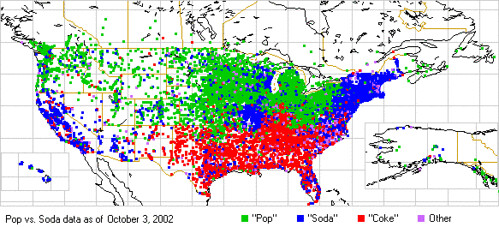
With the exception of Atlantic Canada, which was settled directly from the British Isles, Ontario and points west were originally settled by Americans. As a result, Canadian English bears quite a few similarities to American dialects of English, particularly to Western American English and the Midland and other dialects of the Midwest and upstate New York. The famous pop vs. soda map provides a broad illustration of these similarities.
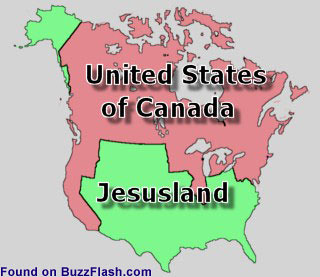
Now take a look at the famous 2004 Jesusland map, based on the divisions between states in the 2004 United States presidential elections.
One news source claims that 64% of Canadians support Obama's candidacy while only 14% support McCain's. I wonder if the dialectal factor might be playing a role in Canada, too, in determining which candidates Canadians like. Thoughts?
[A]dded to the lines drawn by race, gender, geography and class, could there be another, quieter split that defines the way Americans will vote when they head to the polls this Tuesday--a language divide?
Though it might not seem so to watch American television, where most traces of regional accent tend to be carefully excised from the general English used by news anchors and actors, the country is populated by a multitude of different dialects.
Some linguists identify at least three major groups that define the way Americans speak; others insist there are 24 distinct varieties--or more.
So a voter might be a Midwesterner, like the peeved University of Illinois student who slammed Palin's "gosh dern golly-gee" debating style, writing in his student paper that her informal diction "may be okay to say in casual talk among friends, but not when you're talking to the nation... Just because people aren't from Wall Street doesn't mean they stopped at sixth grade."
But go a little further south, and you might find rural voters talking about Palin as someone they could gab with around the coffee table.
"What happens in this scenario is things are so ideologically divisive that people either can't stand to hear her speech or love her speech," says professor Walt Wolfram, an expert on sociolinguistics at North Carolina State University. "It's a reflection of the political divisiveness that now exists."
People who hate the way Palin talks are more apt to judge her as incompetent or lacking intelligence, he explains.
"There is a sense in which people are biased and do make judgments of competence based on speech style," he says. "In Sociology 101 we claim that speech style has nothing to do with intelligence. But people do judge that."
With the exception of Atlantic Canada, which was settled directly from the British Isles, Ontario and points west were originally settled by Americans. As a result, Canadian English bears quite a few similarities to American dialects of English, particularly to Western American English and the Midland and other dialects of the Midwest and upstate New York. The famous pop vs. soda map provides a broad illustration of these similarities.
Now take a look at the famous 2004 Jesusland map, based on the divisions between states in the 2004 United States presidential elections.
One news source claims that 64% of Canadians support Obama's candidacy while only 14% support McCain's. I wonder if the dialectal factor might be playing a role in Canada, too, in determining which candidates Canadians like. Thoughts?


