Feb. 27th, 2012

rfmcdonald: (photo)
I've long been interested in the architecture of the Wallace-Emerson Community Centre, located just to the south and west of the intersection of Dupont and Dufferin in the neighbourhood of the same name. Much of my interest comes from the centre's striking central corridor, an open space bridged by concentric arches.

A quick search through the archives reveals an extended photo post in 2009 and a briefer shot of the front from last August. These three photos were taken of the centre, and its corridor with their arches, looking from the north from the parking lot of the Galleria Mall.

IMG_0658.JPG

IMG_0659.JPG

IMG_0660.JPG

Which photo of the three above do you prefer?
rfmcdonald: (cats)
I saw this example of Maneki Neko in the middle of the very crowded front window of Canada Gifts, located at 370 Yonge Street just north of Yonge and Dundas.

IMG_0647.JPG
rfmcdonald: (Default)
First, from the left comes Tonda McCharles' report in the Toronto Star featuring interviews with call centre employees who report that they were ordered to make phone calls with content that--to say the least--confused everyone.

Callers on behalf of the federal Conservative Party were instructed in the days before last year’s election to read scripts telling voters that Elections Canada had changed their voting locations, say telephone operators who worked for a Thunder Bay-based call centre.

These weren’t “robo-calls,” as automated pre-recorded voice messages as commonly known. They were live real-time calls made into ridings across Canada, the callers say.

In a new twist on new growing allegations of political “dirty tricks,” three former employees of RMG — Responsive Marketing Group Inc.’s call centre in Thunder Bay — told the Star about the scripts.

A fourth remembered directing people to voting stations but did not remember passing on any message that a voting station had changed.

However, one employee was so concerned that something was amiss she says she reported it to her supervisor at the RMG site, to the RCMP office in Thunder Bay and to a toll-free Elections Canada number at the time.

Annette Desgagné, 46, said it became clear to her — after so many people complained that the “new” voting locations made no sense or were “way the hell across town” — that the live operators were, in fact, misdirecting voters.

[. . .]

She said she has no way of knowing whether in fact the poll station locations she gave listeners were wrong addresses or phony locations. But she said the “feedback” elicited by the script was so negative, “we started getting antsy.”

She said she and a few other workers at the call centre were perplexed enough that they began telling the voters they should double-check their poll location with their local Elections Canada office, which was not part of the script.

Desgagné, alone, said some workers shortened their script — although they weren’t supposed to — and said “... I’m calling from Elections Canada ...”

Desgagné’s recollection of the job was largely corroborated by two other women contacted Sunday by the Star. Neither wanted to be named. All worked at RMG throughout the 2011 campaign on Conservative Party voter identification and on get-out-the-vote calls.


And from the right, Chris Selley at the National Post assembles links from journalists--many writing for the generally right-leaning Postmedia News organization--who think that rhetoric comparing the robocalling to something Richard Nixon might have done is justified.

“We do not know for a fact that the [robo-calls] came from anyone acting on the authority of the Conservative party,” Postmedia’s Andrew Coyne muses. “But, well, let’s say it fits a pattern — if not of outright lawbreaking then certainly of close-to-the-wind tactics and ends-justify-the-means ethics.” Exactly. What happened was disgusting; as Coyne says, people ought to go to jail and hopefully will. But the Conservatives need not just to get to the bottom of this. They need to realize, as Coyne says, that even if this was one rogue campaign worker, this brand of crap is very likely to be the party’s eventual undoing.

[. . .]

Postmedia’s Michael Den Tandt doesn’t mince a single word in laying out just how serious this situation is for Canadian democracy, and could end up being for the Conservatives. “Based on the facts now known, this was electoral fraud — focused, organized and widespread. [Interim Liberal leader Bob] Rae did not exaggerate when he called it Nixonian,” says Den Tandt. (True, but we do wish we were grown up enough to deplore political sleaze without mentioning theUnited States.) “To Gomery, or not to Gomery? That is the question,” he says, and he has already made up his mind: “There needs to be a public, arm’s-length judicial investigation.”

We’re not actually convinced of that yet. Adscam was bloody complicated; this is potentially much less so. It seems at least conceivable that Elections Canada and the RCMP, with RackNine’s and the phone companies’ co-operation, could compile a complete record of the dodgy phone calls made, and in the case of the robocalls maybe even their content and the credit card number of the person who paid for them. (Mind you, that looks like the sort of paragraph we’ll revisit in a year and be disappointed.)
rfmcdonald: (Default)
And so the Vikileaks saga comes to an end ... for now?

A Liberal staffer has resigned after being discovered as the creator of an anonymous Twitter account that revealed details of Public Safety Minister Vic Toews’ divorce proceedings.

Liberal interim leader Bob Rae apologized to Toews in the Commons after Adam Carroll left his job in the party’s research bureau Monday because of the social media leaks.

Conservatives initially blamed the NDP when the anonymous Twitter account targeting Toews sparked an uproar in mid-February. But an investigation by the House of Commons Speaker’s office traced the source to the Liberals.

Rae said Carroll, an experienced Parliament Hill aide who had done work for Liberals MPs over the years, was responsible for the cyber-attack on Toews. The Commons’ clerk alerted Liberal officials who in turn notified Rae on Sunday. In a meeting Monday morning, Carroll offered his resignation and Rae said he accepted. “He was extremely apologetic. He’s a perfectly nice, hard-working individual who showed a real error in judgment,” Rae said.

Rae said Carroll had been angered by Conservative remarks likening political opponents to Hitler and child pornographers.

“We all agreed that was no excuse,” Rae said. “Nastiness begets nastiness. At some point you have to stop.”

The revelation and apology took the air out of the Liberal attack on alleged dirty election campaign tricks by the Conservatives.

[. . .]

While accepting Rae’s apology, Toews said Commons Speaker Andrew Scheer should look into the fact that other Liberals may have referred people to the Vikileaks30 account. Toews was probably referring to Liberal MP Justin Trudeau’s tweets when the Vikileaks uproar broke.

On Monday, Trudeau penned a new tweet saying, “Appalled to find out Vikileaks came from us Liberals. Yes, I tweeted about it, but I did not endorse it. Personal attacks are always wrong.”

Vikileaks30 popped up in response to Bill C-30, the Conservatives’ online surveillance legislation that has prompted an outpouring of concern about potential privacy issues for Internet users.

“Vic wants to know about you. Let’s get to know Vic,” the author of the anonymous Twitter account noted. Vikileaks then put up a string of tweets about Toews, including quotations from his divorce proceedings. The account was closed earlier this month.
rfmcdonald: (Default)
Below is the scene at Dupont subway station almost exactly 24 hours after an attempted robbery that saw a TTC employee shot last night. All looked well; the news bulletins had mentioned that the morning commute today wouldn't be interfered with.

Dupont Station, evening of 27 February 2012

TTC officials are considering beefing up security for transit workers, as police issued pictures Monday of a masked man in connection with the shooting of a fare collector.

“We will continue to review our security arrangements to make sure we provide as safe as possible working arrangements for our customers and staff,” TTC chief operating officer Andy Byford said Monday.

William Anderson, 52, is recovering after being shot in the upper chest and neck by a handgun-wielding bandit during an attempted robbery at Dupont subway station Sunday evening.

[. . .]

Byford said replacing the glass on collectors’ booths, which is shatterproof but not bulletproof, is worth looking into.

Staff Insp. Mike Earl, of the Toronto police holdup squad, said at a news conference Monday that the suspect in the shooting is male, white, heavily built and between 30 and 55 years old.

The same man is believed to have committed two robberies in the past year, both taking place in the evening on a weekend at Dupont station. Both times he was armed with a revolver, demanded cash and threatened to shoot, said Earl.

For the first two robberies, the TTC ticket collector handed over the cash and no one was hurt, said Earl.

Anderson did not give up the cash and the suspect fired three shots, said Earl.

The gunman fled north on foot. Despite being seen and pursued by civilians he remains at large.

[. . .]

Anderson, known to co-workers as “Tom,” has been working at the TTC since 2003. He was taken to St. Michael’s Hospital, where he is expected to make a full recovery after undergoing surgery.


The whole thing is particularly disturbing to me not least because this crime occurred on my street, and Dupont is a station I regularly pass through. Toronto's a large city but it has only so many shared public spaces.
rfmcdonald: (Default)
This Saturday's Historicist feature at Torontoist, written by Kevin Plummer, examined the birth of Toronto's Yorkdale Mall.

On February 26, 1964, shoppers dressed in their Sunday best walked through Yorkdale Shopping Centre for the first time. With over 1.2 million square feet of retail, restaurants, and services—although not all of them were yet leased on opening day—Yorkdale was briefly the largest indoor shopping mall in the world.

With three anchor stores—Simpsons at the west, Eaton’s at the east, and a Dominion at the south—Yorkdale was oriented in an L-shaped indoor shopping street. Shoppers could stroll in climate controlled comfort from one end to another, passing stores like Reitman’s, Collyer Shoes, Laura Secord, Toy World, and Eddie Black’s Camera Store along the way. There was a dual cinema, and Encore Noshery was the largest restaurant in a Canadian shopping centre. Until that point, many suburbanites had continued to conduct their shopping downtown. But Yorkdale represented a new feature of postwar life where the best-known stores of the core were installed on the periphery. “It’s Instant Downtown—even though it’s Uptown,” as one promotional article put it.

Not everyone was impressed, however. In the June 1964 issue of Canadian Architect, architect Ron Thom judged: “It is a gigantic compendium of follies, and it fails disastrously to answer up to the complex sociological conditions implicit in any such place, particularly one of this size.”

Noting the influence of New Formalism, Robert Moffatt described Andrews’ work on the three-storey Simpsons: “Pairs of arched columns line the perimeter of the building, curving upward into deep parapets that gently flare outward at the top. The precast concrete cladding, when new, was a pristine white and glittered with Georgian quartz aggregate. Inset panels were Simpson’s blue.” The 83 porcelain-enamel steel panels were reversible to provide the opportunity to change the design scheme’s accent colours. Although taken alone the store was better regarded, Hugo-Brunt complained that viewed from the north, the two department stores “contrast unhappily with each other.”

Perhaps more important than the work of the architect, Howard Lesser wrote in Journal of the Royal Architectural Institute of Canada (June 1964), was the work of the Planning and Development Consultant. Lesser was the consultant who’d worked on the Yorkdale project; his role was determining the required square footage of selling area and storage for each category of merchandise, the number of shop units in each category, and their arrangement around the interior to ensure balanced competition at varying price levels across different retail categories.

Armed with market research and other information, the developers carefully selected which retailers would be invited to become tenants in order to appeal to a broad range of shoppers. While the department stores would carry some higher-end wares, a Kresge’s would cater to bargain shoppers. Similarly, in addition to a Birks, there would also be a Peoples Credit Jewellers. The King Street West men’s tailor, Beauchamp and Howe would be there, but so would Tip Top Tailors. Shop owners would pay rent of $5 per square foot while other plazas in Metro only charged $2.50 to $3.00. (By contrast, however, Yonge Street landlords commanded rents of $7 to $12.)

Such reliance on expertise at the conception and design stage of the project, however, would open Yorkdale to a common critique among its detractors: that the mall was more the product of market researchers, statisticians, and computer operators than of an architect. “I suspect,” Thom lamented, “that the final results are due as much as anything to the owners’ and developers’ decision to make the statisticians responsible for the architecture.”


Pkummer's essay, illustrated with an abundance of period photos, makes the point that the Yorkdale Mall was launched and designed as one element of Toronto's great booming suburbanization in the 1960s, that in many ways Yorkdale with its precise architectural planning and careful market research and location on what had been the distant fringes of the provincial capital was a prototype. In 2005 and 2009, I wrote about how the modernity that Yorkdale imagined--a prosperous self-contained modernity, an arcology almost, physically linked to the core by highway and eventually subway--now seemed dated. But then, expecting perfect knowledge of the future a half-century removed would be expecting too much.

Looking back, Yorkdale evokes what Shawn Micallef called “utopian modernism” in Stroll: Psychogeographic Walking Tours of Toronto (Coach House Books, 2010). But at the time, architecture critics lambasted Yorkdale’s interior. “The shop frontages vary extensively,” Hugo-Brunt wrote, “and their elevational diversity reflects a lack of discipline or control.” Thom complained that the majority of the mall “resembles a group of separate parts, each designed by an angry individualist, determined not only to outdo, but to undo all the other parts around—a sort of architectural salad.” Although still critical, at least interior designer Allison Hymas acknowledged the limits of such critiques in the Journal of the Royal Architectural Institute of Canada (June 1964): “The design critic must bear in mind that this is essentially real estate and not architecture; that return on financial investment is the aim of the developers and not a concern for the creation of well ordered buildings in which buying and selling take place.”


Go, read.
rfmcdonald: (Default)
I've a pessimistic post, "Toronto's Two Solitudes", posted at the interesting-looking group blog Crasstalk about Toronto's sharp internal divisions. (Thanks for pointing me in their direction, Troy!)

Metropolitan Toronto worked well enough for a time, but as the 20th century progressed and the Toronto conurbation expanded beyond the confines of Metropolitan Toronto–the Greater Toronto Area referred to by planners has ten times the surface area that Metropolitan Toronto did–its perceived utility shrank. In the 1990s, as governments throughout Canada and across the world tried to economize on government expenditures, the right-wing Ontario provincial government decided to save money by getting red of Metropolitan Toronto’s component municipalities and making a single City of Toronto.

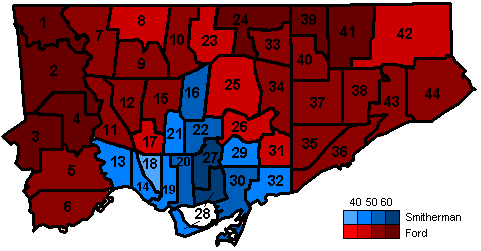
The problem with this? The inhabitants of the megacity didn’t want this unification, and the city remains sharply polarized on the old borders. Look at the results of the 2010 election.


This division also occurred in the 1997 and 2003 mayoral elections. It would be reasonable to say that sharp contrasts endure, between a downtown core that has been strongly in favour of greater government investment in building a dense city of Toronto strongly inclined towards New Urbanist philosophies with a suburban periphery that’s much more skeptical about these projects and skeptical of waste.

Numerous studies have highlighted economic and demographic divisions, too, with the relatively more white downtown being relatively richer than the relatively declining and heavily immigrant peripheral regions of Toronto. This division has defined city politics. In the most recent election, Rob Ford defeated his downtown opponent George Smitherman through his appeal to the suburbs, promising to make city government more efficient (despite more recent studies demonstrating that the city government was already efficient, that there was not in fact a “gravy train” as Ford had said) and to extend to the suburbs the subway service that would mark their inclusion in the city (although subway construction is considerably more extensive than the surface light rail plans he rejected, the suburbs arguably don’t have the density necessary to support subways, and the money would be better spent on light rail which would transport more people more efficiently anyway).


Go, tell me what you think of the post and of the place.
rfmcdonald: (Default)
First is Hamutal Dotan's Torontoist post "Ontario to Toronto: Grow Up".

Municipalities in Canada, Toronto foremost among them, are wont to complain, loudly and often, that they are the orphan stepchild of governance—”creatures of the province,” lacking robust taxation powers, in our case forced to deal with a strange beast called the OMB when it comes to simple development appeals. There is a great deal of truth here: Canada is now anchored by major urban centres and hasn’t adapted its governments to suit that relatively new reality. But here, at least, is a case of a provincial government handing us—the City of Toronto—leadership of an important issue on a silver platter. Ford’s response thus far: demur, deflect responsibility, diminish our own role by saying we can just provide advice but the province actually calls the shots.

As it turns out, Queen’s Park doesn’t want to call the shots. This isn’t, mind you, a sign of charity or altruism or some high-minded sense of duty to let Toronto chart its own course. The transit debate is a decades-old quagmire, and they’d like to keep as clear of the mud as they possibly can. It’s very hard to wade into Toronto transit planning and come out looking good; from the province’s point of view, they aren’t so much ceding power as passing the buck on a problem nobody’s been able to solve. They bungled, badly, when they let Ford rewrite the terms of their agreement and jettison a light rail network in favour of a buried Eglinton line, and they bungled again when they let a year go by before noticing that city council hadn’t ratified that decision. So they are washing their hands of things, and leaving us to our own devices.

Ford should take them up on it anyway. Transit planning is an utter mess, with a long and toxic history, and he has only made it worse. But there are compromises that could be struck: if council’s self-proclaimed fiscal conservatives are calling for a sales tax to pay for transit, and council’s centrists were willing to trade an at-grade LRT on Eglinton for Ford’s subway on Sheppard (as they were a few weeks ago, before the special council meeting on transit), there’s clearly room movement on both sides, if only Ford showed some willingness to embrace negotiation.

More importantly, there are precedents to be set. If Toronto, somehow, can get it together long enough to agree on a transit plan and make it stick, that’s the best possible case we can make that we are, in fact, a mature order of government that ought to have greater latitude to control our own affairs than we currently do. A majority of councillors have shown, and continue to show, that they are capable of this. They built a consensus around the waterfront. They built one around changes to Ford’s budget, around the light rail plan, and most recently around a more measured approach to the sell-off of TCHC property. Ford needs to stop throwing temper tantrums and realize that, though they may have their own cynical reasons for wanting to stay out of it, the province has given him the greatest gift a politician could ask for: the opportunity to rescue an important policy, and the ability to claim ownership of that victory.

If our mayor doesn’t want that chance, he should get out of the way of his colleagues on council who do.


Next is "Council’s growing rainbow majority is creating unity".

In June 2011, Mayor Ford scored a big win with a 33-10 vote to sell-off 22 single-family Toronto Community Housing Corporation (TCHC) homes. This month, however, the mayor was in full retreat when he agreed to a Councillor Ana Bailao-engineered compromise to sell just 56 of the 675 TCHC homes he had planned to divest and create a Bailao-led task force to determine how best to manage the rest of the 675 homes. That compromise occurred at a noteworthy stage: before the issue had even been tabled at a committee of city council. This means the Mayor knew he wouldn't have the votes at council to get his way, implicitly acknowledging the rise of the rainbow majority.

Institutionally, the only thing standing in the way of the rainbow majority from taking over as a governing coalition is committee and board assignments and structures. Agencies are governed by boards of directors that include in whole (TTC) or in part (Toronto Public Library, for example) city councillors that are appointed to their posts by city council (this was done at the very beginning of the term of council when Mayor Ford had a majority of councillors supporting his agenda). As we saw with the vote to oust Gary Webster on Tuesday, Mayor Ford's allies — through their appointments to these boards — can push an agenda that does not have the support of city council.

Additionally, city council has a series of standing committees that are supposed to consider an issue before it gets to city council. Without a two-thirds vote, a new item of business is referred to a standing committee. It's at these committees that the Ford administration can bury initiatives it doesn't like.

The exception to requiring a two-thirds vote to avoid sending a matter to committee is for a special meeting of city council to be called by the mayor or a majority of councillors to discuss one or more specific issues. This was done recently to allow council to debate transit issues when Mayor Ford was preventing that from happening. But governing consistently by special meeting has considerable drawbacks, including the appearance of an unstable government and the inability to include formal opportunity for public input in decision-making processes.

Given that a coalition is unlikely to grow to the two-thirds of councillors (though Councillor Adam Vaughan is optimistic) required to change the structure of committees (for example, removing the mayor's power to appoint committee chairs and thus the majority of Executive Committee), if the rainbow majority is serious about acting as a proactive, governing coalition it needs to begin to alter the composition of key committees and boards where possible, which only requires the support of a simple majority of councillors.
Page generated Feb. 9th, 2026 11:41 pm
Powered by Dreamwidth Studios