![[personal profile]](https://www.dreamwidth.org/img/silk/identity/user.png)
Aug. 11th, 2012


[BLOG] Some Saturday links
Aug. 11th, 2012 04:12 pm- 80 Beats reports on the dscovery of a mass grave in London dating to the mid-13th century that is a pointer to a famine induced by a likely volcanic winter, triggered by volcanoes in perhaps Iceland or even Indonesia.
- Acts of Minor Treason's Andrew Barton reports on recent news stories of the entire online lives of different people being hacked to point out that cloud computing isn't really secure.
- Are Chinese politics opaque? As Daniel Drezner documents, so too are the politics of the United States and Europe, just in different ways.
- Eastern Approaches starts with the recruitment of Georgian soccer player Kakha Kaladze by the opposition led by Bidzina Ivanishvili to speculate about Georgia's political future and the growth of Georgian populism.
- Geocurrents' Nicholas Baldi writes about Egypt's Wadi Tumilat, a defunct distributary of Egypt's Nile River that is the legacy of a Pharonic-era canal connecting the Nile to the Red Sea.
- The Global Sociology Blog reviews Rainie and Wellman's new book Networked, which apparently argues that social networking technologies aren't destroying social network or social capital but rather are facilitating the growth of more diverse and looser networks instead. Looks interesting.
- Supernova Condensate wonders about the watery environment where live on Earth first evolved--was it a "cold soup" or rather a "warm soda"?
- Torontoist covers the Diner en Blanc at Fort York.
- Whatever's John Scalzi talks about why he considers himself to be politically independent, even though the balance of his views do place him more with the Democratic Party than not.
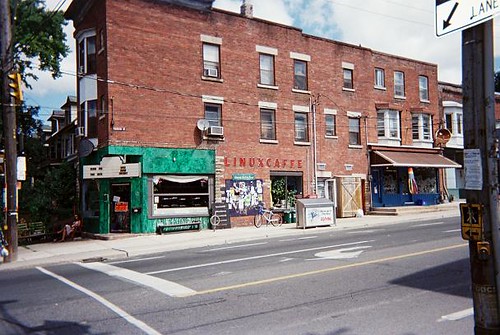
I've fond memories of the Linux Caffè, located at 326 Harbord Street on the intersection of Harbord and Grace across from Bickford Park. For years, I used to go there regularly, to soak up the Linux vibe and drink the coffee and enjoy the WiFi. The Linux Caffe was a notable point for me on the map of Toronto, and has been for a long time; I took the above photo in August 2008.
But the last two times I was there, I've noticed that its windows have been papered over, and the sign on the front door promising a reopening this month blew away. blogTO's Chris Bateman consigns the establishment to the deadpool.
Things aren't looking good for popular coffee shop and tech hub Linuxcaffe. Earlier this summer, management papered up the windows and posted signs announcing a temporary closure for renovations. Sadly, it seems the store has failed to emerge from its cocoon. The notices have come down without explanation and the store's phone has been disconnected.
Speaking with other store owners in the area, it seems as though Linux has now been dormant for some time. Next door neighbour Tosca Teran, who runs Nanopod: Hybrid Studio, a jewellery workshop, says the landlord has a signed lease with another "well-known" local cafe that's ready to take over the space.
As the name suggests, the coffee shop was a home for Toronto's open-source software developers as well as a meeting place for less technologically minded locals. Opened in 2003 in an old convenience store, the shop specialized in dark roast coffee, home baked treats and friendly cyberphile welcomes.
The Harbord and Grace cafe is listed as "permanently closed" on Google Maps, and no-one seems to have disputed that fact through the available channels. Emails and phone calls to Linuxcaffe have so far gone unanswered.
Bother.
[LINK] "Ben Johnson, Fastest Man Alive*"
Aug. 11th, 2012 11:59 pmTorontoist's Kevin Plummer writes, on the occasion of the Olympics, about sprinter Ben Johnson, the man who briefly became a national hero in 1988 with his gold medal-winning performance at the Seoul Olympics only to lose everything when it turned out that he'd been taking steroids.
I was only eight when all this happened, but I can remember being saddened by the news that he'd been cheated.
I was only eight when all this happened, but I can remember being saddened by the news that he'd been cheated.
At the sound of the pistol, eyes glowing with intensity, Ben Johnson exploded out of the starting blocks in a frenetic blur of massive arms and powerful legs. By 50 metres, his lead was insurmountable. “I have never seen anyone run the way Ben Johnson ran that day,” sportswriter Charles P. Pierce recalled in Esquire (February 1999). “He was molten. He covered the distance in 9.79 seconds, and he had time at the end to look back at [his rival Carl] Lewis, whom he had beaten.” Although he obliterated his own world record time, Johnson later claimed that, had he not raised his arm in victory in the last few strides of the 100 metre sprint, he could’ve finished in 9.72 seconds.
The 100-metre sprint was the dramatic climax of the 1988 Summer Olympics. It was seen live, on the bright afternoon of September 24, by 100,000 at the stadium in Seoul, South Korea. Millions more watched on television around the world—including five million in Canada, though it aired at 11:30 at night Eastern Time—as Johnson jogged around the stadium waving the maple leaf.
With the gold medal fresh around his neck, Johnson proclaimed to gathered journalists that his world record would “last 50 years, maybe 100.” There was only one thing more important than the record, he said: “A gold medal—that’s something no one can take away from you.”
With four of the eight finalists breaking the 10-second mark—including Lewis, Linford Christie, and Calvin Smith—journalists dubbed the event “The Race of the Century.” But, as Johnson tested positive for anabolic steroids in the hours to come, it devolved into what another journalist called “the greatest scandal in the history of the Games” and, perhaps, the most tainted race in history. Six finalists, it would later emerge, tested positive for performance-enhancing drugs over the course of their track careers, calling into question their lifetime achievements. But in late September 1988, it was Johnson who was found out, stripped of his medal in disgrace, and permanently seared into the Canadian consciousness.
[. . .]
Johnson’s 9.79 second dash touched off exuberant celebration in Canada and Jamaica. Immediately after the race, Prime Minister Brian Mulroney telephoned with congratulations: “You were just marvelous. We’re all very proud of you.” In Toronto, Metro Chairman Dennis Flynn mused about hosting another huge parade; and kids across the city sprinted through playgrounds, imitating their role model’s racing style.
But in the middle of the night after Johnson’s historic run, Canadian Olympic officials learned that Johnson had tested positive for stanozolol, a banned steroid. The officials’ appeal, which focused on flaws in the testing procedures (including unauthorized individuals milling around the secure area where medalists provided their urine samples), was rejected. The International Olympic Committee’s review of Johnson’s endocrine profile—a test no other athlete was subjected to at Seoul—showed that natural testosterone levels were 15 times lower than normal. It was evidence of long-term steroid use.
Less than 70 hours after being awarded the gold, Johnson handed the medal back. “I’m innocent and I welcome the opportunity of proving it,” an emotional Johnson said as he was hustled out of Seoul. “I’m proud to be a Canadian and I would never do anything to hurt the people who support me.”