[PHOTO] The 519, Church and Wellesley
Feb. 18th, 2013 12:17 pmThis somewhat blurry night photo is of the 519 Community Centre, a community hub in the Church and Wellesley area that also serves the GLBT community of wider Toronto.

On that Sunday in 1968 when Troy Perry borrowed a minister's robe and started a church for gays in his living room, the world was a very different place.
Perry's Metropolitan Community Churches was then a lone spiritual refuge for openly gay Christians, an idea so far from the mainstream that the founders were often chased from places where they tried to worship. Four decades later, some of the most historically important American denominations, which had routinely expelled gays and lesbians, are welcoming them instead.
MCC now has a presence in dozens of U.S. states as well as overseas, reporting a total membership of more than 240 congregations and ministries. But as acceptance of same-sex relationships grows -- gay and lesbian clergy in many Protestant traditions no longer have to hide their partners or lose their careers, and Christians can often worship openly with their same-gender spouses in the mainline Protestant churches where they were raised -- the fellowship is at a crossroads.
Is a gay-centered Christian church needed anymore?
"There are many more options than there used to be," said the Rev. Nancy Wilson, moderator, or leader, of the Metropolitan Community Churches. "But there is not a mass exodus."
[. . .]
The church today is a bit more diverse. MCC pastors say they see a growing number of straight friends and relatives of gays and lesbians among their new congregants, along with heterosexual parents who want their children raised in a gay-affirming environment. While some MCC congregations haven't changed much over the decades, Wilson said, many are emphasizing a broad social justice agenda including serving the homeless and poor.
"We don't have a rainbow flag on our website, nor do we have it on our building," said the Rev. Dan Koeshall, senior pastor at the Metropolitan Community Church of San Diego, which draws about 220 people for Sunday services.
"It wasn't a decision that caused any controversy or split. It's just been moving in that direction. We know that our target audience is the LGBT community. But we're also attracting people who are saying, ‘Yes, I stand in solidarity with you and I want to be part of this."'
Premier Kathleen Wynne thanked a historic Toronto church Sunday for being a place of refuge when she was coming out in the 1990s.
“I can remember the feeling of, this is a place that’s going to give me solace and strength,” Wynne, whose premiership has made history, told the Metropolitan Community Church of Toronto, where the country’s first gay marriages were performed.
After a standing ovation, Wynne explained how when she was coming out, she would sometimes “sneak” from North Toronto to the church near Gerrard St. E. and Logan Ave. Back when her kids were young, she and her partner, Jane Rounthwaite, would go to some evening services there, Wynne said, thanking the congregation for the “strength” it gave them.
“There was lots of turmoil in that coming out; it was not easy to do that. Jane had known her whole life that she was a lesbian and I had not known until I was 37,” said an emotional Wynne, getting laughs when she called herself a “slow learner.”


As in many good bookstores (though not as many as there used to be in Toronto), at Nicholas Hoare you can curl up on a couch for hours undisturbed, walk out with an armful of new discoveries or just make mental note of an art book that is way, way more than you can hope to afford. Most distinctively, Nicholas Hoare is the single best example of the tremendous and increasingly rare service provided by intelligent, imaginative book buyers. A store’s fingerprint is the particular mix of books that go on its shelves, and Nicholas Hoare’s are the most interesting in Toronto.
Like every good bookshop, there are also some quirky details. When you arrive a sign asks you to leave your things at the front cash, at which point whoever is working at the desk will pull out a pair of faded playing cards: one for you as a kind of parcel check ticket, and one that gets clothespinned to your stuff. And though that might sound all too precious, it isn’t—just a homey way to let people explore.
But the lease is up, and the 70-year-old Hoare has decided to mark that occasion “with an orderly run-off, the sale of his trademark fixtures, and a full-time move to his 350-acre estate in Nova Scotia.” He doesn’t intend to slow down, however. Once he’s made the move “Plans include a fledgling vineyard; revamping the garden; and pure book porn: the construction of an 18,000-volume library from scratch.” They also include his book review blog, which Hoare intends to keep updated. The farewell note continues: “On behalf of our entire staff, therefore, a 12-gun salute to our many customers, old and new. It’s been a privilege to serve you; we’re profoundly grateful; and we wish you and your reading well.”
Just after 9 p.m. on May 3, 1887, a train carrying Canada’s governor general rolled into the North Toronto Canadian Pacific Railway station. Accompanied by municipal officials, Lord and Lady Lansdowne led a procession of carriages south along Yonge Street toward Government House at King and Simcoe streets, where the couple would reside for the next three and a half weeks. While there was an enthusiastic turnout to watch the procession, there were also fears that Lansdowne’s presence would prompt one of the periodic riots between Orangemen and Irish Catholics that had marred the city since Confederation.
These fears were sparked by William O’Brien’s vow to visit Toronto while Lansdowne was in town. A journalist who represented East Cork in the British parliament, O’Brien was a fiery Irish nationalist who loved to stir things up. One of his main causes was supporting Irish tenant farmers who were being evicted by their landlords due to sharp rent increases. Lansdowne’s Luggacurran estate was a flashpoint, as he reputedly refused to work with tenant representatives to reduce their rent to affordable levels. As evictions occurred, O’Brien vowed to visit Canada to turn popular opinion against the governor general and paint him as “a most cruel and wanton man.” O’Brien scheduled a North American tour, bringing along evicted tenant Denis Kilbride to arouse sympathy.
From the start, prominent members of the Toronto Catholic community urged O’Brien to stay away. Leaders like Archbishop John Joseph Lynch knew from experience that the incendiary nature of O’Brien’s platform could easily cause a riot. Battles between ultra-Protestant Orangemen and local Irish Catholics earned Toronto a reputation as the Belfast of North America. Triggers ranged from celebrations of St. Patrick’s Day and the Battle of the Boyne to an appearance by Fenian leader O’Donovan Rossa in 1878.
[. . .]
As Toronto awaited O’Brien’s appearance, local papers obsessed over what might happen. The Telegram was prepared to let him talk in the name of free speech, but felt that it was “in execrable taste for an outsider to come among the citizens and abuse their guest.” The News hoped that “Mr. O’Brien will doubtless learn before his coming that an intolerant faction proposes to make trouble, and for the sake of peace will stay away.” Lansdowne was portrayed by the press as an upstanding representative of the crown, whose personal matters in Ireland had no bearing on his duties in Canada. Papers went to extremes to depict Lansdowne in a positive light, such as the Telegram’s unearthing of 20-year-old accounts of good relations with his tenants. The News amusingly observed that “it is very noticeable that the newspapers which have protested most strongly against his visit have harped most unceasingly upon the theme, and by their windy and reiterated articles on the subject have given it a degree of prominence which it could not otherwise have assumed.”
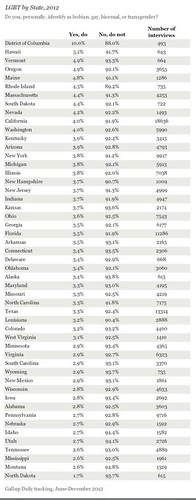
These results are based on responses to the question, "Do you, personally, identify as lesbian, gay, bisexual, or transgender?" included in 206,186 Gallup Daily tracking interviews conducted between June 1 and Dec. 30, 2012. This is the largest single study of the distribution of the LGBT population in the U.S. on record, and the first time a study has had large enough sample sizes to provide estimates of the LGBT population by state.
As was outlined in the first report of these data in October, measuring sexual orientation and gender identity can be challenging because these concepts involve complex social and cultural patterns. There are a number of ways to measure lesbian, gay, and bisexual orientation, and transgender status. Gallup chose a broad measure of personal identification as LGBT because this grouping of four statuses is commonly used in current American discourse, and as a result has important cultural and political significance. One limitation of this approach is that it is not possible to separately consider differences among lesbians, gay men, bisexuals, or transgender individuals. A second limitation is that this approach measures broad self-identity, and does not measure sexual or other behavior, either past or present.
The number of interviews conducted in each state between June and December is large enough to allow for reasonable estimates of each state's LGBT population. Only eight states had less than 1,000 completed interviews, including the lowest sample size of 613 in Alaska. Gallup also asked the LGBT question of 493 District of Columbia residents. The number of completed interviews conducted in each state is presented in the accompanying table.
The margin of error for each state's estimate varies, depending on the state's sample size. Except for the District of Columbia, all are below ±2 percentage points. A caution comes in interpreting rankings of states with relatively small populations. Although, as noted, the margins of error in general are quite small with all of these estimates, differences in the rankings of the states with the smallest numbers of interviews are more prone to being byproducts of sampling error.
Overall, the results from this analysis of LGBT identity by state may run counter to some stereotypes that portray the LGBT community as heavily grouped in certain states of the union. With the exception of the District of Columbia, the range in percentage LGBT is 3.4 percentage points, from 1.7% in North Dakota to 5.1% in Hawaii.
![[personal profile]](https://www.dreamwidth.org/img/silk/identity/user.png) branchandrootdancing_serpent
branchandrootdancing_serpent