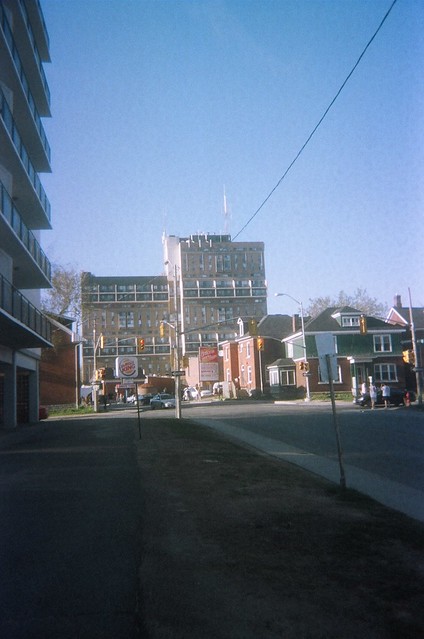


Another gay dance club will close its doors for good after one last big bash during WorldPride. Fly owner Keir MacRae broke the news to his employees over the weekend that the club he’s operated for 15 years on Gloucester Street will shut down when his current lease expires June 30.
The adjacent resto-bar Fire on the East Side, also owned by MacRae, has already closed and is operating only for private functions.
The building Fly and Fire on the East Side are located in has been approved for redevelopment as a 29-storey condo, although developers have not announced plans to begin construction. MacRae says the landlord offered him the option of renewing his lease but demanded a large rent increase for anything more than a short-term extension. MacRae says that keeping the club going just a year at a time doesn’t make sense.
“It’s never been a fly-by-night operation. We plan our events months ahead. The numbers and the terms that they wanted didn’t make sense.”
[. . .]
“It’s a great place and central; I hope someone takes it over,” he says. “It really depends on whether the landlord wants to come to a deal with someone. The space is there, the liquor licence is there, it has a dancefloor. There’s nothing like it in downtown Toronto.”
As the company struggles to remain relevant in the post-CD age, the move makes a whole lot of sense. HMV needs to get people into the store and can tap into a fair bit of local history in opening a live venue on Yonge Street. Over and above the fact that Yonge and Gould was once a nexus of record shops (most notably the former home to Sam the Record Man's flagship location), the stretch of Yonge between Gerrard and Dundas was once a breeding ground for the city's rock and roll scene.
The space will accommodate 140 people and go by the name HMV Underground, which is kind of fitting in its '90s-ness. It was, after all, about 20 years ago when the store was at its peak of popularity. One doubts that a crossover plan like this will restore the location to its former heights, but it sure won't hurt. Hosting live shows is tried and tested way for bricks and mortar record shops to generate traffic and interest on the part of local music fans. In that sense, it's nothing new. But the size and sophistication of the venue is noteworthy. This isn't a little stage tucked into the corner as an afterthought.

Like other stores, HMV has ridden the peaks and valleys of the music business since the dawn of the Internet. A 2010 Statistics Canada study found that 87 per cent of youth aged 15 to 24 download songs at least once a week, while only 6 per cent exclusively listen to CDs.
This shift has hurt sales and triggered store closures, including Toronto HMVs at Sherway Gardens and on Queen St. W.
But the same Stats Canada research found seniors have remained loyal to tangible sound; 80 per cent of those polled over 65 said they only listen to music on traditional formats.
This demographic gap may be partly responsible for HMV Underground’s set list; the first performer will be Canadian classical guitarist Michael Kolk on May 3. The studio has also been reserved for the TD Toronto Jazz Festival in June.
However, Williams insists the Underground isn’t for one age group or music style.
“This isn’t exclusive just to those hardcore consumers, it’s for everybody. If we can bring new people in the store that’s all the better,” he said. “We’re selling the product that is there, but it’s about the artist. It’s a genuine brand extension, really.”
Guizhou Province, one of the least developed in China, has emerged at the center of China's big data ambitions, with Alibaba Group and other tech leaders moving to cash in on the big data boom.
Alibaba signed a framework agreement with the Provincial Government of Guizhou on April 17 to use the province as its industrial base for the development of cloud computing and big data.
[. . .]
Guizhou's visibility has been rising in China's big data frontier as a number of heavyweight telecommunication carriers, including China Telecom, China Unicom and China Mobile, have moved into the province's Guian New District since October to establish cloud computing bases and big data centers.
So far, more than 100 big data enterprises, including Baidu, Jingdong and Dawning, and Internet giants such as Sina.com and Sohu.com have moved in. ( In the eyes of Li Guojie, academician of the Chinese Academy of Engineering, the swarming in of heavyweight players is not driven by bandwagon appeal.
[. . . T]he province is an ideal industrial base for big data development. Cool weather, plenty of energy resources, well-developed equipment manufacturing, military industry, sufficient power supply and lower electricity prices are all advantages to lure data centers to set up bases in the region[.]
As one of China's least developed provinces, Guizhou is eyeing the big data industry to boost its economic sustainability while China speeds up its reforms. In 2012, the GDP per capita of Guizhou was only 50.9 percent of the national average, the lowest in the country.
Although rich in energy and natural resources, Guizhou has seen its economy heavily dependent on traditional heavy industries such as chemical manufacturing and ferrous metal production, whose growth potential have been declining.
[. . . T]he province faces a lack of talent to supply the industry's needs.
To remedy the situation, Guizhou launched a talent recruitment project to attract college graduates to set up big data companies in Guiyang by offering them preferential policies.
Barry Appelman, Eric Bosco and Jerry Harris worked at AOL in the 1990s and early 2000s as engineers on AOL Instant Messenger, known commonly as AIM. They weren't hired to build a messenger. Appelman and Bosco programmed in the Unix operating system. Harris had been a programmer at a small web browser company purchased by AOL.
But together with a group of other engineers they helped take AIM from inception to dominance, then watched it fall into dormancy, unable to convince AOL management that free was the future.
Sitting with them and talking about the program, they exude pride for what they built and how it impacted the Internet. That pride is accompanied by a sense of "what if?"
During our conversation, the term "innovator's dilemma" is thrown around a few times.
Harvard Business School Professor Clayton Christensen coined the term, which is the title of his renowned book. The concept is simple — companies concerned with its current products, profits and customers often fail to recognize and adapt to change even from within.
Whatsapp is not far from their minds. That comes up a couple times as well. The app, which Facebook bought for $16 billion, is essentially what they worked on in the mid 90s — messaging over the Internet.
AOL is still pivoting away from its days as an ISP. Under the leadership of Tim Armstrong it now focuses on video and its ad network. In another life, before a disastrous acquisition of Time Warner, it brought the Internet into the homes of Americans and controlled the program that popularized online messaging without ever really meaning to.
It would be easier to call AIM ahead of its time if it had not become so wildly popular almost immediately after its launch. In many ways, AIM was right in line with the times, just at a company hanging on to a business model that would soon become obsolete.
Queen Lower remains part of the TTC’s infrastructure. It is laced with conduits and houses elevator shafts for the functioning subway station that sits above it. Reclaiming it for anything else would present a massive engineering challenge, said TTC spokesman Brad Ross.
“The shell, as it stands, would not be useable as part of a station. There’s a lot more work that would need to be done,” he said.
Ross and TTC CEO Andy Byford toured the station for a YouTube video last month.
Another challenge to using the station is that a portion of it now forms a pedestrian passageway from the northbound to southbound sides of the tracks.
“TTC erected walls to make that more accessible many, many years ago, so that you can transfer between north and south, and south and north,” said Ross. “You’re actually walking through what was once Queen Lower,” he said.
To this day, the abandoned streetcar station’s very existence makes it alluring to transit watchers, said Steve Munro, transit advocate and blogger. But it’s unlikely that it would be ideally placed for a much-discussed downtown relief line, which is increasingly referred to simply as the relief line.
“It’s got this wonderful attraction for people to draw lines through it, because it’s there. The problem is that, since it was built, the centre of downtown has moved further south,” Munro said.

A second video of Toronto Mayor Rob Ford smoking what has been described as crack-cocaine by a self-professed drug dealer was secretly filmed in his sister’s basement early Saturday morning.
The clip, which was viewed by two Globe and Mail reporters, shows Mr. Ford taking a drag from a long copper-coloured pipe, exhaling a cloud of smoke, his right arm convulsing. The footage is part of a package of three videos the dealer said was surreptitiously filmed around 1:15 a.m., and which he says he is now selling for “at least six figures.”
Mr. Ford declined to answer questions from The Globe and Mail. Less than an hour after The Globe asked the mayor for comment, his lawyer, Dennis Morris, said Mr. Ford is planning to “take a break” from the mayoral election.
In one of the clips shown to The Globe and Mail on Wednesday, the mayor rapidly shifts his weight back and forth on the spot, talking into his cellphone and his right arm swinging at his side. When the camera pans around the room, a man that looks like Alessandro “Sandro” Lisi, the mayor’s former driver and an accused drug-dealing extortionist, can be seen in the background. Mr. Ford’s sister, Kathy, who has admitted in media interviews to being a drug addict, is sitting in front of her brother. In the last of three clips, Mr. Ford is holding the pipe and speaking to his sister.
Toronto Mayor Rob Ford will take a leave of absence to seek help for substance abuse, CBC News has confirmed.
Ford's lawyer Dennis Morris said Wednesday night Ford will take a leave and “seek assistance for his substance abuse problem" but will not drop out of the municipal election.
Ford "thinks this is an opportunity to step back, take a breath and get help," Morris told CBC News.
The news comes amid reports that one or more new recordings of Ford have surfaced and are about to be released. The Toronto Sun reported late Wednesday it has obtained a new and “raunchy” audio recording of Ford “ranting and swearing” in a Toronto-area bar.
The news comes amid a rocky re-election campaign in which Ford has repeatedly described himself as a changed man who has learned from the mistakes of his first term as mayor.
"The decision to immediately step away from the campaign — while staying on the ballot — came after the Toronto Sun exclusively obtained a new raunchy audio recording of Ford ranting and swearing in an Etobicoke bar.
[. . .]
The audio recording, covertly taped by a patron of Sullie Gorman’s Monday night, captures the mayor being unruly as he’s ordering booze at the Royal York Rd. bar, complaining about his wife Renata and making lewd comments about mayoral contender Karen Stintz.
“I’d like to f-----g jam her (Stintz), but she doesn’t want ... I can’t talk like this...I’m so sorry,” Ford is heard saying on the recording. “I forgot there’s a woman in the house.”
According to one witness, Ford was seen buying shooters and tequila and trying to fight with patrons Monday.
“He was really wasted,” said the witness. “And he was acting like a real ass.”"
![[personal profile]](https://www.dreamwidth.org/img/silk/identity/user.png) branchandrootdancing_serpent
branchandrootdancing_serpent