Jun. 30th, 2014

rfmcdonald: (photo)
I saw this rainbow on a parade float.

A rainbow in the Pride parade


This rainbow was on an apartment balcony, a display by a man welcoming people to WorldPride.

A rainbow on an apartment balcony


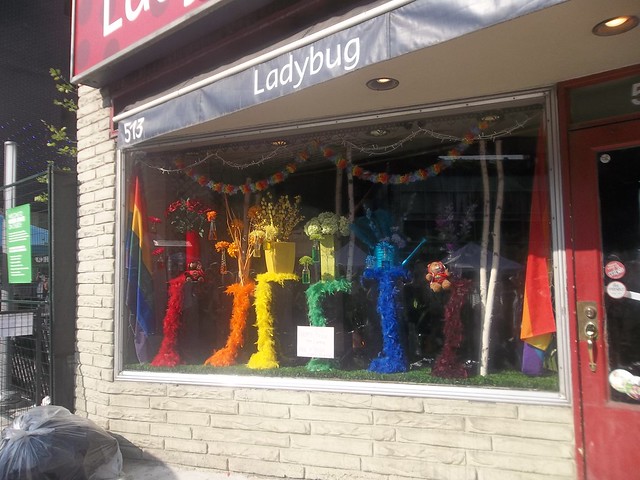
This final rainbow was in the front window of Ladybug Florist just north of Church and Wellesley.

A rainbow in a shop window
rfmcdonald: (Default)

  • blogTO's Chris Bateman writes about the life of William Cawthra, a 19th century millionaire in Toronto who gave his name to--among other places--Church and Wellesley's Cawthra Park.

  • Centauri Dreams considers the idea of engines that can move stars and planets, drawn from science fiction.

  • Crooked Timber visits the topic of the First World War.

  • The Dragon's Gaze links to one paper suggesting TW Hydrae has a borderline brown dwarf in orbit, and to another paper suggesting that exoplanet 55 Cancri e is in a polar orbit of its star.

  • The Dragon's Tales notes that Greenland's icecap is darkening, potentially accelerating the rate of its melt.

  • Eastern Approaches engages with Polish politics.

  • Far Outliers is exploring Soviet history, noting Communist enthusiasm for the Russian civil war and origins of totalitarianism in the war.

  • A Fistful of Euros' Edward Hugh notes that Japanese inflation is at a 32 year high, and that this isn't good.

  • Joe. My. God. notes the suicide of a Tea Party leader in Mississippi who filmed the mentally ill wife of his Republican opponent.

  • Language Log approves of a shift to actual language use in the US Supreme Court.

  • Lawyers, Guns and Money also discusses the First World War, noting that Serbian opinion isn't very anti-war.

  • Marginal Revolution notes economic stagnation among African Americans.

  • Window on Eurasia notes that Georgia, Moldova, and Ukraine are starting to join the same Russian mental category reserved for the Baltic States, for good and for ill.

rfmcdonald: (Default)
Maria Konnikova's blog post at The New Yorker taking a look at the reasons for the global popularity is, besides a fine look at a very good movie, an interesting examination of the underlying mechanics for popular pop culture.

George Bizer, a psychologist at Union College, first became interested in the “Frozen” phenomenon when his seven-year-old daughter requested that they watch it. Normally, a parent shouldn’t be surprised when a young girl wants to watch a Disney-princess movie. But for Bizer’s daughter, the request was highly out of character. “My daughter is a princess-hating daughter,” he told me. “She has made us warn everybody in prior years that she didn’t want anything with princesses on it for her birthday. And if she got a princess, she would get angry. Really angry.” Why, then, would she want to go see a movie where not one but two princesses reigned? “ ‘It’s O.K., Daddy,’ she said. ‘These are strong princesses. I’m going to like it a lot,’ ” Bizer recalled. And she did.

That was enough to pique Bizer’s curiosity, and when he started seeing “Frozen” fans cropping up around the college campus, he realized that there was a potentially more powerful force at work. Union students, after all, weren’t your typical Disney-loving fans. Together with his fellow Union psychologist Erika Wells, Bizer decided to test possible theories on every psychologist’s favorite population: college students. They organized an evening of “Frozen” fun—screening and movie-themed dinner—and called it “The Psychology of Frozen.” There, they listened to the students’ reactions and tried to gauge why they found the film so appealing.

While responses were predictably varied, one theme seemed to resonate: everyone could identify with Elsa. She wasn’t your typical princess. She wasn’t your typical Disney character. Born with magical powers that she couldn’t quite control, she meant well but caused harm, both on a personal scale (hurting her sister, repeatedly) and a global one (cursing her kingdom, by mistake). She was flawed—actually flawed, in a way that resulted in real mistakes and real consequences. Everyone could interpret her in a unique way and find that the arc of her story applied directly to them. For some, it was about emotional repression; for others, about gender and identity; for others still, about broader social acceptance and depression. “The character identification is the driving force,” says Wells, whose own research focusses on perception and the visual appeal of film. “It’s why people tend to identify with that medium always—it allows them to be put in those roles and experiment through that.” She recalls the sheer diversity of the students who joined the discussion: a mixture, split evenly between genders, of representatives of the L.G.B.T. community, artists, scientists. “Here they were, all so different, and they were talking about how it represents them, not ideally but realistically,” she told me.
rfmcdonald: (Default)
Spiegel Online writes about a recent conference in Germany that seems to have been a platform for the Russian government's particular new brand of homophobic cultural conservatism.

In the run-up to it, the event attracted significant controversy, in no small part due to the second half of the title to Saturday's program: "Are Europe's peoples being abolished?" German Middle East expert Peter Scholl-Latour and former news anchor Eva Herman -- who gained notoriety in Germany and was fired from her job at a public broadcaster several years ago for making favorable remarks about family values during the Third Reich -- had both been scheduled to attend. But both withdrew at short notice, Scholl-Latour citing scheduling issues while Herman said she was doing so out of fear for her family's safety and "because I don't want to expose myself to media mud-slinging."

Herman instead addressed conference participants with a pre-recorded audio message. "Family policy in Germany nowadays is scarcely distinguishable from the East German model," she said. While Herman's views are well-known, they pale in comparison with the conference's other speakers. Another last-minute cancellation came from Frauke Petry, spokesperson for the new euroskeptic Alternative for Germany party. Presumably party strategists had decided that the Alternative's mantra-like promise to not enter into coalition with right-wing populists in the European Parliament would sound hollow if Petry participated in a conference that played host to crude theorizing about issues as diverse as demography, heredity, the evils of day care centers or youth they claim can become gay as a result of homosexual proganda.

Several speakers from Russia took part in the Leipzig conference, sparing no effort to promote President Vladimir Putin's family policies. Among them was lawmaker Yelena Mizulina, chair of the Duma Committee on Family, Women and Childrens' Affairs and co-author of the country's infamous law banning "homosexual propaganda.

[. . .]

Mizulina's family policy wish list is a long one: Among the legislative initiatives she'd like to pursue are a tax on divorce, recommendations for married couples to have at least three children and a ban on emergency contraceptive pills. Mizulina denied claims that her country's gay community is subjected to violence while standing in front of a wall with the inscription "Courage to speak truth."

[. . .]

The conference was organized by Jürgen Elsässer, editor-in-chief of the right-wing populist magazine Compact and himself a former West German communist back in the 1970s. He later became a teacher while continuing to write for German left-wing publications like Konkret and Freitag. His politics have since shifted to right-wing populism and conspiracy theories, and he has a penchant for preaching about family values and Europe's supposed imminent decline. Elsässer's partner in France is Paris' Institute for Democracy and Cooperation, a think tank sponsored by private individuals from Russia that is considered to be closely aligned with the Kremlin.
rfmcdonald: (Default)
The Canadian Press, via CBC, reported on one of the sweetest components of WorldPride, a mass wedding at Casa Loma.

Organizers forecast up to 1,000 people would attend the Grand Pride Wedding, which is believed to be the largest of its kind in North America.

The setting was Casa Loma, a palatial Toronto home built between 1911 and 1914, which has since become a popular tourist attraction and event venue.

Liberty Entertainment Group, which operates the facility and hosted the event, absorbed all the costs, with the couples only having to pay for an Ontario marriage licence.

The venue is of particular significance for Windsor, Ont., resident Aaron Bergeron, who was marrying partner Kenneth Grundy. They first visited Casa Loma when they were in Toronto two years ago.

"We were walking around in it and I was like 'how awesome would it be to get married here,"' Bergeron said. "When we found out that that's where they were having the giant ceremony, I was like, this has to happen."

Despite the significance — and scale — of the celebration, some warn that the rights of lesbians, gays, bisexuals, transgenders, queers and two-spirited people (a First Nations term for individuals who are considered to be neither women nor men) still can't be taken for granted.

"This says a lot about acceptance and change in our society," said Helen Kennedy, executive director of national charity Egale, which was involved in planning the "big fat gay wedding."
rfmcdonald: (Default)
Towleroad reports on a recent survey of Grindr users, described here, as to their biographical elements. Almost a fifth of Grindr users aren't out.

When asked the age Grindr users decided to come out of the closet, users in their thirties and forties came out in their twenties (44 percent and 32 percent, respectively). However, 50 percent of users in their twenties came out when they were still teenagers, showing the growing progression and acceptance of LGBT youth. With more than 5 million active monthly users worldwide, Grindr has become a resource for men even before they come out. The survey revealed that nearly a third of respondents were using Grindr before they came out.

“It’s a great time to be gay – not just because it’s pride season, but because the tide is shifting for our community,” said Joel Simkhai, founder and CEO of Grindr. “Our voices are being heard as laws are changing, people are getting married and we have more allies than ever before. Every day, more people are getting involved with our community and our latest survey showed an overwhelming 89 percent of Grindr users support the LGBT community by donating, volunteering or participating in equality initiatives. We are doing our part by helping to increase awareness through our Grindr for Equality campaign and have done some amazing work for equality and to advance the cause of our community worldwide.”

Grindr’s survey also put to test the saying that blood is thicker than water. Apparently not in regards to coming out – 72 percent of respondents said the first person they told was a friend, while only 22 percent told a family member first.

When it comes to how out Grindr users are, a large majority (96 percent) came out to friends and 81 percent have come out to family, but only 68 percent have come out at work. This means workplace discrimination fears are still top of mind for many Grindr users. This may be surprising considering the main reason respondents hesitated about coming out of the closet was the fear of rejection from family and friends. That 81 percent beat out other fears such as gay slurs, threats, excluded by religion and unfair treatment in the workplace.


The comments at Towleroad include discussions from some of these people, one talking about how his livelihood could be threatened if he was out to more than friends and family.
rfmcdonald: (Default)
Walking home tonight, I noticed that there were plenty of dueling campaign signs for Adam Vaughan and Joe Cressy tonight on the western periphery of Trinity-Spadina , on Ossington Avenue at Bloor, to be precise.

Plenty of dueling campaign signs for Adam Vaughan and Joe Cressy tonight on the western periphery of Trinity-Spadina tonight.


The by-election called for this seat, triggered by the departure of the NDP's Olivia Chow to run for the position of mayor of Toronto, has import beyond Toronto. This riding, the pundits say, is apparently a bellwhether for the direction of Canadian politics. In the past, if the Liberals won it, they were on track to form the next government. If, instead, the NDP won it, the Conservatives would prevail. Naturally, both parties invested heavily in this riding.

Torontoist's interviews with three of the four leading candidates--the Green Party's Camille Labchuk, the NDP's Joe Cressy, and the Liberals' Adam Vaughan--were worth reading. (The Conservatives' Benjamin Sharma didn't respond to Torontoist's request for an interview.)

Three Hundred Eight's Éric Grenier predicted that a Liberal victory would be more likely than not. And, indeed, the Liberals did win, taking not only Trinity-Spadina with an absolute majority of votes cast but keeping the east-end riding of Scarborough-Agincourt.

What does this mean? The major break from past elections and parliaments is the strength of the NDP relative to the Liberals. Will this election signal a return to traditional patterns of Liberal dominance over the NDP? Or have things changed sufficiently, especially with the capture of Québec by the NDP, to send Canadian politics into entirely new directions?
rfmcdonald: (Default)
Rob Ford is back, fresh from rehab and ready to continue his campaign to be re-elected mayor.

What Torontoist's Hamutal Dotan said.

Rehabilitation is supposed to be about resetting the trajectory of your life. For politicians, representatives with a sworn duty to protect the interests of those who elected them, rehabilitation must to some extent happen in public. While rehab often causes people to make professional changes (moving work environments or avoiding certain colleagues, for instance), in the particular case of politicians—because of their ongoing relationship with the electorate and the expectation of transparency in a democracy—those professional changes take place out in the open. Or at least they should, if leaders are to regain the public’s trust.

The mayor held an event today, his first day back at the office. It was meant to inform us of his current state and future plans—to serve as his reintroduction to the people of Toronto after rehab. It was meant to demonstrate that he had faced his issues head-on, and was ready to return to work.

There was nothing—in his demeanour, in the content of his remarks, or in the nature of the event itself—to indicate that Rob Ford is a changed man.

The mayor spoke for 18 minutes, and his statement was roughly divided into two halves: an apology and a political call to arms. The first was vague, abstract, and generic. The second, sloganeering we have heard for years. The combination of the two was both odd and odious.

Apologies need, above all, to be specific. For an apology to constitute a genuine gesture toward making amends, you must specify what it is that you have done wrong. You must show some understanding of the toll it has taken on others, and you must indicate in concrete, specific ways the measures you are taking to ensure your behaviour will be different in the future. Ford’s speech contained almost none of these things.

The only specific act the mayor apologized for was making “hurtful and degrading remarks” about Karen Stintz. Entirely absent from his speech were the years of lying; his countless homophobic and racist remarks; the many misogynist remarks he has made independently of the ones about Stintz; the alleged mistreatment of his staff; his relationship to one Toronto’s major gangs; or acts of violence allegedly done in his name, or for the sake of his protection.


Me, all that I'll add as someone who has had a couple of drunken stupors (graduate school and drinks that taste like candy are key elements, here), I've never been hanging around people who've a connection that I know of to crack cocaine.

Torontoist's Desmond Cole has a transcript of the speech, delivered to a personally-selected media crowd.
rfmcdonald: (Default)
The Canadian Press via the CBC reports on the latest Canadian proposal for a guaranteed minimum income for all citizens.

A group of academics and activists is trying to drum up interest in an ambitious plan to provide every Canadian with a guaranteed minimum level of income — whether or not they have a job.

Rob Rainer, a campaign director for the Basic Income Canada Network, envisions a country where everyone is assured a minimum of $20,000 annually to make ends meet.

"For many of us, we think the goal is no one should be living in poverty," Rainer said at a conference on the issue over the weekend at McGill University.

"That's essentially what we're striving to achieve."

More than 100 speakers and participants were on hand for the conference, which focused on the merits of a guaranteed minimum income that would either replace or exist alongside existing social programs.


The project appeals to me.
Page generated Apr. 12th, 2026 03:53 pm
Powered by Dreamwidth Studios