[PHOTO] Dufferin Gate Loop, 11:16 pm
Oct. 1st, 2015 11:42 am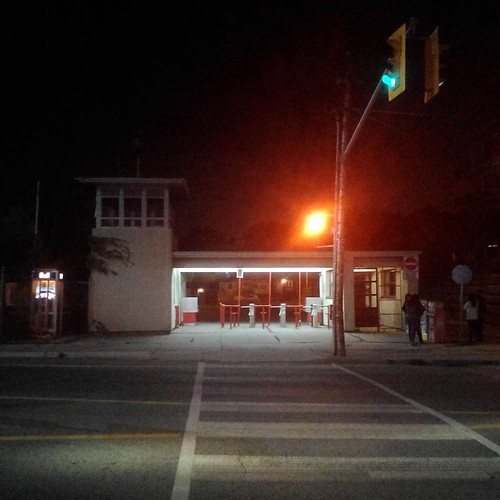
I snapped this nighttime picture of the Dufferin Gate Loop, southern terminus of the 29 Dufferin route, while about to return from my failed attempt to see the lunar eclipse.
Earlier this month, I announced on Twitter that I planned to report on the disconnect between Democratic presidential candidate Sen. Bernie Sanders (I-Vt.) and black voters. Immediately, some of Sanders’s self-described supporters raided my mentions with patronizing tweets.
Over the past few months, Sanders’s predominately white backers have used Twitter to target any black activist or journalist who dares question the candidate’s civil rights record. The battle reveals a long, simmering racial divide in the progressive movement that continues to go unacknowledged. If Sanders wants to win black voters, he’ll need to address it.
A series of Gallup polls this summer found that Sanders has a +13 favorability rating among African Americans, compared with Hillary Clinton’s +68 favorability rating. There are many reasons for Sanders’s poor polling with African American voters: his unknown name, the limited diversity of his home state, his shaky response to interactions with Black Lives Matter protesters. But the social media battles have shown that Sanders’s supporters also have become a major hurdle for the candidate in building a positive image with the black electorate.
The online clashes between some of Sanders’s white supporters and black voters came to a head after protesters interrupted the senator’s speech at Netroots Nation in July, demanding he speak candidly about police brutality. His defenders took their anger to the Web, with condescending blog posts and combative tweets that have continued unabated since[.]
Russian airstrikes are expected to turn up the dial of Syria’s civil conflict, intensifying the chaos that has uprooted millions and split the nation into warring cantons, while complicating Washington’s efforts to find a political solution. The possibility of United States and Russian warplanes operating for different purposes in the same space is similarly unsettling.
And at the moment, there doesn’t appear to be much the Obama administration can do. The US strategy of building a force of moderate Syrian rebel fighters has flopped, and Russia has real national interests in Syria – including a naval base.
US policy appears to have created an opening for Russia to intervene in Syria, and Russian President Vladimir Putin has strutted through it.
The question is whether Putin has a vision of what’s supposed to happen next, or whether he’s winging it. In the answer to that question could come a stinging rebuke to Russian adventurism or an American reappraisal of its own strategy.
But for now, Russia’s endgame is not at all clear.
The murder trial of Ukrainian pilot Nadiya Savchenko has begun despite international condemnation and accusations that the charges have been fabricated for political purposes.
Savchenko – the best known Ukrainian citizen currently being held in Russia – is accused of directing artillery fire that killed two Russian journalists, Igor Kornelyuk and Anton Voloshin, during fighting in eastern Ukraine. She faces 25 years in prison on charges of murder, attempted murder and illegally crossing the border.
Savchenko and some western countries have said she should be considered a prisoner of war. The parliamentary assembly of the Council of Europe approved Savchenko as a member of the Ukrainian delegation in January, a position that entitles her to international immunity from prosecution.
Prosecutors at the trial in Donetsk in the Rostov region of Russia said on Tuesday that Savchenko, the first female military pilot in post-Soviet Ukraine, was working as a spotter for Ukrainian forces near Luhansk in June 2014. Motivated by “hatred and hostility towards … the civilian population of Luhansk region”, they said she called in an artillery strike on a rebel checkpoint where civilians and journalists were present. Investigators have claimed she was later detained after she crossed into Russia as a refugee without documents.
Savchenko has denied the charges and said she was captured by rebels in June 2014 and handed over to Russian authorities. Dressed in a Ukrainian folk costume and looking healthier than after her 80-day hunger strike earlier this year, Savchenko told the court that her case had been fabricated by the investigative committee.
The confrontation between Saudi Arabia and Iran escalated on Wednesday, as the kingdom said it foiled an Iranian arms shipment to Yemeni rebels and the Islamic Republic again hit out over last week’s fatal Hajj stampede in Mecca.
The Saudi-led military coalition said it seized an Iranian boat carrying weapons bound for Yemen. The boat was held in the Arabian Sea with a cargo that included anti-tank weapons as well as missile launchers, the coalition said in a statement. There was no comment from Iranian officials.
Hours later, Supreme Leader Ayatollah Ali Khamenei continued Iran’s attacks on Saudi Arabia over its handling of the stampede near the holy city of Mecca, in which hundreds of pilgrims were killed. Failure to return the bodies of Iranian victims, he said, would be met with a “tough and severe” response from his country.
The two nations are on the opposite ends of some of the Middle East’s bloodiest conflicts from Syria to Yemen. The confrontation between Shiite power Iran and Sunni-dominated Saudi Arabia dims hopes that Iran’s nuclear agreement with world powers sealed in July could help resolve other crises.
‘There is no middle ground – you are either heterosexual or homosexual.’
Until quite recently, this statement was regarded as common sense. More than this, it was a kind of widely-shared article of quasi religious faith, as prescriptive as it was descriptive. An Eleventh Commandment.
Heterosexuality was the default, normal, right, setting and anything that strayed from that was homosexuality. That is to say: sinful, wrong, ill, odd, hilarious, niche.
This heterocentric, essentially monosexual world-view was not just conventional wisdom for many straight people. It was also shared by surprisingly large number of (usually older) gay people, who sometimes regard bisexuality as a kind of heresy, or at least a cop out. What’s not straight must be gay, otherwise you’re just kidding yourself and letting the side down.
But common sense can change. And articles of religious faith can fall. There has been a revolution in attitudes in recent years that has shaken sexual certainties to the core. Compulsory heterosexuality, and the idea that any ‘deviation’ from it is homosexual, is no longer so compulsory. People have lost their faith in monosexuality.
Slowly but surely the mysteries of dwarf planet Ceres are being peeled back layer by layer as NASA’s Dawn spacecraft orbits lower and lower and gathers detailed measurements that have now yielded global mineral and topographic maps, tantalizing researchers with the best resolution ever.
The Dawn science team has been painstakingly stitching together the spectral and imaging products captured from the lowest orbit yet achieved into high resolution global maps of Ceres, released today Sept. 30, by NASA.
“Ceres continues to amaze, yet puzzle us, as we examine our multitude of images, spectra and now energetic particle bursts,” said Chris Russell, Dawn principal investigator at the University of California, Los Angeles, in a statement.
The color coded map above is providing researchers with valuable insights into the mineral composition of Ceres surface, as well as the relative ages of the surface features that were a near total mystery until Dawn arrived on March 6, 2015.
The false-color mineral map view combines images taken using infrared (920 nanometers), red (750 nanometers) and blue (440 nanometers) spectral filters.
In 1992, Romania still had 23 million inhabitants. Today there are 4 million fewer. Those who emigrated profit from the fact that Europe has an undeclared division of labor that goes something like this: Wherever uneducated, rather than educated, workers are needed, employers look for Romanians. Even the Germans.
If it weren't for Romanians, slaughterhouse owners would be chest-deep in pig halves. Without them, real estate developers could forget about Germany's glorious construction boom. The same goes for asparagus and potato harvests. In their view, anything is better than staying in Romania. As a result, leaving home is about the most Romanian thing a person can do -- and that's not difficult at all.
All it takes is climbing into a mini-bus and rattling westward. There are hundreds of these busses in every Romanian city. A one-way ticket to Germany costs €70 ($77); to the Netherlands, €80; Belgium, €80; France, Italy, Portugal, €120. A massive armada of small Romanian buses has been traversing Europe for years.
This is where our hero comes in, a hero for freedom, a hero for the market economy -- somehow, in his own way, a hero for Europe. He prefers to be called Viktor Talic. His real name, he claims, would be unwise to use -- it would put him in danger of being persecuted, as heroes so often are.
Talic is on his way to Portugal. He's more than just a bus driver, he's also a shipper, money courier, messenger and smuggler rolled into one. With eight of his compatriots in his Mercedes Sprinter, he moves people and goods from Point A (Romania) to Point B (Portugal), a route many Romanians have taken.
“A Canadian is a Canadian is a Canadian,” an impassioned Trudeau said during Monday’s televised leaders’ debate.
“You devalue the citizenship of every Canadian in this place and in this country when you break down and make it conditional for anybody.”
Mulcair chose to say nothing on citizenship in the debate. But on Sunday he made much the same point, accusing Prime Minister Stephen Harper of playing a dangerous game.
“He’s dividing Canadians one against the other,” said the NDP chief, “creating two different categories of citizenship.”
Indeed, that is one of the problems of the new law. Those who possess only Canadian citizenship have an ironclad guarantee that they cannot be sent into exile.
![[personal profile]](https://www.dreamwidth.org/img/silk/identity/user.png) branchandrootdancing_serpent
branchandrootdancing_serpent
