Mar. 20th, 2016

rfmcdonald: (photo)
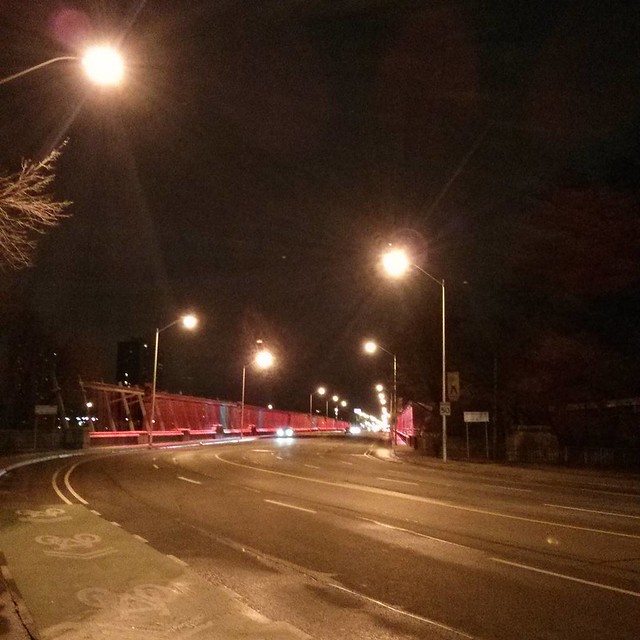
Last Monday, I had the chance to walk across the Prince Edward Viaduct at night to see the Luminous Veil in action, the first time I saw it in action since it was finished last year for the Pan Am Games.

Last July, Spacing Toronto's Kat Eschner wrote at length about the controversies surrounding the Veil, an anti-suicide barrier for one of the most popular suicide bridges in North America. One commonly voiced concern was that the Luminous Veil would detract from the Viaduct's beauty. Looking back at these photos, and remembering my walk, I don't see how this is the case.


Luminous Veil, looking west #toronto #princeedeardviaduct #luminousveil


Luminous veil, seen from the eastern end #toronto #princeedeardviaduct #luminousveil


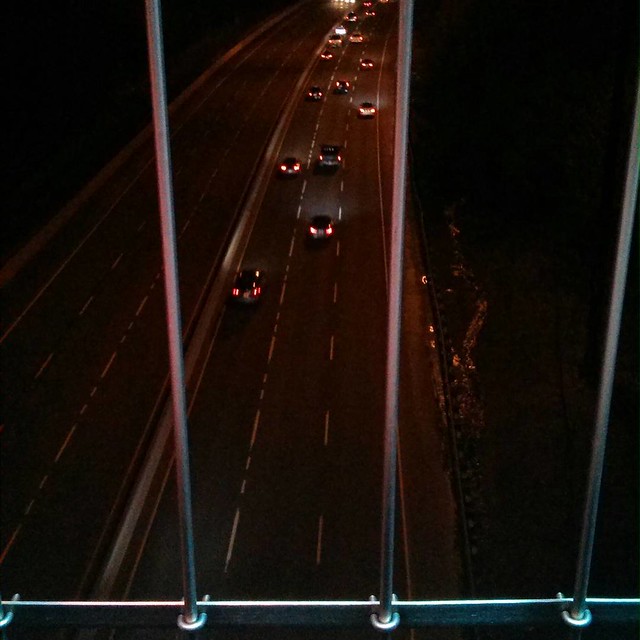
DVP traffic, heading north #toronto #princeedeardviaduct #luminousveil #donvalley #dvp #donvalleyparkway


Colour shift #toronto #princeedeardviaduct #luminousveil


Skeins of highways #toronto #princeedeardviaduct #luminousveil #donvalley #donvalleyparkway


DVP and the East beyond #toronto #princeedeardviaduct #luminousveil #donvalley #donvalleyparkway #broadviewavenue #playterestates


Coming from the east #toronto #princeedeardviaduct #luminousveil #bloorstreet #bloorstreeteast #danforthavenue #danforth
rfmcdonald: (Default)

  • blogTO notes five unusual and little-known buildings in Toronto, from supercomputer complexes to hydro houses.

  • Dangerous Minds celebrates the electronic duo Suicide.

  • The Dragon's Gaze notes the reprint of a study refining the basic characteristics of Alpha Centauri.

  • The Dragon's Tales notes one paper that seeks to use microwave emissions to detect volcanism on Titan and Venus.

  • Lawyers, Guns and Money makes the case for the second-person plural "y'all".

  • The Power and the Money's Noel Maurer speculates that anti-immigration sentiments could be bigger in the United States if Mexicans were, like Russians, whites who could readily assimilate.

  • Transit Toronto notes that, as annoying as periodic shutdowns are, they are much better for everyone than the mass collapses occurring elsewhere.

rfmcdonald: (Default)
At Lawyers, Guns and Money, Steven Attewell describes how Magneto was rehabilitated by Chris Claremont into a compelling anti-hero, from Silver Age stock villain into compelling Miltonian anti-hero.

Silver Age Magneto was a very different kind of antagonist than the ones that fans of the X-Men are familiar with today, due to changes put in place by Chris Claremont. It’s surprisingly how quickly this happened; only eleven issues into his run, Claremont had begun a conscious and sustained effort to transform the character. (Then again, that was very much his style, with Jean Grey dying and coming back as Phoenix all happened within the first eight issues of his run.)

So how did Claremont turn Magneto from a Silver Age Snidely Whiplash into this?

First and foremost, Claremont invested Magneto with a sense of personal presence and dignity that made him a villain to be respected rather than despised. Rather than a cringing coward who ran at the first sign of danger and who primarily relied on his bullied subordinates to fight the X-Men, Magneto was re-imagined as a fearless antagonist who would fight the whole team by himself[.]

[. . .]

Secondly, he emphasized Magneto’s willpower as a core part of his personality. Whereas previously Magneto’s ability to fight off Xavier’s telepathy was explained by Stan Lee’s lack of understanding of magnetism, now Magneto was simply so strong-willed that he could go up against the strongest telepath on Earth and hold his own[.]

[. . .]

Thirdly, and this turned out to be the most fruitful change, is to give Magneto emotional depth. Whereas Silver Age Magneto wanted only to be feared rather than loved, Claremont’s Magneto had a tragic backstory (at this point, confined to a lost love) that showed he had a softer, one might even say, human, side:

What all of these categories have in common is that they’re ideal for a Villain Protagonist, a character who could share a stage with Professor Xavier in political debates, who could challenge the X-Men not only in combat but also to reconsider their previously held notions, and who could change in interesting ways throughout the course of Claremont’s run.
rfmcdonald: (Default)
D-Brief's Nathaniel Scharping blogs about a new computer algorithm that can detect drunken tweeters.

Drunk tweets, long considered an unfortunate, yet ubiquitous, byproduct of the social media age, have finally been put to good use.

With the help of a machine-learning algorithm, researchers from the University of Rochester cross-referenced tweets mentioning alcohol consumption with geo-tagging information to broadly analyze human drinking behavior. They were able to estimate where and when people imbibed, and, to a limited extent, how they behaved under the influence. The experiment is more than a social critique — the algorithm helps researchers spot drinking patterns that could inform public health decisions, and could be applied to a range of other human behaviors.

To begin with, the researchers sorted through a selection of tweets from both New York City and rural New York with the help of Amazon’s Mechanical Turk. Users identified tweets related to drinking and picked out keywords, such as “drunk,” “vodka” and “get wasted,” to train an algorithm.

They put each relevant tweet through a series of increasingly stringent questions to home in on tweets that not only referenced the author drinking, but indicated that they were doing so while sending the tweet. That way, they could determine whether a person was actually tweeting and drinking, or just sending tweets about drinking. Once they had built up a dependable database of keywords, they were able to fine-tune their algorithm so it could recognize words and locations that likely proved people were drinking.

To get tweeters’ locations, they used only tweets that had been geo-tagged with Twitter’s “check-in” feature. They then approximated users’ home locations by checking where they were when they sent tweets in the evenings, in addition to tweets containing words like “home” or “bed.” This let them know whether users’ preferred to drink at home or out at bars or restaurants.
rfmcdonald: (Default)
Discover's Neuroskeptic blogs about a team of psychologists who are starting to publish papers showing negative findings, to help overcome publication bias.

The ‘file drawer problem’ refers to the fact that in science, many results remain unpublished – especially negative ones. This is a problem because it produces publication bias.

Now, a group of Belgian psychology researchers have decided to make a stand. In a bold move against publication bias, they’ve thrown open their own file drawer. In the new paper, Anthony Lane and colleagues from the Université catholique de Louvain say that they’ve realized that over the years, “our publication portfolio has become less and less representative of our actual findings”. Therefore, they “decided to get these [unpublished] studies out of our drawer and encourage other laboratories to do the same.”

Lane et al.’s research focus is oxytocin, the much-discussed “love hormone”. Their lab has published a number of papers reporting that an intranasal spray of oxytocin alters human behaviour. But they now reveal that they also tried to publish numerous negative findings, yet these null results remain in the file drawer because they weren’t accepted for publication.

Is there a file drawer problem in intranasal oxytocin research? If this is the case, it may also be the case in our laboratory. This paper aims to answer that question, document the extent of the problem, and discuss its implications for intranasal oxytocin research. We present eight studies (including 13 dependent variables overall, assessed through 25 different paradigms) that were performed in our lab from 2009 until 2014 on a total of 453 subjects…

As we will demonstrate below, the results were too often not those expected. Only four studies (most often a part of them) of the eight were submitted for publication, yielding five articles (2, 8, 27, 34, 35). Of these five articles, only one (27) reports a null-finding. We submitted several studies yielding null-findings to different journals (from general interest in psychology to specialized in biological psychology and in psychoenodcrinology) but they were rejected time and time again.
rfmcdonald: (Default)
The Dragon's Tales linked to Atif Kukaswadia's Phys.org blog post introducing readers to the idea of a basic income, or a guaranteed minimum income.

I imagine most of my readers have never heard of Dauphin, Manitoba. A small, farming community in Canada, Dauphin is a town that was part of an experiment back in the 1970s. The "mincome" project was launched in 1974, and offered everyone a minimum income. Unfortunately, the project was shut down in 1979 with a change in the government, and so the effects weren't long term enough. The purpose of the mincome project was to see what would happen if a "top up" was offered to everyone. Dr. Evelyn Forget has been studying records from those years, and following up on people to see how it impacted their life. Would people stop working? Would there be higher rates of employment? How would people respond?

But lets start from the top. What is a minimum income? Currently, there are two main models for a minimum income – the universal basic income (UBI), and the negative income tax (NIT). They're similar, but also slightly different in how they're implemented. A negative income tax basically gives you money to top you up to a certain among, after which point you start getting taxed. However, this has problems, such as how often would your income be evaluated? If it was only annually, then someone could be unemployed for a year or more before they receive their minimum income payments. More frequently would be better, but would also be more challenging to implement. The other alternative is a universal basic income, which gives every adult a monthly cheque regardless of income. At the end of the year, this would be included in taxable income. This is also problematic: primarily because of the high costs up front, plus the optics of giving everyone a cheque, including those who do not need it (Huffington Post).

One of the first questions people have when I mention a minimum income is what's to stop people from working. Well, the current model of welfare doesn't incentivize work – once you earn over a certain threshold, you are no longer eligible. So there's a hard cut off before which point there's no reason to work. Under a minimum income model, you are not penalized for working more, and instead the supplement is taxed at a certain rate (often suggested to be 50% for every dollar you earn), up until a certain amount. So there's always an incentive to work[.]
rfmcdonald: (Default)
Nova Scotia's Big Tancook Island has gotten a fair amount of media coverage after the successful effort to save its one-room schoolhouse. The Toronto Star's Jim Coyle wrote about this in "One-room Nova Scotia schoolhouse gets top grades".

Probably no one was happier than Hillary Dionne to see the one-room schoolhouse on Big Tancook Island, N.S., escape closure. For her, that little school is a whole lot more than the sum of its enrolment.

“It’s a huge part of our community,” she told the Star this week. “If we lost the school, that potentially would stop the growth of the island, because no young families would consider moving here without a school.”

Big Tancook is an idyllic 225-hectare patch of terra firma 10 kilometres off Chester, N.S., in the mouth of Mahone Bay. Its population is just over 100. And for the coming school year, Big Tancook Island Elementary School, built about 1950 and among the last one-room schoolhouses in Canada, has all of two students registered for enrolment.

Island residents were on tenterhooks this month after a review by the South Shore Regional School Board and a vote on whether to close the school and have local kids ferry to the mainland for classes.

To the relief of Dionne and her neighbours, the school survived to teach again.
rfmcdonald: (Default)
The National Post shared Aly Thomson's Canadian Press article reporting on an interesting archeological study of Sable Island, a now-deserted island with a long human history waiting to be recovered.

In the wind-blown sands of a narrow, crescent-shaped island off the coast of Nova Scotia, a Coke bottle from 1962 was found resting next a prescription bottle from 1861.

The juxtaposition is telling of Sable Island’s unique and challenging characteristics, said Parks Canada archeologist Charles Burke.

Burke said wind erosion has entombed many artifacts and structures on the sandy island — a National Park Reserve — and has scoured clean thousands of others, leaving them in plain sight.

“Usually an archeologist has to dig to get information. In this case, there’s no digging required. All the artifacts are scattered on the surface,” said Burke. “It was completely unlike anything I’ve done in 40 years of archeology.”

Burke conducted the island’s first-ever systematic archeological survey in August 2015 and will share his findings on Tuesday during a lecture for the Nova Scotia Archeological Society.
rfmcdonald: (Default)
The Irish Times features an article by one Sinéad Ní Mheallaigh reporting on her efforts to revive the Irish language in Newfoundland, the region in North America that has a very strong Irish linguistic heritage.

Tears prick my eyes as I watch the opening scenes of TG4’s ‘1916 :Seachtar na Cásca’ with my students in Canada. I realise that these brave men who organised the Rising and fought for their country had not been just fighting for the freedom of Ireland, but for the freedom of our culture. Without them, and the formation of a Republic of Ireland, I would not be living in Newfoundland right now, teaching the Irish language to students in Memorial University, St John’s.

The Ireland-Canada University Foundation funds six teachers to go to Canada and teach Irish each year, and I was lucky to secure one of these places for this academic year.

On arriving, I found a land that has many links to Ireland. Named “Talamh an Éisc”’, or the land of the fish, by the many fisherman emigrants who graced these shores in the 18th century, Newfoundland is the only place outside of Ireland that has an indigenous Irish language name.

Many people here refer to Ireland as “the Old Country” or “back home”, despite never having set foot on Irish soil in many instances. When I first arrived I almost felt guilty because of the high pedestal on which Newfoundlanders place Ireland. By comparison, how many Irish people could give you information about Newfoundland, or even point it out on a map?

When the Irish came here 200 years ago, it was quite an isolated place. They were far away from mainland Canada, far from America, and as a result, Irish traditions remained true and strong here within isolated communities. Even elements of the accent remains profoundly Irish to this day, passed down from generation to generation.

There is a strong interest in the Irish language. Irish descendent and farmer Aloy O’Brien, who died in 2008 at the age of 93, taught himself Irish using the Búntús Cainte books and with help from his Irish-speaking grandmother. Aloy taught Irish in Memorial University for a number of years, and a group of his students still come together on Monday nights. One of his first students, Carla Furlong, invites the others to her house to speak Irish together as the “Aloy O’Brien Conradh na Gaeilge”’ group.
rfmcdonald: (Default)
  • Amy Grief noted that an east-end Toronto home, in Riverdale, was listed for sale at $C 1.


  • Located at 450 Pape Ave., this 25,000 square foot heritage property is in desperate need of a facelift - even in the listing photos, some of its walls are in pretty bad shape. According to Metro News, the current owners had plans to turn it into a 28-unit condominium, but are now looking to sell.

    Originally owned by William Harris, the property changed hands in the 1930s when the Salvation Army took it over and transformed it into a centre for single mothers.

    Back in 2010, the City of Toronto wanted to turn the 25,000 square foot property into affordable housing units for artists. This plan, however, never materialized.


  • Alana Charles profiled a sumptuous home in Wychwood Park, with photos, priced at just under $C 9 million.

  • Again with photos, Derek Flack noted how an old warehouse at Bathurst and Lake Shore is getting "upcycled".


  • One of Toronto's most interesting development projects is currently underway at Bathurst and Lake Shore as the former Loblaw Groceterias warehouse has been almost completely reduced to rubble to pave the way for a new grocery store and condo complex.

    To drive by heading south on Bathurst, it looks like many other projects of this type where an old building gives way to something new, but when you take a look at the south facade, you notice restoration work has been done on some sections of the old warehouse brick. It's kind of piecemeal, but it hints at the next stages of this massive project.

    It's surely an example of facadism, but the plan here is to tear down the existing building before reassembling the south and west faces of the structure brick by brick. An addition will then be placed on top and condos will rise above the north side of the former warehouse.


  • Finally, Derek Flack lists five up-and-coming neighbourhodos for artists: the Junction Triangle, Brockton Village, Regent Park, Carleton Village/Pelham Park, and my own Dovercourt Village.
  • Page generated Mar. 25th, 2026 04:43 am
    Powered by Dreamwidth Studios