![[personal profile]](https://www.dreamwidth.org/img/silk/identity/user.png)
Jul. 16th, 2016


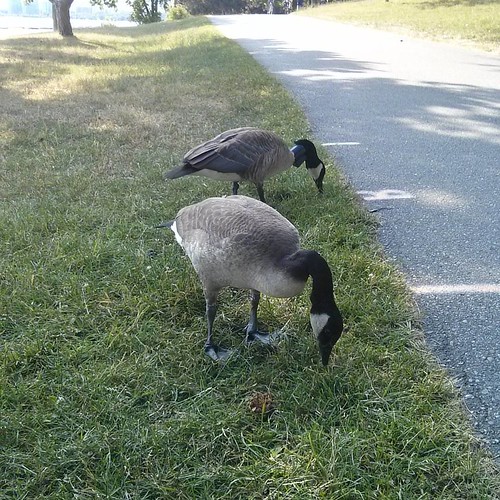
On Monday, I passed by a small flock of a dozen Canada geese feeding on the grass by the Lake Ontario shoreline in Marilyn Bell Park. These archosaurs were not afraid of people, even the ones that had been banded. Handsome and strong animals, I could tell that they and their kin were residents here: The grass had been very carefully nibbled.




[BLOG] Some Saturday links
Jul. 16th, 2016 06:35 pm- The Big Picture shares photos from the Nice terror attack.
- blogTO notes that it might soon be illegal to talk and text in Toronto.
- City of Brass' Aziz Poonawalla responds to Gingrich's call for a deportation of sharia-believing Muslims.
- Crooked Timber considers the prospects for the United Kingdom.
- Language Hat looks at the problems involved with translating Chinese poetry.
- The LRB Blog looks at third-wave jihadism.
- The Map Room Blog examines the most popular walking routes in the United Kingdom.
- Towleroad notes that Trump's vice-presidential candidate Mike Pence wanted to divert funding for HIV/AIDS towards gay conversion therapy.
- Window on Eurasia notes that the dying-off of the old generation of people in the former Soviet Union will not necessarily leave younger pro-market ones.
The Toronto Star's Jackie Hong investigates the temperature on subway cars in summer. Suffice it to say that I will be glad to be on Prince Edward Island, where temperatures will be a few degrees cooler than in southern Ontario.
Commuters are facing sweltering rides as the transit agency works to replace old, worn-out air-conditioners.
But how hot is it exactly?
Using a thermometer, the Star measured temperatures of up to 32.5 C on a Line 2 train car as it travelled between Sherbourne and Dundas West Stations Wednesday – 3.5 C hotter than the temperature at both platforms and 1.5 C higher than the temperature outdoors during the same time frame.
Another car on a different train travelling from Broadview to Donlands hit 29.5 C. An air-conditioned car in the same train was 25 C.
And as Torontonians braved a record-breaking high of 35C outside Wednesday, a Star reporter went underground, riding several Line 2 trains Wednesday afternoon, starting at Yonge Station.
Edward Keenan writes at the Toronto Star about the continued struggles for mass transit in Toronto.
Deep breaths, everyone.
What happened at city council on Wednesday? Among those who, like me, supported an LRT option to replace the Scarborough subway, there is a sense that the biggest news was of a huge mistake — the decision to build a one-stop extension of the Bloor-Danforth subway line to the Scarborough Town Centre. But it was a decision made by a solid majority of city councillors, who have had years to study and debate and consider the issue. There’s no reason to think they would make a different decision with a bit more time, a bit more arm twisting, a bit more information. They are the elected government of this city, and they reaffirmed a big decision I disagree with. It was not the first time this has happened, it won’t be the last time. Democracy: whattaya gonna do?
At the very least, it puts the matter to rest, or should. Some closure. An opportunity to marshal resolve and resources for other work that lies ahead. And there is always work that lies ahead. Much of it on the transit file. More work now than before, actually.
What else happened at city council on Wednesday? Well, city councillors approved a 15-year transit plan that is, on balance, a very good plan. There is much to be happy about here. For example: city council voted unanimously to move forward with detailed design on a 17-stop LRT line on Eglinton East from Kennedy to the U of T Scarborough campus. City council voted overwhelmingly to move forward with more detailed design of an LRT line on Eglinton West to the airport. City council voted overwhelmingly to support SmartTrack alterations to the provincial express rail plan. City council voted overwhelmingly to move forward with developing work on the relief line that will run on Queen and Pape, and eventually up through Don Mills and perhaps to Sheppard — long listed as the TTC’s top building priority and just as long overlooked. Council voted to complete all this work to have all these lines in operation by 2031.
At Torontoist, Jean Boampong describes a conversation that I am glad is occurring in Toronto.
Living in Toronto means hearing the word “multiculturalism” a lot in the context of progress. It is often touted as the most diverse, most friendly, and most livable city in the world. In 2017, Toronto will be made up of at least 50 per cent “visible minorities.” “Diversity is our strength,” reads Toronto’s Coat of Arms. Cultural events and months—such as Caribana and Asian Heritage Month—feature boutiques of colourful ethnic food and music that media outlets capture year round in coverage and advertisements.
But through this appearance of harmony lies barriers, hardships, and the disappearance of people of colour—especially Black Canadians.
Growing up as a first-generation Black Canadian girl, I didn’t have a lot of spaces that told me I belonged. In elementary school, my white teacher told me that Ghana, my family’s country of origin, didn’t exist. In junior high, I was reminded that my Blackness is seen as a threat when an employee at a gas station (who was Brown) accused me of stealing because I bent down to grab a granola bar to pay for. In high school, I didn’t learn about indigenous Black Canadians and their 300-year history in Canada. Instead, I was told that we didn’t exist until the 80s wave of African and Caribbean immigrants entering Canada.
By “we,” I mean all of us: all Black people. We are not, never have, and never will be a monolith that is easily digestible and consumable for everyone else. We are queer, disabled, African, Caribbean, Asian, European, trans, Muslim, women, and many more identities all at once. Existing in multiple intersections means that our experiences are layered and complex. But somehow, Black Canadians are often told to leave parts of us behind at the door.
This was my experience while attending university. When I wanted to enter progressive spaces to grow my understanding of social justice, I was expected not to make anything “about race.” When I hosted an event about food justice, I was told that if I kept talking about race, nothing would get done. In Black student spaces, gender was considered a distraction. In feminist spaces, race was considered a distraction. While I studied Criminal Justice at Ryerson University, I deliberately skipped classes about race and the criminal justice system because I knew I would be erased. For four years, I was repeatedly given an ultimatum: either advocate for issues about my race and lose, or advocate for issues about my gender and lose.
Daily Xtra's Rob Salerno describes the Canadian-Bermudian couple who want to liberalize marriage law in Bermuda.
Winston Godwin and Greg DeRoche just want to get married. Godwin’s homeland of Bermuda doesn’t recognize same-sex relationships, however, so the couple is taking the government to court from 1,800 km away in their current home, Toronto.
Godwin and DeRoche, who live together and have been dating for a year and a half, decided to get married while skipping rocks together on the beach in Bermuda on June 22, the night before the British territory held a referendum on same-sex marriage or civil unions. By a two-to-one margin, the country rejected both in the non-binding vote.
At the time, LGBT activists pledged to continue the fight for marriage rights through the court system. Godwin spotted an ad looking for couples willing to file a test case against the government for same-sex marriage and, after discussing it with DeRoche, agreed to make a very public bid to be the first same-sex couple to wed on Bermuda.
“It’s exciting. There’s a lot of people who’ve contacted me to say they do support me, who say they’re completely for it — people who don’t even know me,” Godwin says.
The couple filed their request to marry on July 4, assisted by their lawyer Mark Pettingill, who is also a member of parliament in Bermuda’s governing party and a former attorney-general. On July 7, the application was rejected on the grounds that the Matrimonial Causes Act only permits marriage between a man and a woman. The next day, the Bermuda House of Assembly passed an amendment protecting the act from challenges under the Human Rights Act, which bans discrimination on the basis of sexual orientation. On July 14, the Senate rejected the bill by a 6-5 vote, but the Senate can only delay legislation for up to a year.
[ISL] "Genealogy is good tourism"
Jul. 16th, 2016 07:28 pmThis article in the regional Island newspaper, the Eastern Graphic, by Allan Rankin, produces a compelling argument. Creating interest in diasporids may be key.
We have the unique ability as Islanders to locate one another geographically by surname and ethnic origin. We know that Le Region Evangeline is where most of our French speaking Acadian brothers and sisters can be found, while Emerald and Morell are old Irish settlements and you are likely to run into fourth generation Scots in places like Belfast and St. Catherines.
Many Island Mi’kmaq families continue to live on Lennox Island.
Genealogy and family history is a passion for many Islanders. My brother began his odyssey to unravel the history of the Rankin side of my own family several years ago, and he and my sister-in-law travelled all over Canada, visiting church cemeteries, public archives, local historical societies and winding through countless reels of microfilm.
The result is an impressive compilation, with photographs and maps, that sits on our living room coffee table for curious visitors to examine.
When I was just out of graduate school and working as Education Officer at the PEI Museum and Heritage Foundation, genealogy seemed like a lesser calling, and some of us were more focused on researching and interpreting the larger themes of Island history than compiling genealogical information on index cards.
But our fearless leader and heritage matriarch, to her great credit, realized the importance of family history and Beaconsfield in Charlottetown became a centre for genealogy under the brilliant guidance of Janet Dale and followed by the indefatigable Orlo Jones.
CBC News' Benjamin Shingler looks at new environmental threats to Québec's Anticosti Island.
Plans to drill for oil and gas on an island in the Gulf of St. Lawrence has made Premier Philippe Couillard the target of environmentalists, with one group calling his decision to go ahead with the project "illogical and unacceptable."
Couillard has repeatedly said he's bound by an agreement signed by the previous Parti Québécois government to allow for testing in Anticosti, a rocky, 200-kilometre stretch of land known for its salmon fishing.
The deal with Quebec City-based Petrolia Inc. was inked shortly before the 2014 election.
The exploratory drilling involves fracking, a controversial practice where a mixture is pumped deep underground in order to crack rocks and release natural gas, which risks affecting the water table.
In a statement, Petrolia said Wednesday it's committed to working with Anticosti residents and being completely transparent about its plans.
The province's Environment Ministry confirmed this week that Petrolia will be allowed to draw a total of 30 million litres of water at three testing sites.
Most of that water will be drawn from rivers on the island, which could put local endangered salmon populations at risk, Montreal's Le Devoir newspaper reported.
MacLean's Adrian Lee writes about mythic Bobcaygeon.
It’s a bright, sunny June day in Bobcaygeon, Ont.—one of the first beautiful weekends in what this area calls “the season,” as if there is only one, the one that brings the tourists and the cottagers. But the day’s charms are dimmed somewhat for Kathleen Seymour-Fagan, whose attention is focused on a different light, one that has lingered at red for too long, allowing cars to inch over a bridge in fits and starts.
“They really need to fix the traffic lights,” she says, squinting as a line of cars waits to cross the bridge, one of two entryways into town. The Bobcaygeon councillor for the City of Kawartha Lakes—the town was amalgamated in 2001, hoovering up six villages and the town of Lindsay—has other things on her mind, too: there are provincially mandated growth rates to meet, costs to maintain. Even the limestone upon which the town is built is causing trouble, creating potholes and sinkholes.
If this all seems like any other small town—well, it is. But it also isn’t, because this is Bobcaygeon: a town woven into the fabric of the Canadian imagination by the Tragically Hip. It was in “Bobcaygeon” that a little town a two-hour drive from Toronto at the mouth of a mighty lock system that spiders between two Great Lakes became the idealization of a small-town getaway, and a kind of CanRock Valhalla. It was in “Bobcaygeon” where the Hip arguably reached the peak of their powers—and, as the band embarks on one final tour later this month, in the wake of frontman Gord Downie’s diagnosis of terminal brain cancer, it is a town pausing to consider what it all means.
“I’ll be driving in, and it’ll be a beautiful night, and that song comes on,” says Seymour-Fagan. “And it’s like . . . yeah.” She lets out a wistful sigh.