Aug. 3rd, 2016

rfmcdonald: (photo)
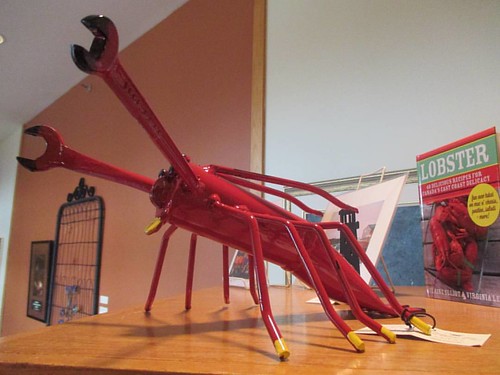
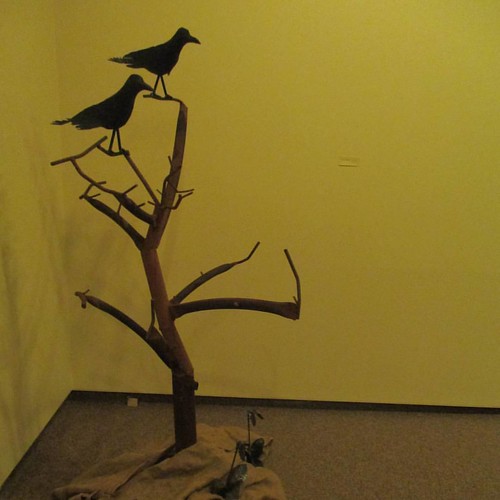
On the Saturday before last, one of my two Island Caturday posts featured the work of Eric Schurman. As described in Summerside's Journal-Pioneer, that city's Eptek Centre is hosting an exhibit of the welded sculptures of local metalworker Eric Schurman, of Malpeque Fine Iron.

Schurman's work appeals to me for its ingenuity and its whimsy, its ability to use the curves and straight lines of pieces of metal and some paint to evoke entire creatures..

Lobster #pei #summerside #eptekcentre #ericschurman #welding #sculpture #latergram #lobster


Seahorse #pei #summerside #eptekcentre #ericschurman #welding #sculpture #latergram #seahorse


Crows perched #pei #summerside #eptekcentre #ericschurman #welding #sculpture #latergram #crows #birds


Insect #pei #summerside #eptekcentre #ericschurman #welding #sculpture #latergram #insect


Crocodile under the palm #pei #summerside #eptekcentre #ericschurman #welding #sculpture #latergram


Shadowcat #pei #summerside #eptekcentre #cats #heavymetal #ericschurman #catsofinstagram #caturday


Welded cat #pei #summerside #eptekcentre #cats #heavymetal #ericschurman #catsofinstagram #caturday
rfmcdonald: (Default)

  • Dead Things looks at the health issues of a hadrosaur.

  • The Dragon's Gaze notes close binary systems may not support planets very well.

  • Joe. My. God. notes Trump's reaction to Obama's statement that he was unfit.

  • The Map Room Blog notes Russia's issues with Google over the non-recognition of Crimea's annexation.

  • Marginal Revolution notes that driverless taxis are coming to Singapore.

  • The Power and the Money's Noel Maurer disproves arguments claiming that Pennsylvania is uniquely suited for Trump.

  • Peter Rukavina shares his schedule for the Island Fringe.

  • Spacing Toronto notes the problem of distracted cycling.

  • Window on Eurasia looks at language death in the North Caucasus.

rfmcdonald: (Default)
The Toronto Star's Robin Levinson King reports on the withdrawal of Toronto NDP MP Cheri DiNovo from the leadership contest for the NDP. That DiNovo's candidacy was informal, and that she was the only one running, says worrisome things.

Cheri DiNovo is dropping out of the NDP leadership race because of problems with her health.

The local MPP for Parkdale-High Park had thrown her hat in the ring to lead the federal NDP last June, positioning herself as the candidate most able to return to the party to its socialist roots.

But after suffering two mini strokes, known as transient ischemic attack, DiNovo says she must focus all her attention on getting better.

“My staff and family have been amazing through this experience and it is in consultation with them – to whom I owe so much – that I have to announce I’m withdrawing from the leadership race. For at least the next month or so my focus will be on my health, so that I’ll be able to return to Queen’s Park in the fall,” she wrote on Facebook.

DiNovo raised eyebrows in June when she announced her bid to replace Tom Mulcair because she didn’t have the $30,000 deposit required of federal NDP leadership candidates.
rfmcdonald: (Default)
Torontoist shares</> an excerpt from the new anthology, Queers Were Here: Heroes and Icons of Queer Canada, taken from Kaeleen Pendleton-Jiménez's "Downtown" about the life of Tim McCaskell. This is compelling.

1974

He sits in the middle of the running track at Riverdale Park, reading a small magazine. He is 23 years old. If anyone comes toward him, he will be able to see the person a quarter mile away. That will be enough time to jump up, stuff the magazine into his bag, and head off. He looks at the pages, but maintains his peripheral vision. The breeze blows on the cool, spring afternoon, the grass slightly damp underneath his jeans. He can’t be seen with this magazine.

It is a magazine about gay liberation. About homosexuals. Nobody has spoken to him about homosexuals. Not his mother or father. Not his church. Not his school. Only briefly and vaguely did it arise on his wanderings across Europe and Asia, in a glance from another man at the hostel; he looked away. There was also the invitation to join another man’s shower, and that could really only mean one thing, but he wasn’t ready. He was desperate to touch another man, but that doesn’t mean he could do it. The only homosexuals he’d known for sure were the ones from TV. During his last year of high school, backlit shadowy figures appeared on screen when [former prime minister Pierre Elliott] Trudeau decriminalized homosexuality. It wasn’t a crime anymore, but that doesn’t mean it could be fully seen, fully visible to upstanding members of the community. It doesn’t mean he could be seen with this magazine. He looks up again but nobody is coming.

It wasn’t so easy to get his hands on the magazine. He had to find a store that carried it. He had to find a way to buy it without drawing too much attention. Just because you have the money to pay for it, and just because they’re selling it, doesn’t mean you’re not still doing something wrong. Something illicit. But one can be clever about such transactions. There are Popular Mechanics and Maclean’s to shield his small gay magazine. The magazine itself can hide for almost the whole time. It emerges just for a moment, for a glimpse at the price by the cashier before it is deposited into a bag. And if he waits until there are no other customers nearby, then only the cashier would know. And the cashier might not know for sure that The Body Politic is a gay magazine, or if he does, he might forget it, or feel confused by the Popular Mechanics. Homosexuals wouldn’t buy Popular Mechanics.

He flips through his magazine. There is an ad for a march. A Gay Pride March. He could do a march. He couldn’t do a bar or a bathhouse. He grew up in a dry town, without bars of any kind, and he’s not sure what a bathhouse is. He couldn’t be that kind of gay man. Those places are too terrifying. But he could be a gay man in a protest. He knew how to pick up a sign, yell slogans, and march with a group of people down the street. He had been a part of many marches and protests. He is an activist. He is a Marxist. Marching is possible.
rfmcdonald: (Default)
Kieran Delamont's Spacing Toronto essay on Camp Wavelength sells me on the festival.

At last year’s Camp Wavelength festival, the enchantment of Friday night still buzzing, Jonathan Bunce (“Jonny,” he insists upon) and his Wavelength organizing partners stood on the beach on Toronto Island. A white dingy, captained by a man in a Super Dave Osborne-esque, all-white jumpsuit came slowly towards the shore. With one foot up on the hull of the boat, à la Washington Crossing the Delaware, ‘Dingyman’ (as they now call him) beached his small boat in front of the festival’s organizers.

“He was like, ‘hey, what’s up guys? Is Kyle here?!’” says Bunce. Before he or Aaron Dawson could answer, Dingyman piped in: “He was like, ‘Hey, hang on — you guys want a beer?’ and he started passing out cans of beer to anyone who was there,” he says. “He figured out Kyle wasn’t there, but he hung out for ten minutes and had a beer with us.” And then, continuing his bacchanalian pursuit of whatever party Kyle was at, he disappeared into the night, heading (puzzlingly) directly away from the beach, rather than along it. “The next morning, the three or four of us who were there had to corroborate to make sure we weren’t hallucinating.”

These moments, bizarre as they are summer-defining, can be hard to come by in the 416; they require a state of unwind that, more often than not, is inverse to one’s proximity to the city. That they are rare makes them that much more valuable. “For me being a city boy,” says Bunce, “I haven’t had a lot of those kinds of experiences.”

Camp Wavelength is a music festival that wants to be unlike any other festival, committed to bring those hazy, summer moments within reach of even the most committed urbanites. As the only camping-and-music festival in Toronto, the experience it aims to create differs sharply from the big, commercial festival experiences that, over the last decade and a half, has exploded in popularity in Toronto and across North America. That’s by design: “Camp Wavelength is an alternative to the typical summer festival,” says Bunce, “where the local band is playing at one in the afternoon and a beer is $11.” This year’s festival will be the second time it has been held, and organizers are hoping they can repeat and build upon last year’s successes. With 25 bands and 16 visual art and mixed-media performances, and a goal of 1,000 attendees, the festival is notably smaller than other big name events. (Wayhome, for example, had an attendance of around 40,000.) It’s small size, though, should not be a measure of its success — small and tight-knit is just the way Wavelength likes to do things. “It lets us be nimble,” says Bunce.

Held between August 19th and 21st, the festival is designed to showcase and promote the diverse range of art and music that Toronto has to offer. “We’re not just booking a lot of sound-alike indie bands,” says Bunce, who excitedly describes the range of genres — the festival offers a mix of indie, hip-hop, free jazz, rock, world music, etc. — showcased by the festival. “Other people [referring to festival organizers] feel like they can’t take the risk of mixing audiences […] A mandate for diversity means you need to live up to it.”
rfmcdonald: (Default)
The Globe and Mail's Marcus Gee writes in favour of allowing the unclothed to use Hanlan's Point nude beach. I support this, but I wish something could be done about the gawkers.

Big cities survive through small compromises. When people of different backgrounds, needs and habits are thrown together in a common space, it takes lots of give and take.

The “clothing optional” beach on Toronto Islands is a nice example of urban compromise in the flesh. Bathers can go naked without committing some kind of infraction. Those who prefer to keep their bathing suits on can use the beach, too. It’s a civilized compact that has held since 2002 when city council approved the mixed system for Hanlan’s Point.

But now there’s trouble on the beach. Some beach regulars say it is being taken over by gawkers and other clothed intruders, spoiling the experience. A homemade sign that went up warned: “Beyond this point you should be nude.” A woman who visited the beach with her male friend said a couple of men approached and encouraged them to disrobe before continuing.

That violated the spirit of this special place. The nudists don’t own the beach. It’s a public space and visitors should have the right to wear what they want. “It’s about freedom of choice,” said Lisa Rutherford, 47, a reinsurance broker who was visiting Hanlan’s on Thursday to sunbathe topless but opts not to disrobe further.

On a hot and sunny afternoon, the live-and-let-live approach seemed to be working. A group of men in bathing suits and sunglasses soaked up the sun. A naked woman helped a man in a bathing suit launch an inflatable raft. Older men with deep all-over sun tans walked back and forth along the water’s edge. A family – the woman naked, the man wearing his bathing suit, their young boys taking their suits on and off as they pleased – sprawled on beach towels as their small dog yapped and ran in circles.
rfmcdonald: (Default)
If Noah Smith's account in Bloomberg View is correct--if--then San Francisco and the whole Bay area will face an unsolvable problem.

San Francisco provides a cautionary tale. In the last decade, the city has been flooded with technology workers, pushing rents into the stratosphere -- a one-bedroom apartment costs around $3,500 a month to rent. Rent control is in effect, but that has just increased the incentive for evictions. Despite efforts by anti-eviction activists, the sheer size and persistence of the economic incentives involved are impossible to resist for long.

Unlike progressives in New York City, who are often big supporters of density, San Francisco progressives have decided to focus on kicking the tech industry out of the city. Booting tech back to wherever it came from seems like a natural way of restoring the old equilibrium. Sadly, efforts to push tech employees out will fail, and will end up hurting the city's low-income residents even more.

For example, activists have proposed levying a 1.5 percent payroll tax on tech companies only. The initiative will probably not become law, but it clearly indicates that tech-bashing is the order of the day.

They’ve also tried to raise tech workers’ transportation costs. The city recently reduced the number of places where private tech company buses are allowed to stop, and is considering forcing all tech buses to stop only at a few “hub” locations.

But the most powerful weapon for bashing the tech industry is also the most destructive -- a general restriction on the supply of housing itself. Progressives on the city’s Board of Supervisors recently called for certain height limit restrictions to be lifted only for developments that include 100 percent below-market-rate housing (the current policy sets the number at 30 percent). Obviously, developing housing at entirely below-market rates is impossible without heavy government subsidies, so this proposal would effectively stop all new construction in many areas of the city. The progressive supervisors also want San Francisco to be exempt from a possible new statewide policy to expedite regulatory approval for new housing development. This is essentially a scorched-earth policy -- raise rents enough to drive tech out of the city, then lower them again once the industry gives up.

The problem is that other cities in the Bay Area will simply respond in kind. If transportation hassle and high rents start pushing high-earning workers to the South Bay or to Oakland, those cities will likely restrict their own housing development. In fact, South Bay suburban towns have done this for a long time, which is one reason tech workers moved to San Francisco in the first place. Oakland shows some signs of following suit.
rfmcdonald: (Default)
Megan Greenwell's article in Wired makes perfect sense to me. If the Olympics are too much for any one city to handle, why force it to do this?

[O]nly two cities have ever made hosting the Olympics work for them: Los Angeles and Barcelona, both of which mostly used existing venues instead of building new ones. And that, most sports economists agree, is the key to success.

Consider Beijing. The Bird's Nest, the Ai Weiwei-designed stadium that hosted the opening ceremony and the track and field events, costs $11 million a year in upkeep. The Water Cube, where swimmer Michael Phelps broke seven world records, now houses a water park but still requires $1.5 million in annual subsidies. Overall, the 2008 games cost China about $40 billion and are thought to have brought in a mere $170 million. Or look at Athens. Greece was in economic trouble before the 2004 games, and spending almost $11 billion on stadiums and facilities helped push it into full-on crisis.

As a fix, Zimbalist and other observers have suggested that the same city host the games every four years. But this plan has faults: Limiting the chance to host to the Londons and the Beijings of the world is anti-Olympic in spirit. Indeed, 30 of the 49 occasions of an event that purports to represent the globe have been held in Europe. Rio will be the first South American host city in the 120-year history of the modern games. Africa has never had an Olympics. Under the permanent-host plan, it never would.


But if we did away with the notion of one host city altogether, it might. Send beach volleyball to Rio permanently, where there are actual beaches. Hold the fencing competition in Italy, where many of its gold medalists are born. Move swimming to Australia, where it's a nationwide obsession. Host soccer in South Africa, where the 2010 World Cup was a moment of national pride. Let each country bear the cost of one set of events at a time instead of dozens.

Despite potential objections that the plan undemocratically violates the spirit of bringing athletes of the world together, it actually promotes a greater sense of equality. A one-sport, one-city policy would mitigate the ongoing wasteful bid process, which takes years and can require $100 million worth of research alone. Indeed, those costs and a dwindling appetite for hosting the games have combined to reduce the number of cities bidding in the first place. The IOC would have to adapt to a new world where it doesn't dole out a crown jewel every four years—but given how few cities actually want this One Ring (or five), the distributed plan might be just the adaptation it needs. Furthermore, permanent homes for events would prevent everyday life in any one city from grinding to a halt during the games, a major factor in Bostonians' outraged response to that city's now-terminated bid.
rfmcdonald: (Default)


Verity Stevenson's Toronto Star article describing how a Peterborough family ran into Justin Trudeau while exploring Québec's Gatineau Park blew up all over my Facebook wall today.

When a Peterborough family set out on a hike inside Quebec’s Gatineau Park, they didn’t expect to see a cave, let alone a shirtless prime minister popping out of one!

“It was like a 20-foot-wide round hole and Justin (Trudeau) emerged with his family in tow and said, ‘This is the moment of truth; do we stop here or do we carry on?’” said Jim Godby, who was on a five-day camping trip at the park last week with his wife, Arlene, and two kids — Alexander, 13, and Charlotte, 10.

They had decided to go on a hike on one of the trails near their campsite Tuesday and happened upon the Lusk Cave, a marble cave thousands of years old in the centre of the park.

As they went to take a peek inside, Godby heard the familiar voice. That’s when Trudeau, Sophie Grégoire Trudeau and two of their children surfaced in what Godby described as a casual chance encounter that humanized the prime minister.

“It was just said with such an enthusiastic, joyful tone that that’s what kind of struck me,” Godby said of Trudeau’s comment, which appeared to be referring to whether the family should continue hiking or not. “He evidently enjoys leading. . . . It seemed pretty characteristic of his personality.”


This is just fun.

Profile

rfmcdonald: (Default)rfmcdonald

February 2021

S M T W T F S
 123456
78910111213
14151617181920
212223242526 27
28      

Style Credit

Expand Cut Tags

No cut tags
Page generated Feb. 13th, 2026 10:50 am
Powered by Dreamwidth Studios