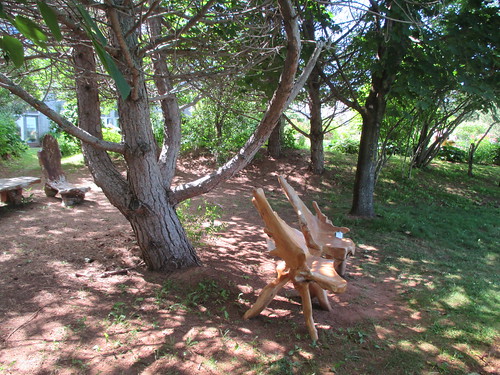
Statuary and sculpture, often of Indonesian or Southeast Asian origins, is everywhere on the grounds.




Residents of Ulukhaktok, N.W.T., population 402, may feel as though New York’s tony Upper East Side has come to visit when Crystal Serenity steams into town later this summer. The towering cruise ship, the biggest to traverse the fabled Northwest Passage, will be carrying 1,070 passengers who paid between $25,000 and $155,000—and 655 crew members—for a 32-day trip that promises “intrepid adventure, the great outdoors and immersive cultural experiences.” Which is where Ulukhaktok comes in. Crystal Serenity is not the first cruise ship to visit the coastal hamlet, mind you, but it’s by far the largest. “There was one back in 2012 called the World,” Janet Kanayok, the local economic development officer, says of the privately owned luxury yacht that carries between 150 and 200 passengers. “But it wasn’t nearly as big as this.”
Nor is Crystal Serenity likely to be the last giant, gilded passenger ship to come calling. Rising temperatures and receding sea ice have opened more of the Northwest Passage’s interconnecting waterways in recent seasons. In 2013, MS Nordic Orion made history by becoming the first bulk carrier to make the historically treacherous trip, hauling a load of B.C. coal to Finland and shaving about 1,000 nautical miles off its usual route through the Panama Canal. The following year, the MV Nunavik, operating on behalf of a Canadian firm, sailed from the Hudson Strait through the passage to China carrying nickel concentrate. In all, there were 25 full transits of the Northwest Passage last season, according to data from Fisheries and Oceans Canada. That’s up nearly 40 per cent from five years earlier.
With the Arctic’s defences melting, Los Angeles-based Crystal Cruises is understandably excited about a huge opportunity to wow well-heeled cruise junkies who’ve grown bored of sand and sun. The company’s inaugural Northwest Passage cruise, from Anchorage, Alaska, to New York, sold out quickly, and tickets for next year’s trip are already on sale.
Travel to Antarctica has reached fever pitch.
You can go by yacht. You can come and go in a single day. You can even book a fly-around for New Year’s Eve. And now you can stay in a five-star hotel with bespoke furnishings and its own fleet of aircraft.
To be fair, the White Desert camp isn’t exactly new. And it’s no secret spot, either; the guest ledger includes such names as Prince Harry and Bear Grylls. But as a means of celebrating its 10th anniversary, the so-called most remote property in the world has gotten a complete luxury overhaul.
What it now humbly calls “sleeping pods” are six heated fiberglass domes, with bamboo headboards, Saarinen chairs, fur throws, and en suite bathrooms stocked with sustainable Lost Explorer-brand toiletries, created by a scion of the de Rothschild family. Wooden skis adorn the walls; thick parkas for each guest hang from free-standing coat racks. And each suite stands alone on a rugged strip of land in the interior of Antarctica, midway between a frozen lake and towering walls of ice. Drama is in no short supply.
Perhaps the most significant renovations have taken place in the lodge’s library lounge and dining room. Whereas the dining room once consisted of one long wooden table, it’s now a more formal affair, with furs thrown over chairs that wouldn’t feel out of place in a Brooklyn Heights apartment. After hangout sessions with 6,000 emperor penguins, this is where guests share convivial, three-course meals comprising ingredients and wines flown in from Cape Town. (They’re prepared by an in-house chef who cooks privately for the British Formula One driver Lewis Hamilton when he’s not at camp.)
A whale watching association says a battle between some of the largest creatures in the seas off the coast of British Columbia appeared to end with the human equivalent of fist waving and name-calling, although they can’t be sure of the outcome.
Several whale-watching boats at the western edge of the Salish Sea, off Jordan River on Vancouver Island, spotted a group of transient orcas surrounding two adult humpback whales and a calf on Sunday.
Mark Malleson, a whale-watching captain and marine researcher, witnessed the fight.
He says in a news release issued by the Pacific Whale Watch Association that encounters between humpbacks and transient orcas, also known as Bigg’s killer whales, rarely result in a kill.
Transient orcas eat marine mammals but Mr. Malleson says it seems as if the species “just likes bugging” the much bigger humpbacks.
While commodities traders still work their way out of a historic slump, Japan is looking ahead to the next boom. According to Bloomberg News, next year a group of Japanese companies and government agencies will start mining minerals at a site 1,000 miles southwest of Tokyo -- and one mile beneath the ocean's surface. It will be the first large-scale test of whether mineral deposits can be mined commercially from the seafloor.
The project is fairly bold. The seafloor is home to priceless deposits of minerals such as gold, copper and cobalt. And thanks to new technologies, it might soon be exploitable. That's potentially good news for miners and commodity speculators. But it poses some alarming challenges for the marine environment -- and the economies that depend on it.
At least as far back as the 1960s, scientists have known that rich deposits of minerals could be found in metallic nodules strewn like stones across the deep seabed. In 1977, researchers discovered hydrothermal vents on the ocean floor, along with some of the richest ore bodies in the world. In both cases, though, slumping commodity prices and high extraction costs doomed exploitation efforts.
China changed everything. As its economy picked up earlier this decade, and demand for commodities surged, the search for alternative sources of raw materials gained steam. Resource-poor Japan resuscitated its interest in seabed mining. China started building its own underwater mining capabilities, including a proposed partnership with India. Between 1984 and 2011, the International Seabed Authority -- which oversees seabed mining under a United Nations convention -- issued just six exploration permits. Since 2011, it's issued 21, covering nearly 400,000 square miles of ocean floor that could one day be mined.
Exploration isn't disruptive to the environment. But seabed mining will be. For one thing, it requires underwater harvesters that will suck up those valuable rocks -- and any organisms or habitats that get in the way. Some will recover, but others never will: Nodules, which support an abundance of organisms, require millions of years to form. Even worse, the harvesters will kick up huge sediment clouds that could spread over vast areas of the seabed, potentially ravaging corals and sponges.
It’s hard to know what to care about. Our terrible world offers plenty of options, and, considered all together, they are overwhelming and exhausting, which is maybe why most of us refuse to pay much attention to anything that isn’t directly in front of our faces getting in the way.
This sad fact of human limitation—our wilful confinement to the immediate and obvious—is bad news for animals, whose main skill sets are sneakiness and hiding (swaggering city raccoons not included). Among the all-time great hiders are the millions of birds that pass through the GTA twice annually, who fly by night to avoid detection.
Toronto lies at the confluence of two major flyways, making it a “bird super-highway,” according to Bridget Stutchbury, author of Silence of the Songbirds. Migrating birds should simply slip past us in the dark. But because they suffer from a condition called “fatal light attraction,” they get stuck on our street lamps and spotlights.
It’s not clear why birds can’t resist light bulbs, but one study suggests that artificial lighting interferes with their internal magnetic compass. So, technically, nocturnal birds aren’t attracted to light, but they reflexively switch to daytime travel mode and then can’t switch back.
The mayor of Victoria wants the B.C. government to give municipalities across the province what Vancouver is getting – the right to tax empty homes – as a way to help ease the housing crunch in their own communities.
Victoria Mayor Lisa Helps said she’s concerned about a scenario in which investors simply buy up properties elsewhere in the province to escape Vancouver’s expected tax on vacant houses.
The B.C. government has announced a special sitting of the legislature next week to give Vancouver the power to tax empty houses, but the change won’t apply to other municipalities.
That disparity “creates an odd, unequal playing field that could exacerbate the problem in other municipalities at the same time as it attempts to solve the problem in Vancouver,” Ms. Helps said in an interview on Thursday after council debated the issue.
“The consequence could be that people stop investing in properties to flip or hold in Vancouver because they know they’re going to get taxed and they just buy properties in Victoria or Burnaby or West [Vancouver] and do the same thing, because that jurisdiction doesn’t have the same taxing powers.”
In the winters of our childhood, and late autumns and early springs as well, every day after school and all through weekends, our little street in Toronto’s east end might as well have been Maple Leaf Gardens or the Montreal Forum.
We were part of the ball-hockey legions who turned the cry “Car!” into as Canadian an icon as the call of a loon. Looking back, how innocent we were of all that we were learning while simply having fun.
What delightful news, then, to learn that Toronto city council decided Friday to alter rules that had threatened road hockey and, in contemporary times, basketball as well.
Play will be allowed on roads with speed limits of 40 km/h or less during daylight hours between 9 a.m. and 8 p.m. Nets will now be allowed on the road as long as they don’t block driveways or impede sightlines for cars and pedestrians. They must be removed when play is done.
None but the dullest of bureaucrats could ever have imagined that all that was going on in those games was play.


![[personal profile]](https://www.dreamwidth.org/img/silk/identity/user.png) branchandrootdancing_serpent
branchandrootdancing_serpent