Oct. 24th, 2016

rfmcdonald: (Default)
The Aga Khan Museum lies just east of the Ismaili Centre, on a non-descript part of Toronto west of the Don Valley Parkway made striking by truly inspired architecture. The simplicity of the lines of the two buildings, and of the park space--including pools--lying between the two, is breathtaking.

Entering #toronto #agakhanmuseum #architecture


Tower behind #toronto #agakhanmuseum #tower #architecture


Pool #toronto #agakhanmuseum #architecture #pool


Looking to the west, 3 #toronto #agakhanmuseum #ismailicentre #evening


Looking back #toronto #agakhanmuseum #trees #architecture


At the Ismaili Centre #toronto #agakhanmuseum #ismailicentre #architecture #evening


Seen from below #toronto #agakhanmuseum #ismailicentre #evening #architecture
rfmcdonald: (Default)

  • Bad Astronomy notes that a NASA probe has photographed the site on Mars where the ESA's Schiaparelli lander crashed.

  • The Broadside Blog's Caitlin Kelly writes about being an immigrant, of sorts, in the United States.

  • C.J. Cherry announces that work on her history of the Alliance-Union universe is continuing.

  • The Dragon's Gaze links to a paper looking at the ionization of protoplanetary disks by cosmic radiations.

  • The Dragon's Tales finds evidence for Planet Nine in the orbits of Kuiper Belt objects and the inner Oort cloud.

  • Far Outliers looks at the culture of addiction in Appalachia.

  • Joe. My. God. notes how a Russian embassy has mocked the European Union for defending GLBT rights.

  • Language Log looks at the sounds made by speakers of English, native and Chinese-language mother tongue both.

  • The Map Room Blog links to a map of the river basins of the United States.

  • Torontoist looks at the history of clowns in Toronto.

  • Window on Eurasia looks at how Central Asia is non-Muslim, reports a call for a historical reorientation of Azerbaijan, reports on a Tatar dramatist's fear that Russia is trying to assimilate non-Russians, and looks at how a court in Sakha has defended the constitutional rights of the republic and its titular people.

rfmcdonald: (Default)


blogTO's Derek Flack was the first person I saw explaining what the above graphic--ostensibly, a City of Toronto notification of a planned condo conversion of Old City Hall--was about.

Plenty of people fell for the prank when they first encountered the sign, especially as it started to make the rounds on social media. Part of the reason for this is that the production of the sign looks convincing (notwithstanding the wood poles and the dated colour scheme.

The other reason, however, is that the real applications we're seeing these days have become so wildly outlandish. It wasn't so long ago, after all, that a massive residential tower was proposed just to the east above the F.W. Woolworth Building at Queen and Yonge.

Aside from the minor giveaways, there was a significant hint as the facetiousness of the application: the Tumblr link at the bottom of the sign. This would normally send people to the city planning website, but instead leads the curious follower to a treasure trove of other prank development applications.

They range from Casa Loma to OCAD to the CN Tower -- in other words Toronto's most sacred buildings. Another proposes to build a whole new condo atop of 1 Bloor East, the nearly complete development that already soars to 65 storeys. The whole lot of them offer some much appreciated levity in the midst of a development world gone mad.


The Toronto Star's Peter Goffin went into more detail.

From 180 residential units built atop the Ontario legislature, to condos balanced on the CN Tower’s observation decks, to a Toronto Islands ferry reimagined as a floating base for a residential tower, the “proposals” get more surrealistic as it goes on.

It’s all a goof on Toronto’s condo-building fervor, care of a pair of artists and self-described “urban interventionists” who work under the pseudonyms Glo’erm and Tuggy.

“It is a piece of satire asking the public and the city to take a critical look at many of Toronto’s recent development projects, which show countless examples of condo towers being naively plopped on top of historic buildings as if this could preserve their elegance and our tie to their history, despite these additions,” Glo’erm told the Star in an email.

“We hope that it reveals how poorly these signs serve Torontonians as a means of notifying them and seeking their feedback about changes to be made to the urban environment,” he added.


Their Tumblr account is here.
rfmcdonald: (Default)
Murray Whyte at the Toronto Star reports on what is, frankly, terrible news from my neighbourhood, a place where I would like to continue to be able to live.

The array of sticky notes on the wall above the desk in Sandra Rechico’s west end studio lay out what lies ahead in stark black letters on hot pink: “MOVE,” “SELL,” “TOSS,” “STORE,” “HOME.”

Everything here will be labelled with one or other, but the conspicuous absence of “STAY” is most important. On September 30, Rechico, along with a couple of dozen other tenants at 224 Wallace Ave, were given eviction notices by Bilnia Inc., the property’s owner, giving them 30 days to vacate. The reason: To make way for Ubisoft, the France-based video gaming corporation, to expand its footprint in the building.

“Commercial spaces for people like us seem to be over in this city,” shrugs Rechico, an artist and professor at the University of Guelph. She’s sitting here, amid the boxes and garbage bags in her soon-to-be-former studio, with a group of neighbours in the same boat: Mark Binks, a photographer; Roula Partheniou and Michael Antkowiak, both artists; and Gideon Naf, whose independent publishing operation sits in the studio next door. “We have — literally — metric tonnes of equipment in there,” says Naf, gloomily. “We’re too bulky to be a travelling circus.”

Painful though it may be, Bilnia’s abrupt notice is perfectly legal (the company did not respond to a request for comment). According to the scant regulations governing commercial real estate, 30 days is the minimum requirement for notice to vacate. The landlord is under no legal onus to provide cause, and no regulation restricts the amount a property owner can charge for its spaces.
rfmcdonald: (Default)
Frances Bula's article in The Globe and Mail is a bit ironic, owing to the prominent role of Chinese investment in Vancouver's real estate boom.

The city’s historic Chinatown may get even more protections and new rules, from a limit on the density and a non-negotiable requirement for seniors’ housing in new residential projects to a possible designation of the neighbourhood as a heritage-conservation area.

Those are some of the ideas being explored this week in community workshops, as city planners continue to try to look for the right formula to preserve the history and traditional businesses in the more than 100-year-old neighbourhood while allowing for new life.

“Over the last four years, we’ve heard from the public that they’re concerned about the loss of character in Chinatown,” said Karen Hoese, whose planning team ran a workshop on Saturday and will do another one Tuesday on the possible changes.

The city’s moves are being welcomed by a group that has been advocating vigorously for changes over the last few years.

“We hope the city has heard us and there are some strategies to put the brakes on a little bit,” said Doris Chow, a co-founder of the Youth Collaborative for Chinatown.
rfmcdonald: (Default)
The Toronto Star's Peter Goffin reports on a historic moment at Honest Ed's. I'm glad that I took part in this.

Frank Salerno has gone to work at Honest Ed’s almost every day for 57 years, but rarely has he had a welcome like the one he experienced Saturday.

Arriving at Toronto’s beloved bargain emporium before dawn, the 74-year-old hardware buyer found a queue of customers that stretched around the block.

“I come in here around 6:15 a.m. and there were people lined up,” Salerno said. “(The store) opened at 8.”

Honest Ed’s is selling off the last of its distinctive hand-painted signs, and shoppers staked out spots at Bathurst and Bloor Sts. as early as 2:30 a.m. for to buy the keepsakes, said store spokesperson Franca Longobardi.

Ed’s will close at the end of December, to be replaced by residential towers, restaurants, artists’ studios and retail space.
rfmcdonald: (Default)
Spacing Toronto's Chris Bateman uses the impending demolition of the Carlton Tower, built on the northeast corner of Yonge and Carleton almost fifty years ago and now slated for demolition, to look at the problematic place of Modern architecture in the city.

What do you picture when you read the words “heritage building.”? It probably isn’t the Carlton Tower at Yonge and Carlton streets.

The 18-storey office building was completed in 1958 in a Modern style typical of Toronto’s post-war boom era. It predates TD Centre, Toronto City Hall, and is an early example of the tower-on-a-podium style used practically everywhere in Toronto today.

This week, its owner submitted plans to demolish the building for a pair of 72-storey condominium towers. The Carlton Tower, which is currently home to a Shoppers Drug Mart and Bulk Barn, is part of the planned Historic Yonge Street Heritage Conservation District, but it is deemed “non-contributing,” which means it lacks legal protection from demolition.

The Carlton Tower, like many Modern Toronto buildings, is in late-middle age, when indifference and neglect are at peak levels. Every architectural style goes through this period before enough people become willing to love and defend it.

Old City Hall was the subject of at least two demolition proposals in the 1960s and 70s, when it was roughly the same as the Carlton Tower. During planning of New City Hall, the venerable old municipal building was derided as being “fortress-like” and unworthy of protection by the Globe and Mail.
rfmcdonald: (Default)
blogTO's Ed Conroy engages with the history of MuchMusic. Myself, it's difficult for me to underestimate the importance of MuchMusic in helping to form my sense of Toronto, even the wider Canadian cultural landscape.

Whatever happened to MuchMusic? At a time when Toronto once again finds itself at the axis of the music universe, with internationally recognized artists, sprawling iconic venues, and world-wide appetite for information on our city and its cultural conduits, "The Nation's Music Station" is AWOL and missed more than ever before.

MuchMusic debuted at the sweaty end of summer '84, after gnomic Citytv visionary Moses Znaimer pursued a 24-hour music station while CRTC indifference kept it at bay for years. In the meanwhile, Znaimer and some extraordinarily talented people in Toronto began producing smart music television - first with The New Music, then Toronto Rocks, then finally the seminal City Limits in 1983.

By the time a broadcast license was granted the creative maelstrom at Citytv's 99 Queen Street East location ensured MuchMusic was unmissable, depth charge television from day one.

Down south, MTV had been trolling TV buzz since its launch in 1981, but outside of the endless stream of music videos it lacked self-awareness, and came across as somewhat dull (to most satellite viewers watching illegally in Canada, anyways).

Citytv's The New Music not only pre-dated MTV, but also presaged the age of the VJ, real "characters" to help guide the audience through all this groovy new stuff.
rfmcdonald: (Default)
blogTO's Phil Villeneuve looks at how the record store has been surviving in Toronto.

When a restaurant or clothing store stays open in Toronto for over 20 years, it's a big deal. When a record shop stays open for over two decades in this city, it's a jaw-dropping, stop-in-your-tracks, holy-hell moment.

That's what makes the 25th anniversary of Rotate This such a big deal. The music sales business is one of the most volatile out there. It has not only survived by being honest and upfront, but also by consistently reinventing itself ever so slightly to remain a go-to spot for music lovers.

How do stores like Rotate This stay alive in this city when the big shops are calling it quits?

"It's kind of neat when a Soundgarden record comes out in 1991 and there you are in 2015/2016 repricing it. It's like wow, that's cool!" say Pierre Hallett, owner of Rotate This. "What's happening now is people are going back to those records that they've listened to for years but have not been able to buy.

"Another really interesting thing that my manager Brian Taylor pointed out is that the biggest thing that has happened in the music industry is the internet. It single handedly changed how music was consumed."
rfmcdonald: (Default)
CBC News' Rachel Maclean looks at how Denver has been much more resilient than Calgary in coping with oil shocks.

The city reaches out to the Rockies — a sprawl of suburbs, farmland, oil rigs, ranches and maybe even a ski hill or two. It's known for a high elevation and western roots. The population is diverse, and alive with a true entrepreneurial spirit and progressive attitudes.

Yes. It's Denver.

The thing is, Denver and Calgary have a lot in common. But while Denver is rising, Calgary is struggling.

Founded within 20 years of each other, both cities were 19th century western frontiers. Places built on railways, agriculture and oil. For decades, both cities followed a similar economic path — including the highs and lows of the energy industry.

But then, just a little more than 30 years ago, both cities faced a crisis. Calgary went one way, and is still riding the energy wave. Denver another, leading to a thriving economy.


See also this article looking at how Calgary can better appeal to millennials.
rfmcdonald: (Default)


Joseph Boyden's novella Wenjack is a sensitive retelling of the story of Chanie Wenjack, an Anishinaabe who ran away from his residential school one October day in 1967 and died of exposure. Wenjack's story has gained national prominence in recent years as Canadians at large have become aware of the borderline-genocidal ills of our country's Indian residential school system. Joined by another new project, Secret Path, an album by Gord Downie and a graphic novel by Jeff Lemire, Wenjack is part of a multimedia effort by Canadian artists to tell Wenjack's story, the better for us all to know.

Wenjack is as superb as one would expect given Boyden's reputation. In spare poetic prose, Boyden tells the story of how a young boy desperate to go home ended up dying alone one cold night northern Ontario railroad tracks, and why. Chanie's interior voice feels true, as true as the voices of the manitous--spirits--who, in the guise of the different animals of the bush, accompany Chanie on his final journey. As we follow Chanie to the end, Boyden helps us to understand something of who he was, and what his sufferings and his joys mean for all Canadians.

Starting Wenjack #canada #chaniewenjack #wenjack #books #josephboyden  #kentmonkman


Wenjack is a sad story that needs to be told, and is here told heartbreakingly well by one of the masters of contemporary Canadian fiction. A quick read at just over a hundred pages, it's something everyone who cares about Canada should take the time to read.
rfmcdonald: (Default)


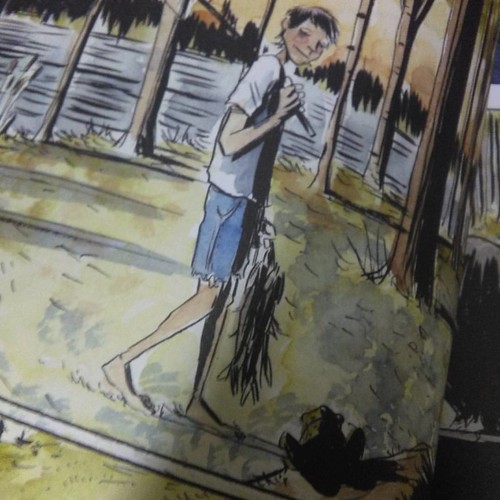
Secret Path, drawn by Canadian cartoonist Jeff Lemire, is another account of the story of an Anishinaabe child Chanie Wenjack, the same told in Boyden's Wenjack. Secret Path is a graphic novel, Lemire's wordless drawings in pencils with watercolours being interspersed with lyrics from Downie's album of the same name.

From Secret Path #canada #chaniewenjack #secretpath #gorddownie #jefflemire

Secret Path is a high point in Lemire's career, and a high point for the the Canadian graphic novel, depicting the struggle of a young boy to return home in all of its sadness and all of its glory with beautiful art.


This, too, is a book that must be read.

Profile

rfmcdonald: (Default)rfmcdonald

February 2021

S M T W T F S
 123456
78910111213
14151617181920
212223242526 27
28      

Style Credit

Expand Cut Tags

No cut tags
Page generated Mar. 13th, 2026 05:13 pm
Powered by Dreamwidth Studios