![[personal profile]](https://www.dreamwidth.org/img/silk/identity/user.png) rfmcdonald
rfmcdonaldBad Astronomy's Phil Plait recently linked to the first entry in one David Friedman's new blog, Sunday Magazine. There, every Friday, Friedman will "post the most interesting articles from the New York Times Sunday Magazine that was published exactly 100 years ago that weekend." What caught Bad Astronomy's attention was Friedman's linking and reproduction of an 24 March 1912 New York Times Sunday Magazine article "French Savant Tells of Life on Venus and Mars," describing French biologist Edmond Perrier's speculations on the alterations of basically Earth-type life to the then-believed conditions on Venus and Mars.
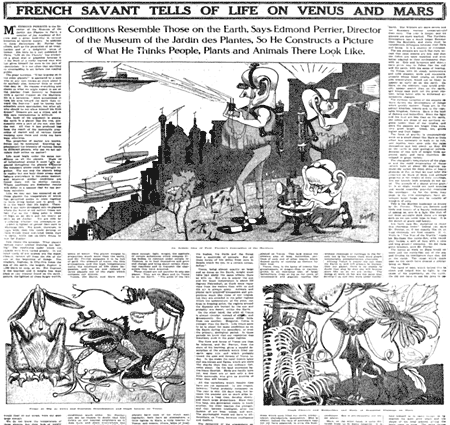
The article is drawn from La Vie dans les planètes, a 1911 tome written by one Edmond Perrier. Perrier was a leading French biologist (or "zoologist") of Third Republic France, a grand systematizer of systems whose The Philosophy of Zoology Before Darwin), translated into English and republished in 2009, is representative of his general project of giving structure to the intellectual universe of humanity. (There's a school named after him in his native Limousin, actually.)
There's a certain novelty value to Perrier's predictions, yes, but looking over the summary it's actually a fairly respectable attempt to imagine what living organisms and ecosystems would be like on other worlds. Life on Earth fits a system, therefore life on Earth's sister worlds must share this system.
The gas giants are too cool and low-density to support life, these worlds' moons aren't considered at all, while of the four inner worlds Mercury is too dense and hot. Venus and Mars, thankfully, lie within the ecosphere of Sol, at the inner and outer edges respectively. Venus, a world of perpetual heat and humidity, with habitable poles and desert equatorial lands, is predicted as having the sort of very stable environment that would slow down evolution, with complexity coming about organizations of social insects like bees rather than complex animals like human beings. Mars, with its lower mass, lower global temperature, and a climate prone to greater extremes than Earth's, would be a world where evolution advanced rapidly, where warm-blooded and furred animals would flourish and Martians would build their advanced civilizations. Yes, they would be pale-skinned and narrow-jawed and broad-chested and slender-legged, there would be "small beauty about them, to our way of thinking, except for the intelligence of their expression," but these evolved beings would have built a civilization of peace and plenty. As Venus would be Earth's past, so would Earth be Mars'.
Perrier was wrong about the characteristics of Venus and Earth. Venus orbits Sol too closely to escape a supereffective greenhouse effect, and besides has a day much too long (243 Earth days versus its year of 224.7 Earth days) to produce an environment as Earth-like as Perrier predicted, while Mars would only be as Earth-like as Perrier had hoped it would be if it was a denser world able to hold on to a dense atmosphere. By the time that La Vie dans les planètes was published, the first signs that Perrier's predictions would be proven false might have already come with the spectrographs of the atmospheres of Venus and Mars revealing atmospheres made up mostly of carbon dioxide, not the oxygen necessary for animal life.
But still, Perrier's predictions don't strike me as as being all that unreasonable, not judged by the knowledge of the time and not necessarily all that much by the knowledge of ours. Stable environments might well diminish evolutionary pressures; cold inhospitable ones might well encourage warm-bloodedness and the development of fur and other like traits. And if, as one might expect, the same evolutionary pressures in the same environments would produce similar technology-using intelligent species, one might naturally expect that the species with the older history would be the wiser. These are all assumptions, but again, they're not inherently unreasonable ones. If Venus was in the right sort of orbit (and quicker-turning) and Mars was more massive, Perrier might well be a famous prophet. As is, I feel a bit sad that I hadn't heard of the man before now.
The article is drawn from La Vie dans les planètes, a 1911 tome written by one Edmond Perrier. Perrier was a leading French biologist (or "zoologist") of Third Republic France, a grand systematizer of systems whose The Philosophy of Zoology Before Darwin), translated into English and republished in 2009, is representative of his general project of giving structure to the intellectual universe of humanity. (There's a school named after him in his native Limousin, actually.)
There's a certain novelty value to Perrier's predictions, yes, but looking over the summary it's actually a fairly respectable attempt to imagine what living organisms and ecosystems would be like on other worlds. Life on Earth fits a system, therefore life on Earth's sister worlds must share this system.
Life must begin under the same conditions on all the planets. Made up of infinitesimal atoms it must have appeared throughout the planets wherever the necessary atoms could be brought together. The sun and the planets being in realiyt but one body these atoms must behave everywhere in the same manner, and wherever similar conditions ar efound there will be similar results. Where conditions are dissimila results will differ in a manner that we can perhaps calculate.
The gas giants are too cool and low-density to support life, these worlds' moons aren't considered at all, while of the four inner worlds Mercury is too dense and hot. Venus and Mars, thankfully, lie within the ecosphere of Sol, at the inner and outer edges respectively. Venus, a world of perpetual heat and humidity, with habitable poles and desert equatorial lands, is predicted as having the sort of very stable environment that would slow down evolution, with complexity coming about organizations of social insects like bees rather than complex animals like human beings. Mars, with its lower mass, lower global temperature, and a climate prone to greater extremes than Earth's, would be a world where evolution advanced rapidly, where warm-blooded and furred animals would flourish and Martians would build their advanced civilizations. Yes, they would be pale-skinned and narrow-jawed and broad-chested and slender-legged, there would be "small beauty about them, to our way of thinking, except for the intelligence of their expression," but these evolved beings would have built a civilization of peace and plenty. As Venus would be Earth's past, so would Earth be Mars'.
Perrier was wrong about the characteristics of Venus and Earth. Venus orbits Sol too closely to escape a supereffective greenhouse effect, and besides has a day much too long (243 Earth days versus its year of 224.7 Earth days) to produce an environment as Earth-like as Perrier predicted, while Mars would only be as Earth-like as Perrier had hoped it would be if it was a denser world able to hold on to a dense atmosphere. By the time that La Vie dans les planètes was published, the first signs that Perrier's predictions would be proven false might have already come with the spectrographs of the atmospheres of Venus and Mars revealing atmospheres made up mostly of carbon dioxide, not the oxygen necessary for animal life.
But still, Perrier's predictions don't strike me as as being all that unreasonable, not judged by the knowledge of the time and not necessarily all that much by the knowledge of ours. Stable environments might well diminish evolutionary pressures; cold inhospitable ones might well encourage warm-bloodedness and the development of fur and other like traits. And if, as one might expect, the same evolutionary pressures in the same environments would produce similar technology-using intelligent species, one might naturally expect that the species with the older history would be the wiser. These are all assumptions, but again, they're not inherently unreasonable ones. If Venus was in the right sort of orbit (and quicker-turning) and Mars was more massive, Perrier might well be a famous prophet. As is, I feel a bit sad that I hadn't heard of the man before now.


