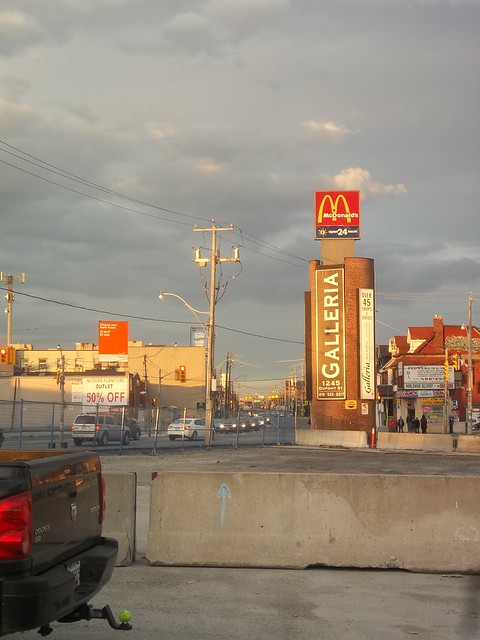
It was late evening at Dufferin and Dupont, and the pillar advertising the Galleria Shopping Centre was aglow.


A Leger poll commissioned by insurance provider Kanetix has found that 66.7 per cent of Torontonians approve of the idea of licensing cyclists. The poll results are consistent with a 2012 Forum poll, which pegged the approval rating at 65 per cent.
The idea of licensing cyclists as we do car drivers has been around for over 80 years—in fact, Toronto cyclists were licensed from 1935 to 1957. According to an amendment signed by Mayor Nathan Phillips, the program ended up being discontinued in part because licensing caused “an unconscious contravention of the law at a very tender age” in that the law was so consistently ignored by young people. The same amendment noted that the licensing also created “poor public relations between police officers and children.”
Council has revisited and rejected the idea of licensing cyclists at least five times since 1984. Staff reports produced throughout the years cite concerns about its prohibitively high cost, the practical difficulties of licensing young cyclists, and the possibility that licensing would act as a deterrent for casual cyclists—and point out that cyclists are already subject to the rules of the road.
At a bookstore, you can browse the shelves, open a book, sample its pages as well as those of its peers shelved in the same category or by the same author. With Amazon, if you do not know the author or the title or a great deal of the plot; your chances of finding that book you overheard friends talking about is like a pricking yourself while rolling in a haystack. Good luck. Oh, and during your online hunt, you’ll be forced to look at so many lurid covers — because isn’t gay publishing about sex, sex, sex? — that searching for a book has become, at times, not-safe-for-workplace.
[. . .]
Some argue that the need for “gay” retailers is disappearing thanks to assimilation — that I am an American first and foremost, who just happens to act a bit fey, so I should just go to a normal bookstore and find the latest Christopher Rice or Sarah Waters. Ahh, the assimilation argument. I would love to walk into a generic bookseller and see LGBT authors prominently shelved. And the major authors, who are published by major presses, already are. David Sedaris. Val McDermid, one of the most read mystery authors in the world. These individuals are assimilated into whatever genre they write in and unless you knew they were gay, you could pass over their books without a second thought. Thank you, America, for hiding the authors’ and the characters’ sexuality. (I promise that none of these covers will be lurid — don’t tell me David Levithan’s “Two Boys Kissing” is lurid. Young adult literature is growing more accepting of LGBT themes, but how many stores have Levithan’s latest spine out?)
In Barnes & Noble, the “gay” shelf is often a single shelf of mixed erotica and university presses with maybe a memoir or a book about Matthew Shepherd. If you wanted to read a gay book — assuming you are not so assimilated that you only want to read about everyday Americans, the vast majority of whom are somewhat favorable to your “lifestyle” and enjoy laughing at fey or butch minstrel characters on television — you have to special-order the book. Which means you are essentially coming out to the busy clerk at the help desk. Can you? Will you? Or will you retreat back home and search again and again for something on Amazon that sounds like a book you want.
Then there’s the argument that the community has failed the local bookstore. Alas, this comment is almost always true. I remember working the front counter of Giovanni’s Room and men and women entering the store at all hours asking to hang posters or leave fliers for their LGBT event or cause. We always agreed and gave them space. And how many of these individuals would then walk around the store. None. We would get people associated with functions and charities and socials approaching Ed for gift certificates to offer as door prizes or silent auctions. And he would never refuse. And after he handed the certificate over, out the door they went.
Wen Zhou of the Chinese Academy of Sciences set up an experiment in which participants looked at a video in which human figures rendered in a connect-the-dots style [. . .] were shown walking. Participants were then asked to guess whether the figures were masculine or feminine. When exposed to androstadienone, heterosexual women were more likely to suggest that the wire figure was a man—but the pheromone had no effect on heterosexual men.
Perhaps most importantly, homosexual men also responded to that pheromone, suggesting that gay men innately perceive (and are perhaps affected by) male pheromones.
Straight men, meanwhile, were more likely to perceive the figure as feminine when exposed to estratetraenol. Straight women showed no effect, while lesbian and bisexual women showed a response somewhere in between. To keep everything on the straight and narrow, the pheromones were masked with the smell of cloves in all cases.
“We were able to demonstrate qualitatively that androstadienone signals masculinity to heterosexual males and homosexual males, whereas estratetraenol signals femininity to heterosexual males, without the recipients being aware of the odors,” Zhou wrote in a study about his findings, published in Cell. “Importantly, the specific sexual information conveyed by androstadienone and estratetraenol strongly supports them as human sex pheromones.”
Essentially, the findings suggest that humans can "perceive" someone's biological sex based on these pheromones, but that the effect only works with those people a person might be attracted to.
Alison Smith, a senior correspondent for CBC News and host of CBC Radio's flagship news show The World at Six, has announced she is leaving the public broadcaster at the end of June.
Smith's revelation comes just after CBC colleague Linden MacIntyre announced he would be leaving CBC at the end of the summer.
"It's time. I've been thinking about this for quite a long time and I've had a terrific run. I've been very privileged to have purpose in my life at the CBC, which has been challenging and creative and fulfilling. But it's time now," she told CBC News on Thursday.
[. . .]
Veteran investigative journalist and award-winning author MacIntyre, who has spent nearly four decades at the public broadcaster and 24 years as co-host of the fifth estate, is to leave CBC at the end of August.
The prominent journalist said he made the difficult decision, in part, to take a stand against CBC's recently announced budget cuts, which he believes are having the strongest impact on young reporters and producers.
"I listened to all the bosses talking about the fact that these are cuts that people are going to notice. And then I realized: Probably not, because these are people cuts and these people are anonymous to the public. Their work is not," MacIntyre, 70, told CBC News.
In April, CBC president Hubert Lacroix announced that funding shortfalls and revenue losses had forced CBC/Radio-Canada to cut $130 million from its budget this year. The move necessitated the elimination of 657 jobs over the next two years, a substantial reduction of CBC Sports and affected all sectors of the CBC, from regional news to radio to digital programming.
Among those losing their jobs, "most of them people have never heard of, [but] everybody knows their work," MacIntyre said.
On April 23, the French government unveiled a dozen proposals aiming at limiting the number of French citizens travelling to Syria with the intent of fighting among Islamist radical groups. This text, which encompasses a large series of initiatives to reduce cyber-recruitment from violent "jihadist" movements, had been in the works for several months but became even timelier following the release of four French journalists kidnapped in Syria since June 2013. Part of the information discovered during the journalists' debriefing was that several of the kidnappers spoke to the hostages in French and were likely French nationals fighting with radical groups in Syria.
The last few months have been marked by a surge of propaganda videos from exiled combatants originally from France or Belgium, posted online to attract new recruits. They showcase heavy military arsenal and the most horrendous crimes. It is estimated that between 500 and 700 of them have now joined the fighting in Syria, more than doubling their number over the last four months.
[. . .]
What is also striking is the fact that the profiles of those foreign combatants contradict most prejudices. While the populist extreme right party led by Marine Le Pen has, as always, been quick to link this phenomenon to the immigrant population in France from North Africa and the French policy towards Syria, testimonies prove the opposite.
According to the Centre de Prevention Contre les Derives Sectaires Liees a l'Islam (CPDSI), a research centre recently created by anthropologist Dounia Bouzar, a former member of the French Council for the Muslim Faith, most French nationals volunteering to fight in the so-called "jihad" in Syria are actually not originally from traditional Muslim families. Two-thirds of them have been raised in family circles that did not dispense any religious teaching with parents describing themselves as atheists, with 80 percent of them being French nationals for more than three generations. Only 20 percent of the "jihad candidates" were raised in traditionally Muslim families, most of them not attending Friday prayer services, while 80 percent of those indoctrinated are below the age of 21.
Additional statistics show that more than one fourth of the candidates come from Seine St Denis, one of the 100 French departments known for its high rate of unemployment and family breakdown. Far from representing a radicalisation of Islam in France, the increasing number of French nationals in Syria is an epiphenomenon resulting from the enhanced capacity of transnational groups to entrap weak minds who have been dejected by the lack of economic growth in France over the last decades.
An epiphany came to Adrian Newton in the form of an afternoon tea. In 2009, the British forest conservation ecologist was surveying threatened fruit trees in the forests of the western Tien Shan mountains, in the Central Asian Republic of Kyrgyzstan, when local residents invited him into their tapestry-bedecked home in the heart of the woods to share a ceremonial meal.
"They sit you down and make you this lovely cup of tea, and then you're served a whole range of different jams and preserves, and all of these are local. They're all made from the forest and [are] absolutely delicious," says Newton, a professor at Bournemouth University in the United Kingdom. "That's when it really hit home to me what a fantastic cultural value these forests are. You do feel in a small way that you are in a land of plenty."
The ancient woodlands of Kyrgyzstan—and of the four neighboring former Soviet republics of Kazakhstan, Tajikistan, Turkmenistan, and Uzbekistan—are home to more than 300 wild fruit and nut trees. They include walnut trees, eight to ten species of cherry, up to ten species of almond, four or five plum tree species, and four wild species of apple, according to a 2009 report co-authored by Newton, The Red List of Trees of Central Asia.
According to that same report, 44 species of trees and shrubs in the region are "critically endangered, endangered, or vulnerable." They've been menaced for decades by overgrazing, pests, diseases, timber—felling for fuel, and most recently, climate change.
One of these threatened species, Malus sieversii—a wild apple that Newton describes as "small but highly colored with a very nice sweet flavor"—is one of the key ancestors of all cultivated apples grown and eaten around the world. So rich and unique is this species, Newton says, that on one wild apple tree, "you can see more variation in apple form than you see in the entire cultivated apple crop in Britain. You can get variation in fruit size, shape, color, flavor, even within the tree, and certainly from tree to tree."
Several thousand years of selective breeding have mined that diversity to give us the varieties we know today, from the Golden Delicious to Cox's Orange Pippin to the improbably named Winter Banana. Just 10 of the 3,000 known varieties account for more than 70 percent of the world's production.
But in the process many traits that might still be valuable—genes for disease resistance, say, or heat tolerance—were left behind. For breeders of apples and other fruits today, tapping the riches of the original Garden has become a practical strategy—and saving it from destruction, Newton says, an urgent necessity.
![[personal profile]](https://www.dreamwidth.org/img/silk/identity/user.png) branchandrootdancing_serpent
branchandrootdancing_serpent