![[personal profile]](https://www.dreamwidth.org/img/silk/identity/user.png)


[URBAN NOTE] Ten Montréal links
Dec. 4th, 2019 12:26 pm- The Map Room Blog links to some old maps of Montréal.
- Major English-language newspapers in Montréal, including the Montreal Gazette, are no longer being distributed to Québec City clients. CBC reports.
- Radio-Canada employees' union is concerned over cost overruns in the construction of a new headquarters for the French-language chain. CTV NEws reports.
- La Presse notes how the to-be-demolished Champlain Bridge is a home for, among others, falcons.
- The Bibliothèque Saint-Sulpice, after the latest delay, will have been closed for nearly two decades. La Presse reports.
- The Montreal Children's Library is celebrating its 90th anniversary with a fundraiser. CBC reports.
- CBC Montreal looks at how, even without a stadium, legendary mayor Jean Drapeau brought major league baseball to his city.
- The anti-gentrification University of the Streets group has some interesting ideas. CBC reports.
- The city government of Montréal is looking into the issue of the high retail vacancy rates in parts of the city. CBC reports.
- At CBC Montreal, Ontario-born Jessica Brown writes about her struggles with employment in her adopted city.
Tags:
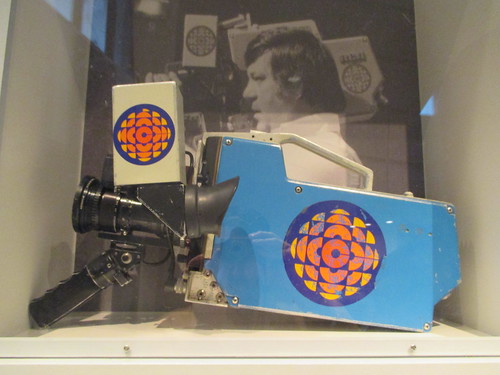
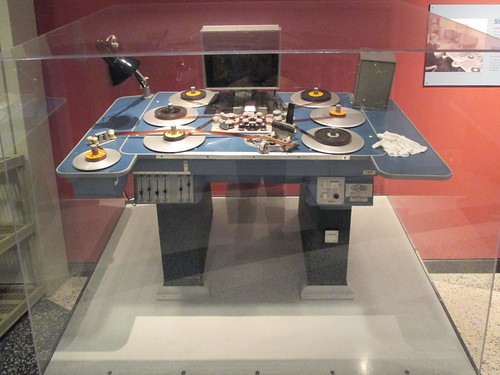
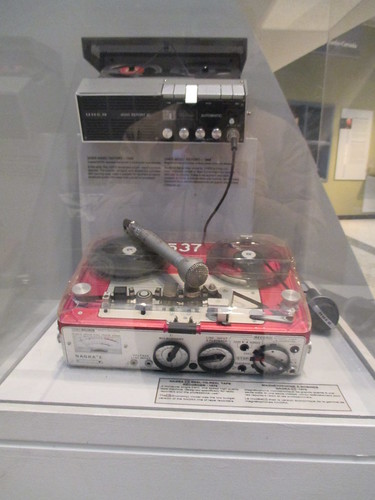
The Canadian Broadcasting Centre's Ivan Harris Gallery is hidden away from the CBC Museum, behind the escalator leading to the Centre's food court. My attention was caught by the vintage technology on display, by the RCA TK-76 A camera that enabled mobile news gathering in the late 1970s, or the Radio Shack TRS-80 Model 100 that could transmit as many as ten pages of text (!) from the field.


Tags:

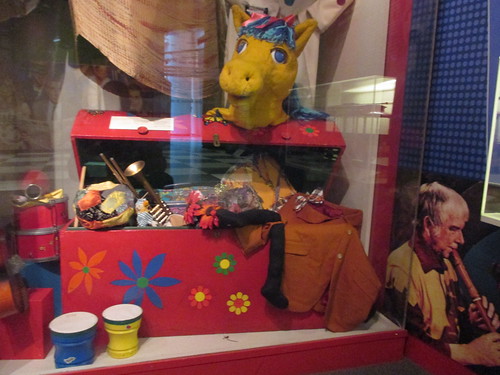
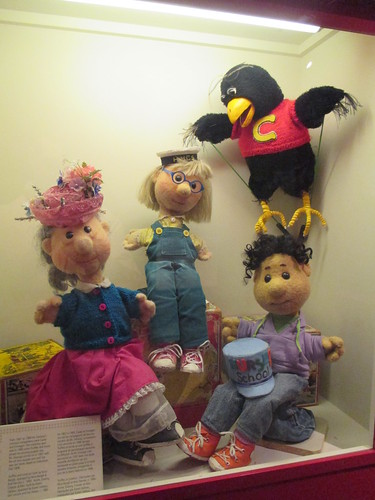
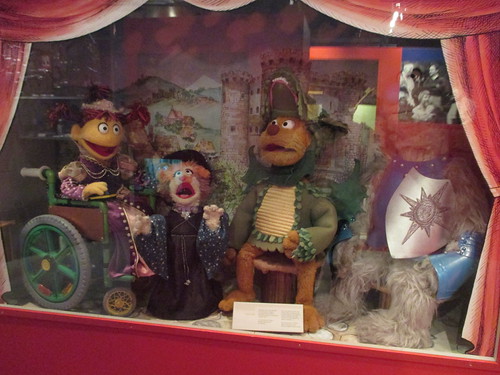
The CBC Museum is a free space inside the CBC headquarters in downtown Toronto on Front Street. The small space is full of artifacts from CBC's technological past and from more recent children's television programs like Mr. Dressup and The Friendly Giant. My attention, naturally, was focused on the latter.






The Globe and Mail's Robert Everett-Green writes about exciting prospects for the new CBC headquarters in Montréal.
Incredible as it may seem, there was a time in recent memory when cutting-edge urban planning could include replacing a bustling residential neighbourhood with parking lots. If the CBC and two private developers have their way, a notorious result of that kind of raze-and-pave mentality in Montreal’s east end may be partly reversed.
The public broadcaster has accepted two purchase-and-development offers for its large and desolate Maison Radio-Canada property, which was expropriated in the 1950s from a working-class community of 5,000 people. The deals are the first step in a plan to build a new headquarters for French-language broadcasting on the site’s eastern edge, and a 280,000-square-metre mixed-use development on the rest of what used to be the old francophone neighbourhood of Faubourg à m’lasse.
“We’re definitely going to try to make up for what was done,” says Vincent Chiara, whose Groupe Mach plans to build about 20 silvery buildings of varying heights on the western portion of the site, including condos, social housing and retail and office space. Chiara also said he would restore some of the road network that criss-crossed the vanished Faubourg, and convert the 24-storey Radio-Canada tower into loft-type offices.
The new broadcast centre would be built by a consortium led by Montreal-based Broccolini, with Béïque Legault Thuot Architectes of Montreal and Quadrangle, a Toronto design firm that developed CHUM/MuchMusic’s pioneering broadcast spaces. Computer-generated illustrations and a video of the concept show a luminous, mainly glass-walled complex of buildings linked by a four-storey atrium. Elevated walkways will pass through the wooden-beamed atrium, which will be visible from offices and multiplatform studios, and will have the same versatility as the atrium at the CBC’s English-language HQ in Toronto. The aim, CBC president and chief executive officer Hubert T. Lacroix says, is to create a more compact, transparent and publicly accessible HQ than the old tower, where 80 per cent of the usable space was underground.
[PHOTO] CBC cool in Leslieville
Nov. 30th, 2016 09:16 am
The T-shirt with the classic CBC logo on the mannequin in the front window of a Leslieville clothing store tries to evokes a certain cool, successfully I think.
I really approve of this CBC proposal, described at the CBC itself. Why not establish Canada's national broadcaster as financially independent?
CBC/Radio Canada has submitted a position paper to the federal government proposing the public broadcaster move to an ad-free model, similar to the one used to pay for the BBC in the United Kingdom, at a cost of about $400 million in additional funding.
"We are at a critical juncture in our evolution, continuing to operate under a business model and cultural policy framework that is profoundly broken," said the CBC's document, released on Monday afternoon. "At the same time, other nations are moving their cultural agendas forward successfully — and reaping the benefits of strong, stable, well-funded public broadcasters."
The additional money CBC is asking for would largely be "replacement funding" if the media organization eliminates advertising. The proposal requests $318 million to replace advertising revenue: $253 million in lost ad sales plus $105 million to "produce and procure additional Canadian content" to fill the programming gaps in their absence. CBC is also asking for $100 million in "additional funding of new investments to face consumer and technology disruption."
However, the proposal notes that removing ads will also result in savings of $40 million in the cost of selling advertising.
Total government funding for CBC would equal an investment of $46 per Canadian every year — up from the current $34 per Canadian it currently receives, the document says.
Two-thirds of the ad revenue given up by the CBC, the proposal argues, "would migrate to other Canadian media, including private TV and digital, for a net gain to them of $158M."
The Toronto Star's Hina Alam reports on Conservative leadership candidate Kellie Leitch's call to take apart the CBC entirely, going one better on Maxine Bernier's call to defund and reorganize the broadcaster.
Conservative leadership candidate Kellie Leitch is proposing to sell the CBC, saying she doesn’t believe the broadcaster should be “propped up by taxpayers.”
“What I’m proposing is that it either be subject to an asset sale or an IPO, whichever will salvage the best value for Canadians with the intention being we get the best value for money for taxpayers,” said Leitch (Simcoe-Grey) on Thursday.
The pledge was dismissed by the NDP as “ridiculous.”
“We’re back in the 1920s,” said MP Pierre Nantel (Longueuil-Saint-Hubert). “How about going back to Morse code?”
Leitch linked her proposal to another of the major policy items she has put forward — instituting a cap on government spending. This means that every department will have to play its part, she said.
The National Post carries a report, from Jason Fekete of the Ottawa Citizen, about how Maxine Bernier would like to undermine the CBC as a strong broadcaster with adequate public funding.
Conservative leadership candidate Maxime Bernier is promising to overhaul CBC/Radio-Canada – an institution he says “seems frozen in time” — by cutting hundreds of millions in funding, streamlining its mandate and getting it out of the advertising market.
Bernier says CBC/Radio-Canada “should stop doing three-quarters of what it still does” that private broadcasters are already doing, including running game shows and cooking programs, sports programming, music streaming and a website devoted to opinion journalism.
It also needs to stop “unfairly” competing with struggling private media in a shrinking advertising market, he says.
With a media landscape that now includes hundreds of channels and millions of sources of information and culture, “CBC/Radio-Canada seems frozen in time,” he said.
“It tries to occupy every niche, even though it doesn’t have and will never have the means to do so, with the result being lower-quality programming,” Bernier told reporters.
“With my proposal, CBC/Radio-Canada will stop competing unfairly with private media, and will be more respectful of the taxpayers that help fund it. It will also become a more relevant public institution, helping to reinforce our culture and our national identity.”
[NEWS] Some Friday links
Aug. 29th, 2016 05:10 pm- Bloomberg notes the recent challenge to one-family rule in Gabon, looks at Russia's new Internet firewall, examines the Syrian Kurds' withdrawal beyond the Euphrates, and reports on near-record migration into the United Kingdom.
- Bloomberg View talks about inequality in China, looks at continuing disputes over Second World War history in Poland and Ukraine, and examines the things Texas and California have in common.
- CBC reports on the impending release of a report on foreign workers, looks at the integration problems of Syrian refugees re: housing, and reports on Canada's interest in more immigration from China.
- The Inter Press Service notes how drought is hurting cocoa farmers in Cameroon.
- MacLean's looks at how some in the Conservative Party have not moved past same-sex marriage, describes how the new British Columbia tax on foreign buyers of real estate is deterring Chinese, and reports on the catastrophic potential of carbon release from melting permafrost.
- National Geographic notes how the young generation sees Pluto and its classification history.
- The National Post describes how design fans want the CBC to release its 1974 standards manual, and looks at controversy over a study claiming extensive support in mosques for extremist literature.
- Wired has photos from the uninhabited cities of China, and describes the new prominence of the alt right.
Tags:
- agriculture,
- astronomy,
- british columbia,
- california,
- canada,
- cbc,
- central africa,
- china,
- cities,
- clash of ideologies,
- democracy,
- environment,
- gabon,
- glbt issues,
- global warming,
- history,
- internet,
- islam,
- links,
- middle east,
- migration,
- news,
- photos,
- pluto,
- poland,
- politics,
- refugees,
- russia,
- second world war,
- space science,
- syria,
- turkey,
- ukraine,
- united kingdom,
- united states,
- war
First is the National Post's "Get front-row-centre seats for the Tragically Hip’s final show in their hometown — just $5,999 a ticket".
Next is the CBC's CBC in talks to broadcast the Tragically Hip’s final concert".
Tragically Hip fans were dumbfounded by the speed at which scalpers grabbed concert tickets to the band’s final tour, with resale prices shooting up to thousands of dollars after a fan club pre-sale launched Monday morning.
In the band’s hometown of Kingston, the cost of seeing the Hip perform one last time ranged from $799 to $5,999 — per ticket — on the site atbtickets.com. Many of the tickets made their way to the site StubHub, where Kingston ticket prices ranged from $720 to $5,000.
On Ticketmaster, the tickets were priced between $60 and $126.
Some fans questioned how the tickets — which required buyers to use a code to complete a purchase — could turn up for resale within minutes. Others lamented that concerts that were raising money for charity were being exploited by scalpers.
“Did ANYONE get Tragically Hip presale tickets? Were there like, 10 released???” asked Twitter user Donna D. shortly after tickets disappeared.
“This is insane. Scalpers win, fans LOSE.”
Next is the CBC's CBC in talks to broadcast the Tragically Hip’s final concert".
Fans frustrated by sky-high ticket prices will be happy to know that the CBC wants to broadcast the Tragically Hip’s final show — but the deal isn’t done yet.
“We are interested in airing the Tragically Hip’s final show and are having conversations with the band to see if we can make it happen,” said CBC communications adviser Emma Bédard.
Ontario’s attorney general said Tuesday she’s prepared to try to find out why so many Tragically Hip fans couldn’t buy tickets for the group’s summer concerts — unless they wanted to pay many times face value on resale sites.
Attorney General Madeleine Meilleur, sympathetic with fans who would have to pay such tremendous prices to see the band, said the ministry needs to look at resale prices and insists she wants to fix the situation.
A number of fans outraged by the scarcity of tickets to the hotly anticipated concert series — announced at the same time the band said lead singer Gordon Downie had incurable brain cancer — urged the public broadcaster to help make the band’s farewell tour part of the public domain.
I've already linked to Sandy Garossino's National Observer opinion piece on Facebook. My reaction remains the same: Borel can fight back, and how!
Jian Ghomeshi and Marie Henein never saw it coming, and neither did we. The rookie Kathryn Borel entered the legal Thunderdome and beat Henein at her own game without breaking a sweat.
Round 1 of the greatest legal rope-a-dope* in Canadian history took place Wednesday inside Toronto’s Old City Hall courthouse. It was there that Borel must have appeared on the defensive, watching as the Crown dropped all criminal charges in exchange for a measly peace bond. Oh, and an apology.
In legal terms, this doesn’t even rate as a plea bargain. The apology seemed like a sop, potentially designed to give cover to a demoralized prosecution in no mood for a second helping of Henein’s trademark dish. The unmistakable inference was that the Crown lacked confidence in its complainant and star witness.
But she was just warming up.
Kathryn Borel then held Round 2 on the steps of Old Toronto City Hall all by herself. Over the course of four minutes and twelve seconds she delivered blow after merciless blow to Ghomeshi’s reputation and future. His evisceration was so swift and devastating that, had this been a real boxing match, the ref would have stopped the fight.
But no one was there to cover for him. No well-heeled lawyer could leap to his defence, intimidate Borel with smeary details of long-forgotten transgressions, or spring some hidden surprise.
She was the surprise.
The Toronto Star carried in full complainant Kathryn Borel's statement concerning Jian Ghomeshi's decision to issue an apology andsign a peace bond in relation to Ms. Borel.
MacLean's also carries the statement. The National Post also carries other statements, including from Ghomeshi.
CBC has since apologized for its neglect of Ms. Borel's complaints and its creation of an unsafe working environment.
Toronto Life goes into more detail about the mechanics of the peace bond.
Hi everyone. Thanks for coming out and listening. My name is Kathryn Borel. In December of 2014, I pressed sexual assault charges against Jian Ghomeshi. As you know, Mr. Ghomeshi initially denied all the charges that were brought against him. But today, as you just heard, Jian Ghomeshi admitted wrongdoing and apologized to me.
It’s unfortunate, but maybe not surprising, that he chose not to say much about what exactly he was apologizing for. I’m going to provide those details for you now.
Every day, over the course of a three-year period, Mr. Ghomeshi made it clear to me that he could do what he wanted to me and my body. He made it clear that he could humiliate me repeatedly and walk away with impunity. There are at least three documented incidents of physical touching. This includes the one charge he just apologized for, when he came up behind me while I was standing near my desk, put his hands on my hips, and rammed his pelvis against my backside over and over, simulating sexual intercourse. Throughout the time that I worked with him, he framed his actions with near daily verbal assaults and emotional manipulations. These inferences felt like threats, or declarations like I deserved to have happening to me what was happening to me. It became very difficult for me to trust what I was feeling.
Up until recently, I didn’t even internalize that what he was doing to my body was sexual assault. Because when I went to the CBC for help, what I received in return was a directive that yes, he could do this, and yes, it was my job to let him. The relentless message to me, from my celebrity boss and the national institution we worked for were that his whims were more important than my humanity or my dignity. So I came to accept this. I came to believe it was his right. But when I spoke to the police at the end of 2014, and detailed my experiences with Mr. Ghomeshi, they confirmed to me what he did to me was, in fact, sexual assault.
And that’s what Jian Ghomeshi just apologized for: the crime of sexual assault. This is the story of a man who had immense power over me and my livelihood, admitting that he chronically abused his power and violated me in ways that violate the law. Mr. Ghomeshi’s constant workplace abuse of me and my many colleagues and friends has since been corroborated by multiple sources, a CBC fifth estate documentary, and a third-party investigation.
In a perfect world, people who commit sexual assault would be convicted for their crimes. Jian Ghomeshi is guilty of having done the things that I’ve outlined today. So when it was presented to me that the defence would be offering us an apology, I was prepared to forego the trial. It seemed like the clearest path to the truth. A trial would have maintained his lie, the lie that he was not guilty, and it would have further subjected me to the very same pattern of abuse that I am currently trying to stop.
Jian Ghomeshi has apologized, but only to me. There are 20 other women who have come forward to the media and made serious allegations about his violent behavior. Women who have come forward to say that he punched, and choked, and smothered and silenced them. There is no way that I would have come forward if it weren’t for their courage. And yet Mr. Ghomeshi hasn’t met any of their allegations head on, as he vowed to do in his Facebook post of 2014. He hasn’t taken the stand on any charge. All he has said about his other accusers is that they’re all lying and that he’s not guilty. And remember: that’s what he said about me.
I think we all want this to be over. But it won’t be until he admits to everything that he’s done. Thank you.
MacLean's also carries the statement. The National Post also carries other statements, including from Ghomeshi.
CBC has since apologized for its neglect of Ms. Borel's complaints and its creation of an unsafe working environment.
Toronto Life goes into more detail about the mechanics of the peace bond.
CBC's Nicole Ireland reports about CBC's abandonment of pseudonyms, requiring real names for commenters in the hope of elevating dialogue. I suspect, alas, that some people will not be deterred by this.
CBC will ban the use of pseudonyms for readers commenting on stories on the CBC.ca website, the corporation announced Thursday.
All commenters will be required to use their real names, Emma Bedard, spokeswoman for CBC English Services, told CBC News.
The move is a "request for transparency on the part of [online] users," Bedard said.
The decision was a result of a review of CBC's commenting policy that began in January, she said, after audience members expressed concerns about the content of comments appearing online.
Thursday's announcement was spurred by a complaint from a group of prominent New Brunswick francophones over what they considered hateful attacks on the province's French-speaking community.
"CBC has heard from a number of Canadians concerned about our commenting space, the use of pseudonyms, and some audience submissions that violated our guidelines around hate speech, particularly with respect to the francophone community in New Brunswick," said Jennifer McGuire, general manager and editor in chief of CBC News, in an Editor's Blog published on the website Thursday afternoon.
Over the past two weeks, I've been haunting YouTube extensively, watching and listening to the artifacts of David Bowie. Tonight I've been enjoying the brilliant imagery and the sound of the video of Bowie's 1993 "Jump They Say", so dense with meaning for Bowie and his fans.
There's so much there.
Bowie's not alone. I've been binging on sketches from classic Canadian comedy show The Kids in the Hall, enjoying clips of things like the monologues and sketches of Scott Thompson's Buddy Cole.
In their own ways, different yet congruent, the works of Bowie and The Kids in the Hall have lasted well. They still feel fresh, new, enjoyable.
What non-contemporary pop cultural artifacts have you been engaging with? What shows, what music, what books?
Discuss.
There's so much there.
Bowie's not alone. I've been binging on sketches from classic Canadian comedy show The Kids in the Hall, enjoying clips of things like the monologues and sketches of Scott Thompson's Buddy Cole.
In their own ways, different yet congruent, the works of Bowie and The Kids in the Hall have lasted well. They still feel fresh, new, enjoyable.
What non-contemporary pop cultural artifacts have you been engaging with? What shows, what music, what books?
Discuss.
The Globe and Mail's Simon Houpt writes about the unsurprising decision of the CBC to stop permitting comments on stories relating to First Nations, given the volume of racism that appears there.
The Canadian Broadcasting Corporation is temporarily suspending comments on its online stories about indigenous people, after its editors determined that too many comments were being posted that it deemed “off the mark” or “racist.”
In an online note to readers, the CBC’s acting director of digital news said that comments on those stories will be barred until editors can review moderation procedures.
“While there are a number of subjects and groups of people who seem to bring out higher-than-average numbers of worrisome comments, we find ourselves with a unique situation when it comes to indigenous-related stories,” wrote Brodie Fenlon.
“We’ve noticed over many months that these stories draw a disproportionate number of comments that cross the line and violate our guidelines. Some of the violations are obvious, some not so obvious; some comments are clearly hateful and vitriolic, some are simply ignorant. And some appear to be hate disguised as ignorance (i.e., racist sentiments expressed in benign language).”
CBC uses third-party moderators to monitor comments. Still, Mr. Fenlon said in an interview, “We do see people who use language that, on the surface, if you’re a moderator and you’re not familiar with the story, it might not stand out to you as a racist comment, but in the context of the story it becomes obvious what it is, even though it’s almost disguised.”
It begins.
Disgraced former radio host Jian Ghomeshi today pleaded not guilty in a Toronto courtroom to all five charges against him.
The former host of CBC Radio's cultural affairs show q is facing five charges, including four counts of sexual assault and one count of overcoming resistance by choking.
The 48-year-old did not speak with reporters as he walked into the downtown courthouse, where he was arraigned during a court appearance.
Ghomeshi, wearing a dark suit and tie, said only "not guilty" when asked how he pleaded. He had to repeat that because he wasn't speaking into a microphone.
[BLOG] Some Thursday links
Sep. 24th, 2015 08:08 pm- blogTO notes the report that the CBC might sell its holdings.
- Centauri Dreams observes another search for a Kardashev III civilization that ended in failure.
- Crooked Timber is fed up with Rod Dreher.
- The Dragon's Gaze and Centauri Dreams report on new orbital parameters for Beta Pictoris b.
- The Dragon's Tales reports the Permian extinction lasted sixty thousand years. Marginal Revolution looks at the dynamics of British inequality.
- pollotenchegg maps Russification in Soviet Ukraine in the 1920s.
- The Russian Demographics Blog notes reports of a brain drain from Russia.
- Spacing Toronto looks at the iconography of city signage.
- Torontoist reports on a documentary regarding Toronto's gun culture.
- Window on Eurasia warns of a crackdown on Crimean Tatar institutions, notes the opening of a new mosque in Moscow, reports on inter-Muslim violence in Russia, and suggests Belarus now is in the position of the Baltic States in 1940.
Tags:
- astronomy,
- belarus,
- blogs,
- cbc,
- cities,
- crime,
- crimean tatars,
- demographics,
- economics,
- extraterrestrial intelligence,
- former soviet union,
- history,
- islam,
- language,
- links,
- mass media,
- migration,
- popular culture,
- religion,
- russia,
- russian language,
- space science,
- television,
- toronto,
- ukraine,
- ukrainian language,
- united kingdom,
- urban note
Metronews shared this terrible news. Why is this being done? Getting rid of the property of the CBC is a good way to keep the CBC from being a content-generator in its own right. I quite hope this will be stopped, immediately, after the elections trigger a change in government.
On the same day Liberal Leader Justin Trudeau pledged to reverse $115 million worth of cuts to the CBC, the national broadcaster unveiled its plan to sell off all of its buildings.
The Canadian Media Guild said CBC announced at a staff town hall today that it will be “selling all its property across the country, including major production facilities in Montreal and Toronto.”
Ian Morrison, spokesperson for Friends of Canadian Broadcasting, had not yet heard about the announcement when reached by Torstar News Service Tuesday evening.
“It’s news to me,” he said, adding the broadcaster’s decision to sell real estate assets was akin to “burning the furniture to heat the home.”
Not only will this saddle the CBC with the need to pay rent forever, Morrison added, but the timing couldn’t be worse.
“This is a period of time when a government only makes caretaker decisions,” Morrison said. “It is widely understood during a general election you don’t do controversial things.”

