Nov. 24th, 2014

rfmcdonald: (Default)
I'd forgotten about these pictures.

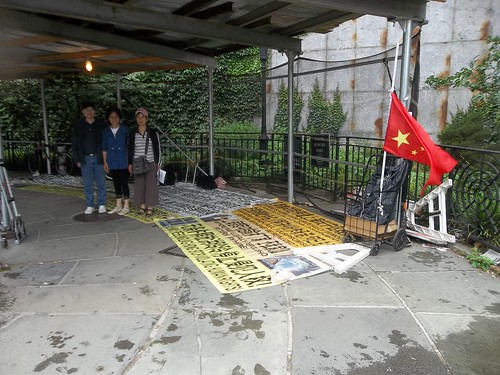
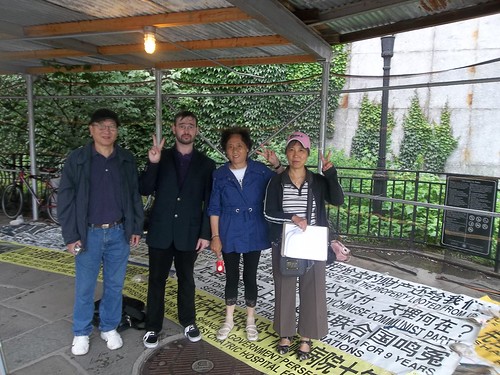
In June of 2012 as I was walking through Manhattan on a rather rainy day, I passed by the headquarters of the United Nations. On the opposite side of the street from the headquarters of the United Nations were three Chinese protesters, petitioning for redress.

Petitioners from Shanghai in New York City outside the United Nations, 2012 (1)


I talked with them at some length. The gist of their complaints were that the Shanghai municipal government had confiscated their property without providing appropriate compensation, and that they wanted redress. Going to New York City and setting up a permanent protest outside the United Nations' headquarters was, I suppose, their way of getting attention for their grievances, going one level above Beijing.

Petitioners from Shanghai in New York City outside the United Nations, 2012 (2)


I wish I hadn't lost the pamphlet they gave out. I wish they got the justice they deserved. I wish, honestly, that I could find out who they were. (Google is not being helpful.)
rfmcdonald: (Default)

  • blogTO shares photos of the destruction of the World's Biggest Bookstore.

  • Centauri Dreams looks at a proposal for interstellar slingshots.

  • The Dragon's Gaze links to a paper suggesting that tidally-locked Earth analogues will be habitable, avoiding scenarios where all their water is trapped on the nightside unless they have too little water.

  • The Dragon's Tales notes a paper studying mechanisms for creating Ganymede's grooves.

  • A Fistful of Euros' Alex Harrowell is skeptical of separatism in Catalonia, as in other relatively rich European regions, where it involves a desire to separate from poorer areas.

  • Language Hat links to a paper suggesting that Taiwan is not the ultimate homeland of the Austronesian language family.

  • Robert Farley of Lawyers, Guns and Money links to an article of his commenting on what China learned from the Gulf War of 1991.

  • Marginal Revolution notes that Brazil once enjoyed roaring economic growth until the 1980s. Is this China's future?

  • Personal Reflections' Jim Belshaw has a forum post seeking to explore stereotypes of Australia, as a country as a whole and as component regions.

  • The Russian Demographics Blog links to an article suggesting that the shrinkage of Russia's working-age population may lead to a decline of the oil industry, if it lacks sufficient workers.

  • Torontoist looks at the new TTC Pioneer Village station being worked on.

  • Towleroad notes furor creating by the decision of a transgender woman to bury her as a man.

  • Towleroad looks at problems with PReP.

  • Window on Eurasia notes non-recognition of Crimean annexation and suggests that Russian minorities outside Russia are now in a weaker position because of Russian irredentism.

rfmcdonald: (Default)

  • Al Jazeera looks at the Tunisian election, notes the challenges of the Cherokee language, examines the situation of the Russian exclave of Kaliningrad, looks at the plight of Sudanese refugees in Jordan, and shares photos indicating the possible future rise of Buddhist nationalism in Thailand.

  • Bloomberg notes how Paul Krugman's thinking has altered Japan's Abenomics, considers the immunity of Britons to facts on immigration, looks at sports rivalries in Tehran, suggests that if Iran is any guide Russia will not be able to evade sanctions, examines the human consequences of Russia's devaluation of the ruble, and looks at Ukrainians' new interest in entering NATO.

  • The Inter Press Service wonders if growing Chinese influence in Central Asia will undermine Russia's Eurasian Union, suggests that high rates of stress are responsible for high rates of infertility in Kashmir, looks at the plight of Russian immigrants, considers economic inequality in Mexico, looks at the flight of Iraq's Mandaeans from ISIS, considers the persecution of Sikhs in Pakistan, notes the plight of Syrian refugees, suggests that Cuba's response to Ebola might help Cuban-American relations, and examines the consequences of drought in Jamaica.

  • National Geographic notes the importance of counties in England, looks at the devastating drought facing the Colorado River and its watershed, and notes Italy's increasingly fraught relationship with immigration.

  • Open Democracy lambasts calls for Italy to become centralized and notes similarities and differences between Russia's Putin and Turkey's Erdogan.

rfmcdonald: (Default)
IFLScience's Janet Fang writes about an astonishing discovery. Certain people on Facebook have joked that this might be an alien artifact. (Should I wonder if they're right?)

Quasars separated by billions of light-years are lined up in a mysterious way. Astronomers looking at nearly 100 quasars have discovered that the central black holes of these ultra-bright, faraway galaxies have rotational axes that are aligned with each other. These alignments are the largest known in the universe.

[. . .]

Using the European Southern Observatory’s Very Large Telescope in Chile, a team led by Damien Hutsemékers from the University of Liège in Belgium studied 93 quasars known to form huge groupings. We’re seeing them now at a time when the universe was only about a third of its current age. “The first odd thing we noticed was that some of the quasars’ rotation axes were aligned with each other—despite the fact that these quasars are separated by billions of light-years,” Hutsemékers says in a news release.

So the team wanted to find out if the rotation axes were linked at that time—and not just to each other, but also to the structure of the universe on large scales. When looking at the distribution of galaxies on scales of billions of light-years, astronomers have found that galaxies aren’t evenly distributed: They form a web of filaments and clump around huge galaxy-scarce voids. This arrangement of material is known as the large-scale structure.

The team could not see the rotation axes or the jets of the quasars directly. Instead they measured the polarization of the light from each quasar and found a significantly polarized signal for 19 of them. The direction of this polarization helps to deduce the angle of the disc and the direction of the spin axis of the quasar.

These new findings indicate that the rotation axes of quasars tend to be parallel to the large-scale structures that they inhabit. That means that if the quasars are in a long filament, then the spins of their central black holes will point along the filament. (See the image above.) According their estimates, there’s only a one percent probability that these alignments are simply the result of chance.
rfmcdonald: (Default)
Spacing Toronto's John Lorinc argues that the Toronto District School Board needs drastic reforms to be capable of meeting its challenges.

If Premier Kathleen Wynne truly had the courage of the convictions that made her a great education advocate a decade ago, she’d ditch the measured calls for an investigation into the TDSB’s outrageous problems (here, here and here) and instead appoint a tough, veteran supervisor to thoroughly clean house at 5050 Yonge Street before letting the new trustees anywhere near the place.

[. . .]

Recent data from the Toronto District School Board echo these stark differentials; from Junior Kindergarten to Grade 6, fully 48% of black children and 56% of Middle Eastern children lived in families with incomes of less than $30,000 a year, compared to only 9% of white children.16 Similarly, 36% of white children in Grades 7-12 had parents in professional or senior management positions, compared to only 12% of black children.

It also outlines the corrosive and ultimately cyclical relationship between poverty and education, with the former contributing to problems with the latter, e.g., low readiness-to-learn indicators for pre-school-age children. These children, according to the report, are (not surprisingly) less likely to be involved with extracurricular activities than their counterparts from more affluent households. And on and on.

TDSB officials won’t be surprised by these findings; indeed, the board produced a lot of the research that went into the report. But for reasons that defy comprehension, this same organization has become consumed with inane sideshows — stupid little money-making adventures, like the sports bubble at Central Tech or the One-Stop electronic billboards in some schools — as well as seriously smelly executive decisions, namely the Confucius Institute deal with the Chinese government.

[. . .]

It took a team of investigative reporters to unearth all this muck. A well-governed institution would have the checks in place to defuse these kinds of ticking grenades before they turn up as sensational scandal pieces in the media.
rfmcdonald: (Default)
Bloomberg's Sam Kim writes about East Asia's history wars, starting from South Korea.

A 17-year-old Korean girl tortured to death for opposing Japanese colonial rulers nearly a century ago has become the latest touchstone of the nationalism that is shadowing Asia’s economic rise.

Yu Gwansun became known as Korea’s Joan of Arc after she lost her parents and was imprisoned during a 1919 uprising against Japan’s 1910-1945 colonization. South Korean Education Minister Hwang Woo Yea wants to know why she doesn’t appear in half of the nation’s newly approved high-school history textbooks. He’s considering putting the government in charge of writing history.

Textbooks have become part of the front line in East Asia’s propaganda war as recent administration changes in China, Japan and Korea see leaders fomenting nationalism to bolster their hold on power. In South Korea’s schools, history books shape the attitude of the next generation not only toward neighboring countries but also of the legacy of former dictator Park Chung Hee, the current president’s father.

[. . .]

In South Korea, the rewriting of history has been influenced by factions in the tumultuous domestic politics of the past century, including 35 years of rule by Japan, the three-year Korean War that cemented the division of the peninsula and a series of dictators in the South who oversaw rapid economic growth and fierce anti-communist campaigns.

“Modern history is extremely contentious in South Korea and almost anything since 1910 is controversial,” Charles K. Armstrong, a professor of history at Columbia University, said by e-mail. Some South Korean conservatives think the left-of-center governments of Kim Dae Jung and Roh Moo Hyun from 1998 to 2008 tilted history textbooks to their side, he said.
rfmcdonald: (Default)
The CBC's Anik See has an article up about the idea of rewilding the world, something to be explored in a CBC Ideas documentary tonight.

The human impact of centuries of destruction and manipulation of the landscape to extract resources and build communities is taking its toll on the planet, even in areas still considered "wild." However, a global movement known as "rewilding" is gaining traction, with the goal of returning areas to a more natural state.

"Rewilding is the act of making a place more wild again ... it's taking landscapes and somehow bringing back qualities of wildness that have been lost,” says J.B. MacKinnon, author of The Once and Future World: Nature as it was, as it is, as it could be.

“We've lost these very healthy, abundant, resilient ecosystems we had in the past when ecosystems had all of their components and were in full operating condition,” says MacKinnon. “It’s absolutely critical that we do rewilding, preferably on a global scale. But I think it's also very important for ourselves.”

The question is, what does wild really mean?

One of the reasons we need rewilding, MacKinnon says, is because of “shifting baseline syndrome.” The notion of what is "wild" is often measured against previous reference points or baselines, which themselves may represent significant changes from an even earlier state of wildness.

For example, the state of the natural world that a 40-year old grew up with and uses as his or her reference point to define what is "wild" or "natural" is substantially different from the baseline of the next generation. In the period between those two generations, nature gets degraded further by human influence, but the younger generation views this degraded nature as still being "wild," because it's their reference point.
rfmcdonald: (Default)
The Bloomberg View's Mac Margolis writes about the newly-revealed complicity between Castro's Cuba and the atrocious Argentine junta in the late 1970s and early 1980s. Les extrêmes se touchent.

A search engine -- created recently as part of Argentine President Cristina Kirchner's campaign to strengthen democracy by lifting the veil on human-rights crimes committed under the military -- confirms those suspicions [of Cuban-Argentine alliance]. (Kirchner, a devoted Peronist, has been less eager to bare the secrets of other friendly authoritarian regimes, starting with that of the iconic Isabelita Peron) Argentines may now scour some 5,800 sealed documents from the dictators' crypt. The digging has just begun, but already media and civic groups have found a rare window on Latin America's blackest years, when guerrilla insurgency and bloody repression coexisted with a complex skein of cloaked commercial and strategic interests.

Although they kept it quiet, Argentina's dictators had a gentlemen's agreement with Castro. Under the pact, Videla supported Cuba's bid in 1977 to join the Executive Council of the World Health Organization, a diplomatic feather in Castro's beret. The quid pro quo was that Havana stump among nonaligned nations to name Argentina to the United Nations prestigious Economic and Social Council. Apparently Cuba's vote was the 18th and decisive ballot, landing Argentina the coveted UN seat.

Both sides profited from the arrangement. "The Cubans always, always supported us and we supported them," Gabriel Martinez, then Argentina's ambassador to Geneva, said, though no one appeared to be listening at the time.

[. . .]

It also shines a light on why Castro could carry on for hours in the Plaza de la Revolucion in Havana railing against right-wing tyrants but never raise his voice against the Argentine junta, even as it threw scores of discontents in the dungeon or into the Atlantic.

[. . .]

Cuba effusively supported Argentina's disastrous South Atlantic war against Great Britain, which lasted 74 days and hastened the end of the crumbling dictatorship. It may even have funneled Soviet guns to the junta. Moscow had its eyes on wheat and imported 20 million tons of Argentine grains between 1980 and 1985, flouting the U.S. grain embargo against the Soviet Union.
rfmcdonald: (Default)
At IEEE Spectrum, Ross Koningstein and David Fork argue from a failed Google project that green energy won't be enough to prevent a climate meltdown, that new technologies--geoengineering--will be needed to prevent atmospheric carbon dioxide from causing catastrophe.

We had some useful data at our disposal. That same year, Google had completed a study on the impact of clean energy innovation, using the consulting firm McKinsey & Co.’s low-carbon economics tool. Our study’s best-case scenario modeled our most optimistic assumptions about cost reductions in solar power, wind power, energy storage, and electric vehicles. In this scenario, the United States would cut greenhouse gas emissions dramatically: Emissions could be 55 percent below the business-as-usual projection for 2050.

While a large emissions cut sure sounded good, this scenario still showed substantial use of natural gas in the electricity sector. That’s because today’s renewable energy sources are limited by suitable geography and their own intermittent power production. Wind farms, for example, make economic sense only in parts of the country with strong and steady winds. The study also showed continued fossil fuel use in transportation, agriculture, and construction. Even if our best-case scenario were achievable, we wondered: Would it really be a climate victory?

A 2008 paper by James Hansen [PDF], former director of NASA’s Goddard Institute for Space Studies and one of the world’s foremost experts on climate change, showed the true gravity of the situation. In it, Hansen set out to determine what level of atmospheric CO2 society should aim for “if humanity wishes to preserve a planet similar to that on which civilization developed and to which life on Earth is adapted.” His climate models showed that exceeding 350 parts per million CO2 in the atmosphere would likely have catastrophic effects. We’ve already blown past that limit. Right now, environmental monitoring shows concentrations around 400 ppm. That’s particularly problematic because CO2 remains in the atmosphere for more than a century; even if we shut down every fossil-fueled power plant today, existing CO2 will continue to warm the planet.

We decided to combine our energy innovation study’s best-case scenario results with Hansen’s climate model to see whether a 55 percent emission cut by 2050 would bring the world back below that 350-ppm threshold. Our calculations revealed otherwise. Even if every renewable energy technology advanced as quickly as imagined and they were all applied globally, atmospheric CO2 levels wouldn’t just remain above 350 ppm; they would continue to rise exponentially due to continued fossil fuel use. So our best-case scenario, which was based on our most optimistic forecasts for renewable energy, would still result in severe climate change, with all its dire consequences: shifting climatic zones, freshwater shortages, eroding coasts, and ocean acidification, among others. Our reckoning showed that reversing the trend would require both radical technological advances in cheap zero-carbon energy, as well as a method of extracting CO2 from the atmosphere and sequestering the carbon.

Those calculations cast our work at Google’s REC program in a sobering new light. Suppose for a moment that it had achieved the most extraordinary success possible, and that we had found cheap renewable energy technologies that could gradually replace all the world’s coal plants—a situation roughly equivalent to the energy innovation study’s best-case scenario. Even if that dream had come to pass, it still wouldn’t have solved climate change. This realization was frankly shocking: Not only had REC failed to reach its goal of creating energy cheaper than coal, but that goal had not been ambitious enough to reverse climate change.
rfmcdonald: (Default)
Facebook's Alexander pointed me to Adrian Cho's brief article in Science suggesting that gamma-ray bursts--flashes of gamma rays associated with massive stellar explosions--might mean most galaxies, even most of our galaxy, is unsuitable for complex life. (In 2006, I mentioned that apparently our galaxy does not have many candidates for this type of catastrophe, in 2008 adding Phil Plait's observation that Wolf-Rayet star WR 104 just might serve for us.)

How likely is that to happen? Tsvi Piran, a theoretical astrophysicist at the Hebrew University of Jerusalem, and Raul Jimenez, a theoretical astrophysicist at the University of Barcelona in Spain, explore that apocalyptic scenario in a paper in press at Physical Review Letters.

Astrophysicists once thought gamma ray bursts would be most common in regions of galaxies where stars are forming rapidly from gas clouds. But recent data show that the picture is more complex: Long bursts occur mainly in star-forming regions with relatively low levels of elements heavier than hydrogen and helium—low in "metallicity," in astronomers’ jargon.

Using the average metallicity and the rough distribution of stars in our Milky Way galaxy, Piran and Jimenez estimate the rates for long and short bursts across the galaxy. They find that the more-energetic long bursts are the real killers and that the chance Earth has been exposed to a lethal blast in the past billion years is about 50%. Some astrophysicists have suggested a gamma ray burst may have caused the Ordovician extinction, a global cataclysm about 450 million years ago that wiped out 80% of Earth's species, Piran notes.

The researchers then estimate how badly a planet would get fried in different parts of the galaxy. The sheer density of stars in the middle of the galaxy ensures that planets within about 6500 light-years of the galactic center have a greater than 95% chance of having suffered a lethal gamma ray blast in the last billion years, they find. Generally, they conclude, life is possible only in the outer regions of large galaxies. (Our own solar system is about 27,000 light-years from the center.)

Things are even bleaker in other galaxies, the researchers report. Compared with the Milky Way, most galaxies are small and low in metallicity. As a result, 90% of them should have too many long gamma ray bursts to sustain life, they argue. What’s more, for about 5 billion years after the big bang, all galaxies were like that, so long gamma ray bursts would have made life impossible anywhere.
rfmcdonald: (Default)
I made a brief post at Demography Matters looking to Monica Hughes' 1990 young adult science fiction novel Invitation to the Game as a frame for considering certain moral issues. The full text is below.

* * *

Just this week, I've had the occasion to reread prolific Canadian young adult science fiction writer Monica Hughes' 1990 novel Invitation to the Game. I read the book back when it came out in hardcover, as a Grade 6 student on Prince Edward Island, and was impressed. I'm happy to say that the book still holds up as well, that the novel still deserves my warm memories and the awards and good reviews of others. Understandable as a prototype of the dystopias that seem to predominate nowadays in young-adult literature, Invitation to the Game is a novel that I was surprised to find provided an interesting commentary on some of the demographic issues facing us right now.
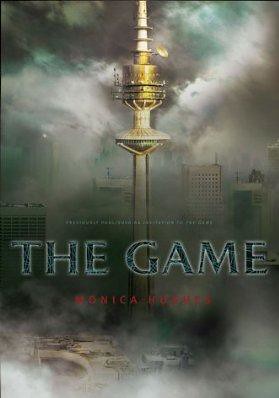
Monica Hughes, Invitation to the Game

The novel starts in the year 2154, as the 16-year-old protagonist Lisse and her friends graduate from their elite private school to their jobless adult lives. There had been a population crash in the early 21st century, precipitated by pollution, and of necessity robots were made to take over much of the day-to-day routines of human society. Even after the population recovered, however, the robots remained entrenched, with the net effect of dooming most of each coming generation to unemployment. Two of Lisse's friends are lucky enough to end up employed, for a time. The remainder are exiled with Lisse to live out their lives in a "Designated Area", an urban district to which they are confined by internal passports, depending on stipends from a resentful employed minority and grey-market jobs to live. Without any hope of escaping their condition, the young graduate drift into despair until they are invited to "The Game," a mysterious but detailed virtual reality scenario that allows them to escape to another world. Eventually, they do.

This post is not a ridiculous post about space colonization being a solution to issues of unemployment and underemployment, to marginalization and anomie. Any kind of program of space colonization is no kind of answer at all to these issues. Author
Charlie Stross' 2007 essay "The High Frontier, Redux" makes the point that, even if there are economically exploitable resources in space, the optimistic dreams of human settlement are unlikely to be realized because human beings are just too fragile to persist. Many things would have to change radically for this to happen, and we don't even know if these radical changes are possible.

This is, however, a post that's concerned about the ethics of this. In this world, as in Hughes' fictional future world, people are a resource. In many parts of the world, people are an increasingly scarce resource, especially people belonging to particular demographics or possessing certain skills. Despite the value of people as a resource, and despite these local scarcities, in many cases people are being prevented from being useful. This might be because of barriers to migration. This might be because of mistaken government policies that prevent others from realizing their talents. Whatever the precise cause, it's fundamentally ill-thought and--I'd suggest--in many ways quite wrong. As Hughes' characters note, this kind of waste might even be very problematic for the survival of any numbers of regimes.


"[I]t seems the Government's not interested in any new ideas."

"That's the problem with this society," Trent interrupted. It is uninterested. Dead in the water. We should scrap it and start over."

"How?" Karen asked, her big voice booming. "Societies tend to go on until they run down by themselves or rot from inside."

"Can you afford to wait that long?" Trent pushed his sharp face aggressively at Karen. "I can't." (13-14)


When considering demographic issues, now and in the future, it's also worth considering the extent to which particular treatments are, or are not, sustainable. Various marginalizations--keeping people out, keeping people down--might be politically convenient, but they might equally be politically dangerous.

Profile

rfmcdonald: (Default)rfmcdonald

February 2021

S M T W T F S
 123456
78910111213
14151617181920
212223242526 27
28      

Style Credit

Expand Cut Tags

No cut tags
Page generated Mar. 14th, 2026 08:15 am
Powered by Dreamwidth Studios