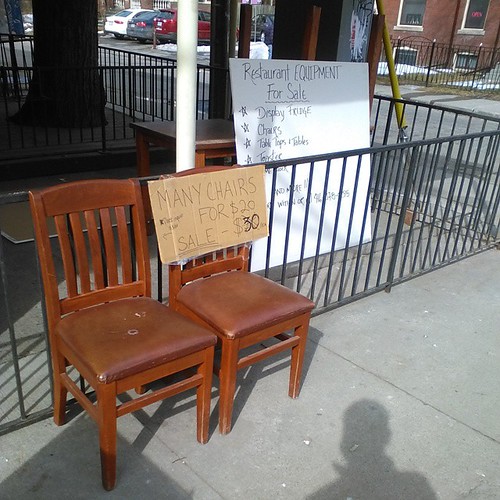
By The Way Restaurant in the Annex seemed to be selling off some of its equipment last week. Has this Toronto standard disappeared? Only time will tell.
I ask him if he thinks he should have been punished, by the public, for what he did.
Yes and no, he says.
“Yes, because I didn’t get the help earlier on that I needed. And I was lying and conniving and just doing what an addict does,” he says.
“Then on the other side of it, I didn’t do it here. I wasn’t high here, I was doing my job, showing up every day, running a great city. That was in my private life.”
He stares straight ahead, and pauses for a few moments to reconsider.
“But then I look back on it and say, would I have wanted my mayor to do what Rob Ford was doing, regardless of if it was at his private time or not? No, I wouldn’t. And I don’t think anybody would want a mayor who was, you know, an alcoholic and a drug addict, and not recognizing that, and not getting help for it.”
At the intersection of Fifth Avenue and Ninth Street in Brooklyn, the heart of Park Slope’s tree-lined prosperity abruptly gives way to grittier windswept blocks that march south to Sunset Park and west to the Gowanus Canal. Trucks and cars speed down Ninth Street as dusty construction workers, sharply dressed professionals, nannies with strollers, and roughhousing teens hustle across Fifth Avenue, all on their way to somewhere else. Perhaps this neither-here-nor-there-ness explains why two skinned goat heads that appeared without explanation above the intersection last November remained there for days. The heads were tied together at the base of the skull with twine and slung over a light pole on the intersection’s northeast corner. After at least four days, an employee from a nearby car service knocked the goat heads down with a pole and threw them in a garbage can.
Or maybe the sluggish reaction to the Park Slope goat heads signals the extent to which such discoveries have become a routine occurrence in the area. Severed goat heads keep turning up in nearby Prospect Park. Last year alone, readers sent the blog Gothamist photographic evidence of three goat heads found in the park. (In all of these cases, the goat heads had their skin still attached.) Gothamist seems to be experiencing something like goat-head fatigue, judging from the increasingly nonchalant tone of its goat-head coverage. Pretty soon it will probably take a cow head to get them excited. "It's New York,” one spectacularly unimpressed passerby told DNAinfo. “I've seen the towers come down, so beyond that, nothing really stings that bad.”
But while repeated exposure to goat heads may have inured some local residents, others have sensed an unsettling trend. Many news reports about the Park Slope goat heads suggested a dark link to the goat heads discovered in Prospect Park. “Residents have questioned whether the incidents could be connected to religious animal sacrifice,” The Wall Street Journal wrote. The specter of Santería was invoked. The Drudge Report picked up the story. The goat heads went global. As I read all this in my apartment a few blocks from the site of the hanging goat heads, I was riveted. A mysterious flood of goat heads is the only interesting thing that has happened in Park Slope since I moved to the neighborhood three years ago. Yes, the rush to blame a little-understood religion practiced largely by immigrants smacked a bit of lazy xenophobia, but the idea of Park Slope as a hotbed of animal sacrifice, in addition to child-friendly bars, was undeniably intriguing. In a city where everyday occurrences are casually weighed against the events of September 11, 2001, it was shocking to find that so many of my neighbors and I were actually shocked. The goat heads seemed to rear out of some shadow New York City that was even gnarlier than the pre-Guiliani version I’d seen in the movies, and at the edge of Brooklyn’s most thoroughly gentrified neighborhood, to boot. When New York asked me to investigate the goat heads, I leapt at the chance. I wanted to see if the world they hinted at lived up to the hype.
I quickly learned that any answers would not be forthcoming from official channels. The NYPD opened an investigation into the hanging goat heads back in November, but a public information officer with Park Slope’s 78th Precinct informed me that “no further information has been found out.” A spokesman for the Prospect Park Alliance said, “I don't think anyone in the park is going to have that much to say about it.” A FOIL request I filed with the New York City Parks and Recreation Department (for “all records related to reports of decapitated animal corpses and animal heads found in New York City parks between the years 2010–2014”) didn’t seem to be at the top of their list of priorities.
Manhattan’s smallest apartments are fueling big gains in rents.
The median rent in the borough jumped 8.9 percent last month to $3,375, according to a report Thursday by appraiser Miller Samuel Inc. and brokerage Douglas Elliman Real Estate. Costs for studio apartments climbed 10 percent to a median $2,351, while rents for one-bedrooms rose 9.4 percent to $3,400, both the highest in more than seven years of record-keeping.
New York’s smaller apartments are luring new tenants entering an improving job market in the city, as well as those who can’t afford bigger homes. Would-be buyers who have been shut out of owning because of high prices and tight credit are also lingering as renters.
“The studio and one-bedroom market is the more common jumping-off point for first-time buyers,” said Jonathan Miller, president of Miller Samuel and a Bloomberg View contributor. Rents are rising “because of the logjam that has been created by people who have either been priced out of the purchase market or don’t qualify for a mortgage.”
Manhattan apartment prices jumped to the highest since their 2008 peak in the fourth quarter as buyers competed for a limited supply of homes. Demand was greatest for one-bedroom apartments, which accounted for 38 percent of all sales last quarter, Miller said.
Philippine billionaire Enrique Razon will buy an island in South Korea to develop a leisure and tourism complex, as he taps the country’s growth in gambling on rising tourist arrivals from China.
Bloomberry Resorts Corp., controlled by Razon and operator of a casino in Manila, will buy the 21-hectare (52-acre) Silmi Island through unit Solaire Korea Co., according to a Philippine Stock Exchange filing on Tuesday. It’s Bloomberry’s second announcement of a property purchase in the country this year after the company signed in January four deals with landowners on Korea’s Muui Island, which is adjacent to Silmi Island.
Asian casino operators including Bloomberry are capitalizing on a downturn in the gambling industry of Macau as China’s corruption crackdown scares many away from the world’s biggest gambling hub. Macau casino revenue fell last year for the first time and may decline another 8 percent this year, according to analysts surveyed by Bloomberg.
In contrast, gambling revenue in South Korea and the Philippines will grow 16 percent and 33 percent respectively this year, gaining from the spillover of Chinese gamblers, Deutsche Bank analyst Karen Tang wrote in a note in January.


On one side of the line that has divided two societies for so long, the words arrive as fast as globalization can bring them — English-based lingo like "shampoo," "juice" and "self-service." To South Koreans, they are everyday language. To defectors from the insular North Korea, they mean absolutely nothing.
Turn the tables, and the opposite is true, too: People in Seoul furrow their brows at homegrown North Korean words like "salgyeolmul," which literally means "skin water." (That's "skin lotion" in the South.)
Two countries, mortal enemies, tied together by history, by family — and by language, but only to a point. The Korean Peninsula's seven-decade split has created a widening linguistic divide that produces misunderstandings, hurt feelings and sometimes even laughter. The gap has grown so wide, scholars say, that about a third of everyday words used in the two countries are different.
North and South Koreans are generally able to understand each other given that the majority of words and grammar are still the same. But the differences show how language can change when one half of the country becomes an international economic powerhouse and the other isolates itself, suspicious of outside influences.
America's huge cultural influence through its military presence, business ties and Hollywood has flooded the South Korean vernacular with English loan words and "konglish," which uses English words in non-standard ways, like "handle" for steering wheel, "hand phone" for cellphone and "manicure" for nail polish.
Annie Proulx got ficced. In a recent interview in the Paris Review, the Pulitzer Prize–winning author confessed that she wishes she’d never written her most famous work, the short story “Brokeback Mountain,”about the star-crossed romance between two cowboys. Having fans is a good thing, especially for authors of quiet, spare realism — not exactly a cohort with a healthy surplus of readers. But in the last few years, writers, filmmakers, and other artists have seen fans seize control of their creations and reimagine them as fanfiction, or fic, as its aficionados like to call it. Proulx first got ficced when a whole new audience came to “Brokeback” after the Academy Award–winning film adaptation was released in 2005. Less reverent than her typical reader, these fans have busily set themselves to producing what Proulx has termed “pornish” fiction based on her story’s two main characters, Jack Twist and Ennis Del Mar. “Unfortunately,” she said, “the audience that ‘Brokeback’ reached most strongly … can’t bear the way it ends — they just can’t stand it. So they rewrite the story, including all kinds of boyfriends and new lovers and so forth after Jack is killed.” The resulting stories, Proulx grumbled, “just drive me wild.”
Proulx is far from the only mainstream artist being dragged unwillingly into a new, fan-dominated world. Once exiled to obscure corners of the internet, fanfiction — amateur fiction based on characters from preexisting works or real-life celebrities — has lately become a force driving popular culture. As Proulx realized, fans these days aren’t satisfied to just sit back and consume. They want to participate. They want to create. And they don’t want to wait for anyone else’s permission to do it. Millions of fanfiction stories have been uploaded onto vast online archives where other fans read, rate, and comment on them. Romances, often torrid, between ostensibly straight male characters like Harry Potter and his onetime nemesis Draco Malfoy are especially popular, and there’s an entire category of fanfiction, called mpreg, in which beloved male characters and celebrities (e.g., One Direction singer Harry Styles) are able, bizarrely, to get pregnant. Fandom’s untrammeled imagination is also colonizing the wider world. E L James’s Fifty Shades of Grey started as Twilight fic. And what are J. J. Abrams’s Star Trek and Star Wars reboots — which take the original source materials (called “canon” in fic circles) and shape them to new ends — if not examples of the fanfiction spirit when enabled by hundreds of millions of dollars?
Although human beings have been stealing and reworking each other’s stories for millennia, fanfiction as we now know it began back in the days of Star Trek fanzines, on whose mimeographed pages female Trekkers wrote of Mr. Spock swooning in the arms of an ardent Captain Kirk. For decades, fanfiction communities — soon to migrate en masse to the web — functioned as a subset of science-fiction and fantasy fandom, where they were treated, by the mostly male nerds who ran things, like a younger sister best banished to her room whenever company came by. The internet changed all that by ushering in the era of the networked fan, often a girl who sampled her first taste of fic in Harry Potter fandom. Like it or not, the once-Olympian creators of the canon — known among fic writers as TPTB, or “the powers that be” — now have little choice but to listen to them. Robust, established online networks of Harry Potter and Twilight fans played a significant role in making The Hunger Games books into best sellers and, after that, blockbuster films.
![[personal profile]](https://www.dreamwidth.org/img/silk/identity/user.png) branchandrootdancing_serpent
branchandrootdancing_serpent