Aug. 3rd, 2015
[BLOG] Some Monday links
Aug. 3rd, 2015 02:16 pm- James Bow reflects on Mulcair's decision to ignore the debates boycotted by Harper, and examines the decline of the Bloc Québécois.
- The Broadside Blog's Caitlin Kelly reflects on the social forces pressuring people, especially women, to smile.
- Centauri Dreams reflects n the pessimism over the potential of interstellar expansion in Kim Stanley Robinson's new Aurora.
- The Dragon's Gaze links to a study examining the links between concentrations of elements in stars and their exoplanets, shares art of HD 219134b, wonders about distributions of brown dwarfs in nearby interstellar space, wonders if a lithium-rich giant star known as HD 107028 swallowed its planets, and imagines compact exoplanets made of dark matter.
- The Dragon's Tales shares a study of the growth of the state of Tiahuanaco, and imagines what a durable Russian-American relationship could have been.
- A Fistful of Euros looks at dodgy Greek statistics.
- Joe. My. God. shares the new New Order single, "Restless."
- Language Hat celebrated its thirteen anniversary and looked at the ephemeral St. Petersburg English Review of the 19th century.
- Language Log examines the origins of modern China's standard language, and looks at the reasons why French texts are longer than English ones.
- Lawyers, Guns and Money examines settler violence in Israel.
- Marginal Revolution looks at how charity, in an age of global income disparities, is inexpensive, and notes the economic issues of Cambodia.
- Personal Reflections' Jim Belshaw reflects on Cilla Black.
- The Russian Demographics Blog looks at Ossetian demographics and examines the growth of Kazakhs in Kazakhstan after 1991.
- Speed River Journal's Van Waffle likes the Cosmonaut Volkov heirloom tomatoes.Towleroad reports on a push for marriage equality on the Navajo reservation.
- Understanding Society examines the concept of microfoundations.
- Window on Eurasia notes how Russia's war in Ukraine has been underachieving, argues Ukrainians should not count on change in Russia, reports on a Russian writer who wants the Donbas to be separated from Ukraine as a buffer, looks at ethnic Russian identity and propensity to emigrate in Kazakhstan, and looks at the identity of Belarusians in Siberia.
[BLOG] Some Monday links
Aug. 3rd, 2015 02:46 pm- James Bow reflects on Mulcair's decision to ignore the debates boycotted by Harper, and examines the decline of the Bloc Québécois.
- The Broadside Blog's Caitlin Kelly reflects on the social forces pressuring people, especially women, to smile.
- Centauri Dreams reflects n the pessimism over the potential of interstellar expansion in Kim Stanley Robinson's new Aurora.
- The Dragon's Gaze links to a study examining the links between concentrations of elements in stars and their exoplanets, shares art of HD 219134b, wonders about distributions of brown dwarfs in nearby interstellar space, wonders if a lithium-rich giant star known as HD 107028 swallowed its planets, and imagines compact exoplanets made of dark matter.
- The Dragon's Tales shares a study of the growth of the state of Tiahuanaco, and imagines what a durable Russian-American relationship could have been.
- A Fistful of Euros looks at dodgy Greek statistics.
- Joe. My. God. shares the new New Order single, "Restless."
- Language Hat celebrated its thirteen anniversary and looked at the ephemeral St. Petersburg English Review of the 19th century.
- Language Log examines the origins of modern China's standard language, and looks at the reasons why French texts are longer than English ones.
- Lawyers, Guns and Money examines settler violence in Israel.
- Marginal Revolution looks at how charity, in an age of global income disparities, is inexpensive, and notes the economic issues of Cambodia.
- Personal Reflections' Jim Belshaw reflects on Cilla Black.
- The Russian Demographics Blog looks at Ossetian demographics and examines the growth of Kazakhs in Kazakhstan after 1991.
- Speed River Journal's Van Waffle likes the Cosmonaut Volkov heirloom tomatoes.
- Towleroad reports on a push for marriage equality on the Navajo reservation.
- Understanding Society examines the concept of microfoundations.
- Window on Eurasia notes how Russia's war in Ukraine has been underachieving, argues Ukrainians should not count on change in Russia, reports on a Russian writer who wants the Donbas to be separated from Ukraine as a buffer, looks at ethnic Russian identity and propensity to emigrate in Kazakhstan, and looks at the identity of Belarusians in Siberia.
The island of La Réunion, a French overseas department in the southern Indian Ocean, is getting a higher profile these days since the discovery of wreckage possibly part of missing flight MH30. Joe Brock's Reuters article, hosted at The Globe and Mail, notes the hope of some on the island that this might rebound to the island's benefit.
Many of the 800,000 residents have been overwhelmed by the attention placed on their island, where big local stories are usually about shark attacks and volcanic eruptions.
“Before, the only people who knew about this island were scientists and surfers,” Villeneuve, 43, told Reuters from the island’s volcano observatory, where he is studying the after effects of the latest eruption.
[. . .]
Reunion’s tourist board and residents hope the island’s unexpected role in the MH370 mystery will have a positive impact on visitor numbers, as images of the dramatic volcano, sandy beaches and crystal blue waters are aired around the world.
Reunion, roughly half the size of Indonesia’s tourist island of Bali, attracts a fraction of the millions of tourists who flock to other Indian Ocean islands, like Mauritius and the Maldives.
“The island is so beautiful and mysterious. It’s like Hawaii,” said Fadila Hammachi, 55, a French businesswoman who comes to Reunion on holiday every year.
“I hope more people come but not too many. I like it for myself,” she adds, pointing towards the lush, mountainous interior where sugar cane, ginger and pineapples are grown.
The Washington Post's Mark Bonesteel reports on the news. Is this one sign of Greece's recent political changes?
If you’re Cristiano Ronaldo and you made $79.6 million last year, chances are you can hand out some pretty sweet wedding presents. And if you’re Ronaldo’s agent, who helped him make all that cash, you’re probably going to get something that’s not on the registry.
[. . .]
The BBC translated the Mundo Deportivo report, revealing that there are in fact many Greek islands for sale., one for the low, low price of around $3.3 million. The BBC also said that Mendes is one of Portugal’s richest men, worth nearly $110 million thanks to his work with a number of soccer’s top stars. So he should be able to furnish his brand-new Greek island without much trouble.
[WRITING] "An Introverted Writer’s Lament"
Aug. 3rd, 2015 06:44 pmThe Atlantic features an essay by one Meghan Tifft somewhat critical of what she sees as the newly-extroverted culture of writers.
Whether we’re behind the podium or awaiting our turn, numbing our bottoms on the chill of metal foldout chairs or trying to work some life into our terror-stricken tongues, we introverts feel the pain of the public performance. This is because there are requirements to being a writer. Other than being a writer, I mean. Firstly, there’s the need to become part of the writing “community”, which compels every writer who craves self respect and success to attend community events, help to organize them, buzz over them, and—despite blitzed nerves and staggering bowels—present and perform at them. We get through it. We bully ourselves into it. We dose ourselves with beta blockers. We drink. We become our own worst enemies for a night of validation and participation.
Lately, though, I’ve been asking why.
This question comes after several years of feeling ill at ease about my increasing lack of participation in the writing world. There’s my avoidance of readings, my fake enthusiasm as I swindle my own students out of their Friday nights to go to a lecture I won’t attend, my gag-triggering physical loathing of bookstores, my requirement that reading materials appear on my nightstand by benevolent conjury, without any consumer effort from me. There’s my acute failure as an educator to fill any tiny part of the role of writing-community steward that is assumed of me. There’s my own titanic hypocrisy most recently as I think about promoting a new book in the very community I can’t show love for. So here I am. In all my humility. Hello friends. Hello community. If you could pretend along with me that I’ve been here this whole time, that would be super.
My personal reticence aside, I agree with the general consensus that these live and in-person performances are a good thing: good for writers, good for the larger book world. Whether authors like to attend them or not, they’re justly lauded as an authentic celebration of earnest aspiration in a world that’s perennially hijacked by commercial concerns—worries about getting the story formulated for the eventual TV/movie adaptation bonanza, or timing the genre mash-up so that it can best crest the fad frenzy. Amid this noise, the writer’s variety show of readings, interviews, conferences, and Q&As is a way of talking back, creating and sustaining a community around writing that matters. It’s a way of feeling a little less desperate and a little more resourceful, of proudly professing our interdependency and earning our solidarity.
The purpose of all this is to enact the larger mission of the writing and arts communities: We want to transfigure the market demands of self-promotion into something inherently more valuable, to say yes and no to those rites of passage offered to us by the powers that be. We want to do all we can to promote our writing—and good writing in general—but sometimes the rituals by which we put ourselves out there can seem empty and exhausting. And if we choose to reject them altogether, we can feel like we’re not being good team players or doing our part.
That is why my first and most pressing question seems like such an outright act of mutiny. What I want to know is, since when does making art require participation in any community, beyond the intense participation that the art itself is undertaking? Since when am I not contributing to the community if all I want to do is make the art itself? Isn’t the art itself my intimate communication with others, with the world, with the unfolding spectacle of the human struggle as we live and coexist on this earth?
[WRITING] "The Web We Have to Save"
Aug. 3rd, 2015 06:47 pmEarlier today, I linked to famous Iranian-Canadian blogger Hossein Derakhshan's essay at Medium. Imprisoned in Iran for six years because of his blogging, to him the changes that hit the online world between 2008 and 2014 were all the more visible. Original content, exemplified by the hyperlink, no longer matters nearly as much.
Six years was a long time to be in jail, but it’s an entire era online. Writing on the internet itself had not changed, but reading — or, at least, getting things read — had altered dramatically. I’d been told how essential social networks had become while I’d been gone, and so I knew one thing: If I wanted to lure people to see my writing, I had to use social media now.
So I tried to post a link to one of my stories on Facebook. Turns out Facebook didn’t care much. It ended up looking like a boring classified ad. No description. No image. Nothing. It got three likes. Three! That was it.
It became clear to me, right there, that things had changed. I was not equipped to play on this new turf — all my investment and effort had burned up. I was devastated.
[. . .]
The hyperlink was my currency six years ago. Stemming from the idea of the hypertext, the hyperlink provided a diversity and decentralisation that the real world lacked. The hyperlink represented the open, interconnected spirit of the world wide web — a vision that started with its inventor, Tim Berners-Lee. The hyperlink was a way to abandon centralization — all the links, lines and hierarchies — and replace them with something more distributed, a system of nodes and networks.
Blogs gave form to that spirit of decentralization: They were windows into lives you’d rarely know much about; bridges that connected different lives to each other and thereby changed them. Blogs were cafes where people exchanged diverse ideas on any and every topic you could possibly be interested in. They were Tehran’s taxicabs writ large.
Since I got out of jail, though, I’ve realized how much the hyperlink has been devalued, almost made obsolete.
blogTO's Chris Bateman makes the case that the Toronto neighbourhood of St. Lawrence holds the historic core of the city of Toronto.
There is more, including abundant photos, at the site.
In 1793, the little frontier town of York consisted of just 10 blocks: two rows of five stacked on top of each other between present day George, Front, Adelaide, and Berkeley streets. The entire city of Toronto grew from this tiny waterfront nucleus.
The original city is now firmly within the St. Lawrence neighbourhood. King St. east of Jarvis cuts right through the centre of the more than 200-year-old community.
In 1797, plans were made to extend the city to the north and west. Peter Russell, an administrator who succeeded town founder John Graves Simcoe, mapped out new roads west to Peter St. and north to Queen St. The extension included space for a market, court house, church and jail.
As historian Wendy Smith notes, the westward push was limited by an "ordnance boundary" located 1,000 feet east of Fort York. The canons that were meant to protect York from invasion needed a clear line of sight and so, at the time, nothing could be built closer to the military base.
toronto oldest neighbourhoodThe allowance for a market spawned today's St. Lawrence Market (the original allocation is currently occupied by St. Lawrence Hall) and the church block is now home to St. James Cathedral. The city's first coffee shop was also located in the area, as was the first Upper Canada parliament buildings at Front and Berkeley.
There is more, including abundant photos, at the site.
The Toronto Star's Peter Edwards reports on patterns in Google searches in Toronto. I would suggest that another explanation might be that users of Chinese languages use search engines other than Google, Baidu for instance.
Toronto has a large Chinese community, but there’s not much Chinese-language Googling out of the GTA. But Toronto has a far smaller Spanish-language community, and Spanish is the most-used language for Googling from here, after the official languages of English and French.
Those are a few of the findings of a just-released study by the Google News Lab.
The study breaks down the estimated more than 3 billion searches a day globally by language and city for Berlin, Delhi, London, Madrid, New York, Paris, Sao Paulo, Shanghai and Toronto.
“It’s interesting,” McMaster University sociology professor Vic Satzewich said in an interview.
Satzewich, who has studied patterns of immigration, suggested ebbs and flows in immigration and tourism help explain the Googling patterns.
He suggested that the low number of Chinese-language Googlers from the GTA might be reflected in part by an effort by the government to attract immigrants who are strong in Canada’s two official languages.
The high Spanish-language Googling from the GTA could reflect an increase in temporary workers from Mexico and Guatamala over the past decade.
The CBC reports on the discovery in Newfoundland of fossils a half-billion years old providing hints about how reproduction first occurred among complex organisms.
A team led by researchers from England's University of Cambridge found the fossils in the Trinity Bay North area. The new fossils were estimated to be 565 million years old and belonged to Fractofusus, a type of rangeomorph. Rangemorphs, marine organisms that looked a bit like ferns, were some of the earliest complex organisms on Earth. Earlier life forms were mostly single-celled and reproduced simply by dividing.
The Fractofusus fossils are clustered together in a way that suggests there are three generations of organisms in a cluster — larger, older ones surrounded by younger, smaller ones.
Jack Matthews of Oxford University has been studying rocks in Newfoundland for about eight years. He was part of the team that found the fossils.
"It [the clustering] suggests that these organisms could reproduce rapidly via what's known as asexual reproduction," said Matthews.
The pattern strongly resembles clustering observed in modern plants such as strawberries, where smaller offspring grow from "runners" sent out by the older generation.
I've read and re-read Wolverine: Enemy of the State, a 2008 graphic novel collecting the various issues of Wolverine in 2004 and 2005. Scripted by Mark Millar and drawn by John Romita Jr., Enemy of the State tells the story of what happens when HYDRA gets their hands on Wolverine and brainwashes him to by their mass-murdering agent of the apocalypse.
I have to agree with the reviewer who said that Enemy of the State is an exciting if shallow romp through the Marvel universe. I'd go further and say that the whole thing--Wolverine's lethality, HYDRA's aims, the revelation of the terrors hidden beneath the facade of the Marvel Universe--takes on the qualities of a highly violent camp style.
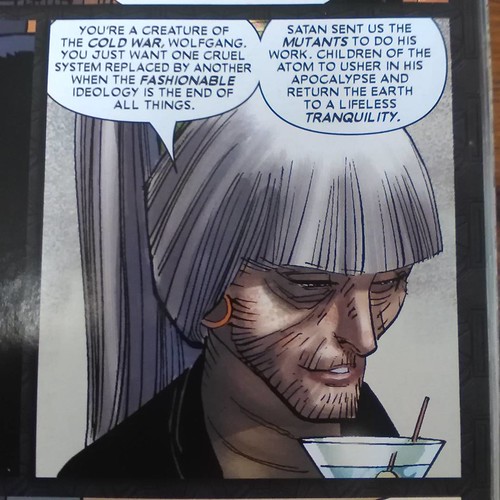
Take HYDRA, for instance. Initially, it is headed by Baron Wolfgang von Strucker, a moderate. What does he do? He complains that his wife does not love him in his diary, mourning the loss of his love even as he mentions in passing how he engages in the blood sacrifice of children.

What of Baroness Elisbeth von Strucker, his Satanist wife nearly two centuries old who ends up taking HYDRA away from him? Her aims are simpler.

Millar does some things well. He does not do subtle, complex villains.
Another example of this camp comes in the middle of the arc, when Wolverine breaks into the X-Mansion and tries to force Rachel Grey to use Cerebro to kill the American president. As she seemingly sets to work, obeying the man who threatens to use a terraformer developed by Reed Richards to kill everyone in Westchester County, Wolverine's brainwashers try to convince him to rape Rachel. After all, she looks just like her recently-dead mother Jean ...
This is not a good plan.

(The above image comes from a Scans Daily post collecting some images from Alan Davis' run on Excalibur, this one coming from Excalibur #61.)
"Hey, HYDRA-brainwashed Wolverine. What are you doing?"
"Oh. You're planning on raping the beloved only daughter of the feared cosmic force that burns away what doesn't work."
"Yes, sure. She's been radically depowered. She's no longer capable of draining the life-energies of the future universe to brutally beat up Galactus. She's much weaker."
"Sure. She's just one of the most powerful telepaths and telekinetics alive. But you've got claws. Go get her! I'll just stand over here."


Possibly Millar was trying to evoke a previous fight between Wolverine and Rachel, in Claremont's Uncanny X-Men #207, when Wolverine stabbed Rachel to prevent her from murdering a villain. My takeaway from this is simply that Wolverine, as guided by HYDRA, was making an almost hilariously bad decision.
Finally, one thing I've noticed in Millar's other books, like Kick-Ass, is that the actions of violent characters usually receive approbation by normal people, by people rooted outside of the realm of the superhero or the vigilante who approve of this violence because it is directed against people who deserve it. In this book, this role is played by Fukuko, a Japanese wife and mother whose only child was abducted by HYDRA as part of a ploy to lure Wolverine. (Her son was later murdered, fed to pigs, and buried on a barren hillside.) When Wolverine phones her and his husband to let them know what had happened and that he vows vengeance, she has only this to say.

Never ask Wolverine rhetorical questions.

Yes, the above is a picture of Wolverine riding a Sentinel into a mystic hidden city in Japan so he can kill ninjas by the hundreds.

Enemy of the State is a fun book, but I have problems taking it seriously. I think you can see why.
I have to agree with the reviewer who said that Enemy of the State is an exciting if shallow romp through the Marvel universe. I'd go further and say that the whole thing--Wolverine's lethality, HYDRA's aims, the revelation of the terrors hidden beneath the facade of the Marvel Universe--takes on the qualities of a highly violent camp style.
Take HYDRA, for instance. Initially, it is headed by Baron Wolfgang von Strucker, a moderate. What does he do? He complains that his wife does not love him in his diary, mourning the loss of his love even as he mentions in passing how he engages in the blood sacrifice of children.

What of Baroness Elisbeth von Strucker, his Satanist wife nearly two centuries old who ends up taking HYDRA away from him? Her aims are simpler.

Millar does some things well. He does not do subtle, complex villains.
Another example of this camp comes in the middle of the arc, when Wolverine breaks into the X-Mansion and tries to force Rachel Grey to use Cerebro to kill the American president. As she seemingly sets to work, obeying the man who threatens to use a terraformer developed by Reed Richards to kill everyone in Westchester County, Wolverine's brainwashers try to convince him to rape Rachel. After all, she looks just like her recently-dead mother Jean ...
This is not a good plan.

(The above image comes from a Scans Daily post collecting some images from Alan Davis' run on Excalibur, this one coming from Excalibur #61.)
"Hey, HYDRA-brainwashed Wolverine. What are you doing?"
"Oh. You're planning on raping the beloved only daughter of the feared cosmic force that burns away what doesn't work."
"Yes, sure. She's been radically depowered. She's no longer capable of draining the life-energies of the future universe to brutally beat up Galactus. She's much weaker."
"Sure. She's just one of the most powerful telepaths and telekinetics alive. But you've got claws. Go get her! I'll just stand over here."


Possibly Millar was trying to evoke a previous fight between Wolverine and Rachel, in Claremont's Uncanny X-Men #207, when Wolverine stabbed Rachel to prevent her from murdering a villain. My takeaway from this is simply that Wolverine, as guided by HYDRA, was making an almost hilariously bad decision.
Finally, one thing I've noticed in Millar's other books, like Kick-Ass, is that the actions of violent characters usually receive approbation by normal people, by people rooted outside of the realm of the superhero or the vigilante who approve of this violence because it is directed against people who deserve it. In this book, this role is played by Fukuko, a Japanese wife and mother whose only child was abducted by HYDRA as part of a ploy to lure Wolverine. (Her son was later murdered, fed to pigs, and buried on a barren hillside.) When Wolverine phones her and his husband to let them know what had happened and that he vows vengeance, she has only this to say.

Never ask Wolverine rhetorical questions.

Yes, the above is a picture of Wolverine riding a Sentinel into a mystic hidden city in Japan so he can kill ninjas by the hundreds.

Enemy of the State is a fun book, but I have problems taking it seriously. I think you can see why.