Aug. 5th, 2015

rfmcdonald: (Default)
Playing the game #toronto #sports #football #stclairwest


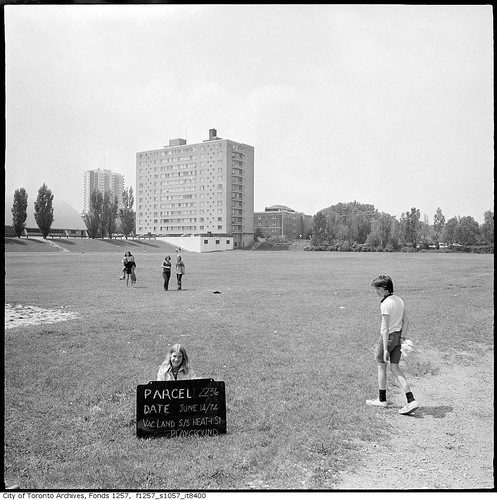
I was exiting the northern exit of the St. Clair West subway station on Tichester Road/Heath Street when I saw a team playing on the field in late evening. A later googling brought up the below photo from 1974, revealing that even before this space became a high-end sports field for St. Michael's College School--I think--it was still used. Continuity impresses me.

Vacant land used as playground, Heath Street West, south side
rfmcdonald: (Default)
Bloomberg's Pietro Pitts reports on the parlous state of Venezuela's Lago Maracaibo, a brackish bay that hosts much of the country's oil industry.

From the moment the diver in red nylon coveralls and blue Chuck Taylor sneakers resurfaces after replacing rusted pipeline on the bed of South America’s largest lake, it’s a race against time. Coated head to toe in dark-black oil, he clambers aboard the service boat, rips off his makeshift uniform and scrambles to hose himself down with a special compound to wash away the contaminants.

For nearly a century, the petroleum deposits beneath giant Lake Maracaibo served as a cash cow for successive Venezuelan governments. In return, especially in the years since the industry was brought fully under state control by former President Hugo Chavez, it has received little back but neglect.

The Maracaibo basin is where Venezuela’s enormous energy bounty, including oil reserves that dwarf even those of Saudi Arabia, smacks up against the diminished capacity of the state-owned monopoly producer, Petroleos de Venezuela SA, to manage the twin demands of increased production and environmental protection.

[. . .]

The economy began slowing well before the oil price rout of the past year. Growth now is solidly in negative territory, inflation is running above 80 percent a year, the highest in the world, according to Bloomberg News consensus forecasts, and the country’s benchmark bonds trade at about 41 cents on the dollar -- giving them a yield over 20 percent -- compared with a peak price of 129 cents on the dollar back in 2006. Venezuela is more reliant than ever on petroleum revenues, which account for 95 percent of export earnings and nearly half of government revenues, according to the country’s foreign ministry.

Even by the standards of a country as blessed with resource wealth as Venezuela, the Maracaibo basin is a marvel. It has been producing oil for a century, ponying up nearly 43 billion barrels so far. With 19 billion barrels of proven reserves remaining -- more than the total proven reserves for either Brazil or Mexico -- the lake could be providing greater relief if troubled Venezuela was more receptive to outside capital and expertise beyond China and Russia, Antero Alvardo and Carlos Rossi, analysts from Gas Energy Latin America and EnergyNomics, said in separate interviews.
rfmcdonald: (Default)
The editors of the Bloomberg View suggest that the Spanish economy is well on its way to recovery. This is critical, not only for Spain but for Mediterranean Europe and the wider Eurozone generally. If Spain recovers while part of the Eurozone as a consequence of policy, this undercuts certain Greek claims.

The economy suffered a crippling downturn in the financial crisis, then hobbled along until 2012 without anybody doing much about it. At that point, the government applied for a 100-billion-euro rescue package from the European Union. The situation was grim. Spain's real-estate bubble had burst, unemployment (a blight on Spain for years) had climbed above 25 percent, and cascading bankruptcies further undermined confidence. The yield on 10-year Spanish bonds in July 2012 ran more than five percentage points over Germany's, prompting the European Central Bank to step in to save Spain from speculative runs on its sovereign debt.

The government of Prime Minister Mariano Rajoy bowed to austerity demands, cut public-sector wages and benefits, and increased VAT to 21 percent (with exemptions) from 18 percent. Had he stopped there, Spain might have bumped along the bottom for a good while longer, rather than seeing the recovery it's now enjoying.

Low inflation, a cheap euro, the fall in energy prices and renewed financial stability in Europe have supported consumer spending and lifted Spain's beleaguered retailers. Holidaymakers have favored Spain this season, too -- in part because visiting Greece without bundles of cash has presented difficulties. Put much of all that down to luck.

But Spain's recovery today also owes a lot to hard reform aimed at particular failings in the economy. The Rajoy government braved street protests and the rise of an anti-reform left-wing opposition and persisted in a deliberate rewiring of the Spanish economy, with an emphasis on far-reaching labor-market and tax reforms.

In 2014, the government said it would gradually lower the corporate tax rate to 25 percent from 30 percent. The top marginal rate on personal income will fall to 45 percent from 52 percent. The government is limiting deductions, broadening the tax base and making a serious effort to curb evasion.
rfmcdonald: (Default)
The Conversation hosts an interesting article describing how early 20th century records of the language of the Chitimacha of Louisiana, drawn from the last two speakers, are being used to support a contemporary revival.

In the early 1990s, cultural director for the tribe Kim Walden received a call from the American Philosophical Society Library informing her that they had all of Morris’ notebooks, and even his drafts for a grammar manual and dictionary, which totaled hundreds of pages in all. Thus began the herculean effort to revive the language.

The tribe put together a small-but-dedicated team of language experts, who set out to learn their language as quickly as possible. They began to produce storybooks based on Ben and Delphine’s stories, and word lists from the dictionary manuscript.

In 2008, the tribe partnered with the software company Rosetta Stone on a two-year project to create computer software for learning the language, which today every registered tribal member has a copy of. This is where I came in, serving as editor and linguist consultant for the project, a monumental collaborative effort involving thousands of hours of translating, editing, recording and photographing. We’re now hard at work finishing a complete dictionary and learner’s reference grammar for the language.

Today, if you stroll through the reservation’s school, you’ll hear kids speaking Chitimacha in language classes, or using it with their friends in the hall. At home they practice with the Chitimacha version of Rosetta Stone, and this past year the tribe even launched a preschool immersion program.

The kids even make up slang that baffles adult ears, a sure sign that the language is doing well – and hopefully will continue to thrive, into the next generation and beyond.
rfmcdonald: (Default)
Tara Isabella Burton of National Geographic describes life for the vanishingly small remnant of Bukharan Jews who remain in their homeland of Uzbekistan. The near-totality of the community has emigrated, to Israel and New York City.

Under the secularist Soviet Union, remembers Abraham Ishakov, cantor at the old town’s synagogue, carrying out the yushvo—mourning rituals central to the faith and culture of Bukharian Jews—was strongly discouraged. When his own father died, “we used to have to sneak into the synagogue and pray in secret.”

Now, caring for the dead in Bukhara is no less challenging an affair, albeit for different reasons. There is almost nobody left to mourn them.

Ishakov points out a plaque from 2000, commemorating the donors who paid for the most recent renovation. “Rafael Davidov. He moved to America. Jacob Rafaelkov. Off to Israel. Hasimov Sharimov. Israel. Isaac Abramov. New York. Soson Priyev. USA.”

Once, Central Asia was home to 45,000 Bukharian Jews: an ethno-religious group—speaking a dialect known as Judeo-Tajik—centered in this city. They worked as merchants and craftsmen, trading along the Silk Road.

When the Soviet Union collapsed, waves of Jews emigrated abroad—mostly to America and Israel—some for economic reasons, some because of fear of persecution, should an Islamist government should come to power in Uzbekistan.

Today, around 100 Jews are left in Bukhara, the community's heartland. In the New York City borough of Queens, alone, there are about 50,000.
rfmcdonald: (Default)
Sam Cooper at the National Post describes how Vancouver's airport is a major corridor for money smuggled from China.

Vancouver International Airport is the major port of entry for millions in hidden cash being smuggled into North America by mostly Chinese citizens, a federal document investigation by The Province reveals.

And according to money laundering investigators, the amounts identified in Canada Border Service Agency cash seizure data, obtained by The Province under freedom of information law, is only the tip of the iceberg.

Experts said Vancouver appears to be targeted by Chinese citizens because Canada’s forgiving border laws allow seized cash to be returned for minimal fines. As well, permissive property investment rules and loose reporting compliance in the real estate industry make Vancouver homes the perfect vehicle for illicit offshore investment.

“A lot of the illicit money coming into Canada from Chinese citizens is laundered through real estate in Vancouver,” Hayley Labbé, a senior forensic investigator with the firm MNP LLP, told The Province.

The Province obtained CBSA data months after undertaking a wide-ranging federal document search to learn more about China’s anti-graft initiatives such as Operation Fox Hunt and SkyNet — the aggressive crackdowns by the Communist Party of China on political corruption suspects.
rfmcdonald: (Default)
Greg Miller of Wired describes a remarkable online atlas of a neighbourhood in Manhattan.

Walk down Greene Street in SoHo today and you’ll pass an Apple Store, a Ralph Lauren store, and a variety of other high-end retailers. A hundred forty years ago, you’d be walking by brothels. The street has been up and down (and up again) several times in its 400 year history, as a fascinating new website illustrates with maps, graphics, and historical photos.

There’s a ton of data behind the flashy graphics, pulled from the US Census Bureau, city directories, and other sources. Economist William Easterly of New York University and colleagues made the site to accompany a research paper they’re getting ready to submit to a journal. “It’s a very wonky paper full of academic jargon,” Easterly says. “This [website] is meant to make it more accessible.”

Most research on economic development takes a very broad view, focusing on a country or other relatively big region, Easterly says. Very few studies have tried to investigate how the fortunes of much smaller areas map onto broader trends. In this case, Easterly and colleagues chose a single block of Greene Street, between Houston and Prince. He admits the choice was partly driven by convenience—the block isn’t far from his office at NYU and it’s close to his home. “I’ve been walking my dog there for years,” he says.

With its upscale retail and astronomical real estate, the block is extremely prosperous, and Easterly says he first assumed it had always been so. As it turns out, it had not.

The first inhabitants of record were four “half-free” slaves given land by Dutch colonialists in the 1640s. By 1700, under British control, the area was a farm that grew food that was sent to the Caribbean to feed slaves working on sugar plantations. In the 1820s, a yellow fever outbreak near the downtown port prompted wealthy New Yorkers to move north, into the area around the Greene Street block. By the 1850s it was a wealthy residential area.
rfmcdonald: (Default)

  • blogTO notes chain Second Cup's reboot of its Toronto cafes.

  • Centauri Dreams notes that the Rosetta probe's comet is approaching perihelion.

  • The Dragon's Gaze links to a paper connecting stellar metallicity to a galactic habitable zone.

  • The Dragon's Tales updates us on the Donbass war.

  • Joe. My. God. notes a Swiss Catholic bishop's approval of murderous homophobia.

  • Language Log notes that the Spanish of Jeb Bush is actually pretty decent.

  • Languages of the World looks at the complex grammar of the Mohawk language.

  • Towleroad notes the fight for same-sex marriage in the Philippines.

  • Window on Eurasia is critical of Russia's claims to a unique position in Crimea.

rfmcdonald: (Default)
New York's Jesse Singal has an extended NSFW interview with Jane Ward, author of the upcoming book Not Gay: Sex between Straight White Men. In this book, Ward seems to make the argument that self-identified straight man who have gay sex are not necessarily in the closet, whether about being gay or bisexual, but that they actually are straight. They just don't think of what they're doing as sexual, necessarily. Further into the interview, Ward makes some unsettling observations, suggesting that sexuality can be based on repulsion as much as attraction.

I'll be keeping my eyes out for this book.

There does seem to be this idea that women can do it without being seen as gay, while with men, either there’s some explanation that can explain it, or they’re gay and just don’t realize or won’t acknowledge it.

Right, and it's not just sort of conventional wisdom or conservative ideology that teaches that. I think there's been a lot of sexological and psychological research suggesting that men's sexuality is more rigid than women's and that women are inherently more sexually fluid. And what I argue in the book is that even that research is situated within some long-held beliefs about the fundamental difference between men and women that are not accurate from a feminist perspective. It's interesting, because if you look at this belief that women's sexuality is more receptive — it’s more fluid, it’s triggered by external stimuli, that women have the capacity to be sort of aroused by anything and everything — it really just reinforces what we want to believe about women, which is that women are always sexually available people.

With men, on the other hand, the idea that they have this hardwired heterosexual impulse to spread their seed and that that's relatively inflexible, also kind of reinforces the party line about heteronormativity and also frankly, patriarchy. So one selling point for me in the book was to think about, Why are we telling this really different story about women's sexuality?

You take readers on sort of a 20th-century American tour of heterosexual dabbling in homosexual behavior, and there was never a lack of evidence that such dabbling took place. You write about homosexual activity within biker gangs, for example — one Hell’s Angel, enthusiastically describing having gay sex for cash, memorably told Hunter S. Thompson, “Shit, man, the day they call me queer is when I let one of these faggos suck on me for less than a tenner.” This stuff was sort of always going in all sorts of different situations and cultural contexts, right?

Right, exactly, but what's interesting about all of those accounts is that because we’re so committed to this narrative that men's sexuality is bound by biology and can only be shifted somehow by the most extreme circumstances, the authors of those various accounts always seem to come to the conclusion that it was the very unique and particular circumstances of that context that account for why heterosexual men would act homosexually.

So if it was in prisons it was like, Well, this would only happen in prison because there are no women available, and that's how we would explain this. And people who looked at the military would say, This would only happen in the military, but no one who was looking at prisons or the military was also looking at what was happening in bathrooms or bars or living rooms or in biker gangs or all of the other contexts where, frankly, those constraints aren’t in place. And yet despite lacking any pressing reason to do so, men are still manufacturing reasons to touch each other’s anuses. So that was one of the guiding questions through the book: What happens when we pull all of this evidence together? What might we glean about straight men's sexuality?
rfmcdonald: (Default)
Alex Boutilier and Joanna Smith of the Toronto Star report on the cost of the upcoming October federal election, and its implications.

The true cost of an extra-long campaign goes beyond what the national political parties can spend on advertising and airplanes, because it also allows their candidates another $73.6 million nationwide.

A Star analysis of preliminary election expenses limits released by Elections Canada — newly calculated to reflect the 78-day campaign leading up to the Oct. 19 vote — shows that candidates on the ballot are able to spend up to 114 per cent more than they could have had Conservative Leader Stephen Harper kicked off the election later.

That would be in addition to the record-breaking $54.5 million that could be spent by political parties running candidates in all 338 federal ridings, up from the $25 million allowed in a 37-day campaign.

Much has been said about how much of an effect higher spending limits could have on the national campaigns, with many observers giving the advantage to the Conservatives. But it could also affect the ability of local candidates to compete in communities against better-financed opponents.
Page generated Apr. 13th, 2026 02:04 am
Powered by Dreamwidth Studios