![[personal profile]](https://www.dreamwidth.org/img/silk/identity/user.png)
Feb. 12th, 2016


National Geographic's Marianne Lavelle notes the complexities of dealing with atmospheric carbon dioxide.
To meet the Paris climate deal's goal of deep greenhouse gas cuts, nations appear to be relying on costly, possibly harmful large-scale projects to suck carbon dioxide from the atmosphere, says a new paper with sobering calculations of the risks.
"The Paris agreement shows where we want to go — the brave new world of a balanced carbon budget — but not how to get there," says Phil Williamson, environmental scientist at the University of East Anglia in the United Kingdom and science coordinator for the U.K. government's Natural Environment Research Council.
Williamson warned in a commentary Wednesday in Nature that even seemingly beneficial approaches like tree planting could wreak havoc if they are implemented on the massive scale required to limit the increase in average global temperature to below 2° Celsius.
"There's a lot of optimism based on the assumption it will all be all right, because sometime in the future, we're going to be able to remove the carbon," Williamson said in a phone interview. "Well, that's actually going to be more trouble and more expensive than if you face up to the problem now." He said research is urgently needed on the consequences of these massive carbon removal projects, which he says are essentially geoengineering projects by another name.
Paris negotiators did not specifically discuss carbon removal, but Williamson argues their deal implicitly relies upon large-scale mitigation projects, because nations are not on track to cut fossil fuel burning enough to meet the pact's targets.
Wired's Nic Cavell notes poaching of the South China Sea's giant clams.
Last fall, the United States and China came together to crack down on the ivory trade. Both countries—the two biggest markets for illegal ivory—banned the import and export of the stuff, hoping to save some of the elephants being poached for their tusks. No more alabaster piano keys, no more intricately carved jewelry. At least not made of ivory. In the absence of elephant tusks, trinket makers in China are shifting to a new medium. And they’re threatening a new species in the process.
Giant clamshells—made of lustrous calcium carbonate, sometimes streaked with green or gold, and weighing up to 450 pounds—are the new quarry of fishermen in port towns like Tanmen, on the southern island province of Hainan. Harvesting used to be an art: A man dove, held his breath, teased the clam, and wrestled it to the surface. But with the help of new technology and bolstered by the ivory ban, giant Tridacna clams have become a full-blown industry in parts of China.
In the afternoon, trawlers haul hundreds of clams back to port, harvested with the help of scuba tanks, new breathing techniques, and outboard motors that the fishers rev to kick up sand around reefs. Craftsmen carve the shells in their workshops, selling the scrimshaw in hundreds of local shops. The “jade of the sea” can fetch prices upward of $12,000 per clamshell, supporting around 100,000 people on Hainan. “Even a few years ago, there were three, maybe four ships devoted to clam fishing,” says Zhang Hongzhou, an expert on the giant clam trade at Nanyang Technological University in Singapore. “Now, there are dozens.”
But the trade is taking a toll on the reefs. The fishermen aren’t just killing the giant clams—which are already extinct in some places. It turns out when you use rev your motor on a coral reef, you bust up its whole ecosystem. Clam flesh is a vital source of food for predators and scavengers. Their huge shells—up to four feet wide—serve as reservoirs for small invertebrates like tubeworms and a special phytoplankton called zooxanthellae. Without the clams’ protection, grazing animals quickly overfish the phytoplankton, eliminating a crucial food source for coral and other creatures in the reef’s ecosystem.
That’s not all. Even after they die, the clams function like an underwater giving tree. Scavengers pare the clam flesh away, leaving the calcium carbonate skeletons standing in an upright position. “I’ve seen new animals come in and colonize them on my dives,” says Neo Mei Lin, a marine biologist at the National University of Singapore. Later, the reef incorporates the shell material into its framework.
As fishermen whittle away the reefs closer to Hainan, these underwater poachers are spreading into areas contested by Taiwan and the Philippines in the South China Sea. On a visit to Tanmen in 2013, Chinese president Xi Jinping encouraged the fishermen to go farther and build bigger ships. “But I don’t think even Xi Jinping knows how much they’re harvesting,” says Zhang.
Al Jazeera America notes that rising rents are driving a Catholic sisterhood out of San Francisco.
Sister Mary Benedicte wants to focus on feeding the hungry lined up outside a soup kitchen in a gritty part of San Francisco.
But the city's booming economy means even seedy neighborhoods are demanding higher rents, threatening to force out an order of nuns who serve the homeless.
The sisters of Fraternite Notre Dame's Mary of Nazareth House said they can't afford a monthly rent increase of more than 50 percent, from $3,465 to $5,500, and they have asked their landlord for more time to find a cheaper place to serve the poor.
"Everywhere the rent is very high, and many places don't want a soup kitchen in their place," Sister Mary Benedicte said Tuesday, in French-accented English. "It's very, very hard to find a place for a soup kitchen where people can feel welcome and where we can set up a kitchen for a reasonable price."
Since 2008, the modest kitchen has sat on a derelict street in the Tenderloin neighborhood, long associated with homelessness and drug use. But it's within walking distance of a revitalizing middle Market Street area, led by the relocation of Twitter in 2012.
There's been a "dramatic increase" in residential and retail rents in the middle Market area since 2010, spilling over into the Tenderloin, said Brad Lagomarsino, an executive vice president with commercial real estate company Colliers International.
The still-seedy neighborhood, in other words, is trending up.
The Map Room Blog linked to a paper, "Crowdsourcing Language Change with Smartphone Applications".
The paper is fun!
Crowdsourcing linguistic phenomena with smartphone applications is relatively new. In linguistics, apps have predominantly been developed to create pronunciation dictionaries, to train acoustic models, and to archive endangered languages. This paper presents the first account of how apps can be used to collect data suitable for documenting language change: we created an app, Dialäkt Äpp (DÄ), which predicts users’ dialects. For 16 linguistic variables, users select a dialectal variant from a drop-down menu. DÄ then geographically locates the user’s dialect by suggesting a list of communes where dialect variants most similar to their choices are used. Underlying this prediction are 16 maps from the historical Linguistic Atlas of German-speaking Switzerland, which documents the linguistic situation around 1950. Where users disagree with the prediction, they can indicate what they consider to be their dialect’s location. With this information, the 16 variables can be assessed for language change. Thanks to the playfulness of its functionality, DÄ has reached many users; our linguistic analyses are based on data from nearly 60,000 speakers. Results reveal a relative stability for phonetic variables, while lexical and morphological variables seem more prone to change. Crowdsourcing large amounts of dialect data with smartphone apps has the potential to complement existing data collection techniques and to provide evidence that traditional methods cannot, with normal resources, hope to gather. Nonetheless, it is important to emphasize a range of methodological caveats, including sparse knowledge of users’ linguistic backgrounds (users only indicate age, sex) and users’ self-declaration of their dialect. These are discussed and evaluated in detail here. Findings remain intriguing nevertheless: as a means of quality control, we report that traditional dialectological methods have revealed trends similar to those found by the app. This underlines the validity of the crowdsourcing method. We are presently extending DÄ architecture to other languages.
The paper is fun!
The Everyday Sociology Blog featured a guest post from American university student Audrey P. Scott talking about international students.
American colleges and universities are becoming increasingly more like multi-national corporations. Their products? Students trained to further market growth through wide ranges of advanced skills— a prospect that may seem positive to the economically savvy. Universities teach students to improve the world, making a dime while at it. High school microeconomics, however, teaches us that sometimes efficiency and production do not equate with another important factor: equity.
As American colleges focus more on profit, they invest less on shrinking the international equality gap. Consequently, they diminish economically diverse international participation in their universities. Colleges either need to expand their need-blind financial aid to international students or improve multinational schools to better cater to poorer populations. Many are doing neither.
Early last year, my college search process brought me dozens of emails promising global incorporation at different schools. Nearly all of them highlighted the diversity and of their student bodies. Not one, unsurprisingly, spoke of the economic disparities of their international students. While many see education as an equalizer, the truth is that higher education exacerbates global inequality.
It starts with the admission process. According to US News and World Report, 62 American institutions offered need-blind admission to domestic students in 2014. This may seem low, but comparatively only five schools—Harvard, Amherst College, Yale University, Massachusetts Institute of Technology (MIT), and Princeton University—offered the same benefit to international students, who also lack American governmental aid. In fact, although the number of international students "enrolled in US institutions has increased by 23%", their college admission rates are still lower than those for domestic students. The 2012 international student acceptance rate at MIT, for example, is only 3 percent, which makes even the domestic student's low 10.8% acceptance rate seem large.
These discrepancies between foreign and domestic aid allow universities to select wealthy students rather than more qualified applicants who may not be able to afford full tuition. And U.S. institutions make a fortune off of other countries' wealthy students. In 2014-2015 alone, international student tuition generated approximately twenty-seven billion dollars. To put this in perspective, only four percent of total university students in the United States are international, and the money collected greatly exceeds the GDP of countries like Afghanistan and is over four times the company General Mills's annual income. This wealth may not be initially apparent, but it can be felt by the students on these campuses.
Wired's Julia Greenberg looks at the legal fight over Crispr, the first modern genetic engineering technology for beings like us (potentially).
The future of medicine may rest in altering our genes. That’s a constant refrain in the recent history of medical science. Over the past few decades, researchers and investors have pinned their hopes on experimental gene therapies with the potential to change the landscape of disease, from transplanting engineered stem cells into humans to injecting them with viruses. The most recent addition to the list: Crispr-Cas9, a powerful gene-editing technique that allows researchers to rapidly—and cheaply—cut-and-paste genes.
Crispr is still a long way from snipping disease-causing mutations from the cells of humans. Right now, it’s most successful as a experimental tool, editing the genomes of yeast cells and a worm here and there. But that’s not stopping a number of biotech companies from capitalizing on the technology: Crispr Therapeutics, Caribou Biosciences (and spinoff Intellia Therapeutics), and Editas Medicine all hope to use the technique to develop human therapeutics. And yesterday, Editas became the first to go public.
Backed by Bill Gates and GV (venture capital arm of Alphabet, Google’s parent company), Editas filed for an initial public offering in January, and began trading on the NASDAQ exchange at $16 per share. It sold 5.9 million shares, raising $94.4—and the stock rose nearly 14 percent yesterday, its first day of trading.
Despite that successful opening, the company has a long way to go. Editas promises to do a lot with science that’s still in its infancy. Founded in 2013, Editas probably won’t begin clinical trials for at least a few years, even as scientists and ethicists negotiate the rules for fundamentally changing someone’s genes. More crucially, though, its ability to develop drugs rests on the results of a weedy ongoing patent dispute over the Crispr technology. “There’s a graveyard full of gene-editing biotech companies that have gone public that are no longer with us,” says Jacob Sherkow, an associate professor at New York Law School who has written about the Crispr-Cas9 patent dispute.
Quartz' report about Hindu nationalist propaganda at American universities is alarming.
Much more at the site.
In October 2015, the University of California, Irvine, announced the creation of an endowed chair—the Thakkar Family-Dharma Civilization Foundation Presidential Chair in Vedic and Indic Civilization Studies—supported by a $1.5 million grant.
As reported in this article in a local newspaper, following pushback from faculty and students because of the suspected Hindu nationalist or Hindu-right sympathies of the foundation, and concerns about excessive interference in the hiring process, the plans for the chair seem somewhat uncertain at present.
Compared to the shenanigans of Hindu-nationalist organisations and their supporters, the controversy, thus far, appears relatively tame, more of the order of a dull tussle between faculty and administration about procedural autonomy than about anything else.
The interventions of the Hindu right in the academic field, in India and more broadly, have generally fallen into the category of the absurd or the violent. The former is exemplified by the routine claims of the achievements of the ancient Hindu civilisation—Vedic aeroplanes, plastic surgery, intergalactic travel, and so on. The recently concluded 103rd edition of the Indian Science Congress, for instance, featured a bizarre conch-blowing performance by an officer of the elite IAS (Indian Administrative Service), ostensibly as an act of impeccable scientific merit.
Much more at the site.
[LINK] "Facebook and the New Colonialism"
Feb. 12th, 2016 04:37 pmThe Atlantic's Adrienne Lafrance examines how Facebook stumbled into a needless confrontation over colonialism in India.
Mark Zuckerberg hasn’t had the best week.
First, Facebook’s Free Basics platform was effectively banned in India. Then, a high-profile member of Facebook’s board of directors, the venture capitalist Marc Andreessen, sounded off about the decision to his nearly half-a-million Twitter followers with a stunning comment.
“Anti-colonialism has been economically catastrophic for the Indian people for decades,” Andreessen wrote. “Why stop now?”
After that, the Internet went nuts.
Andreessen deleted his tweet, apologized, and underscored that he is “100 percent opposed to colonialism” and “100 percent in favor of independence and freedom.” Zuckerberg, Facebook’s CEO, followed up with his own Facebook post to say Andreessen’s comment was “deeply upsetting” to him, and not representative of the way he thinks “at all.”
The kerfuffle elicited a torrent of criticism for Andreessen, but the connection he made—between Facebook’s global expansion and colonialism—is nothing new. Which probably helps explain why Zuckerberg felt the need to step in, and which brings us back to Free Basics. The platform, billed by Facebook as a way to help people connect to the Internet for the first time, offers a stripped-down version of the mobile web that people can use without it counting toward their data-usage limit.
Tags:
CBC continues to react to yesterday's announcement of the detection of gravitational waves. What will the gravitational observatories of the near future discover, I wonder?
Gravitational waves, ripples in space-time predicted by Einstein's general theory of relativity 100 years ago, have finally been detected.
"Ladies and gentlemen, we have detected gravitational waves. We did it," announced Dave Reitze, executive director of the U.S.-based Laser Interferometer Gravitational-Wave Observatory (LIGO) at a news conference Thursday morning.
Scientists said gravitational waves open a door for a new way to observe the universe and gain knowledge about enigmatic objects like black holes and neutron stars. By studying gravitational waves they also hope to gain insight into the nature of the very early universe, which has remained mysterious.
"I think we're opening a window on the universe," Reitze said.
"Until this moment we had our eyes on the sky and we couldn't hear the music," said Columbia University astrophysicist Szabolcs Marka, a member of the discovery team. "The skies will never be the same."
[. . .]
The scientific milestone, announced at a news conference in Washington, was achieved using a pair of giant laser detectors in the United States, located in Louisiana and Washington state, capping a long quest to confirm the existence of these waves.
I shared a screenshot of a PDF on my phone, a map of the Milky Way Galaxy from a PDF copy of the Star Trek Star Fleet Technical Manual. (I leave my physical copy, from the 1986 printing, at home.)
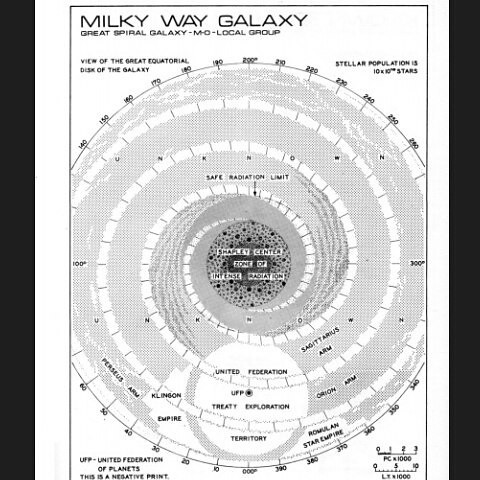
Much in this book has since been superseded. In particular, the map of the Federation's exploration zone is far too large even by the book's own terms, given that the warp speeds described are too slow to reach the sphere's edges.
Much in this book has since been superseded. In particular, the map of the Federation's exploration zone is far too large even by the book's own terms, given that the warp speeds described are too slow to reach the sphere's edges.