Jun. 15th, 2016

rfmcdonald: (photo)
AIDS Memorial, Barbara Hall Park #toronto #aidsmemorial #barbarahallpark #churchandwellesley #hiv #aids


I've visited the AIDS Memorial in Church and Wellesley's Barbara Hall Park. I even shared a picture of it here last year, looking at the memorial pillars from the outside as framed by the roses. I had not taken a picture of the memorial from the inside, the pillars with the plaques of inscribed names--so many names--arcing away into the distance. So, here one is.
rfmcdonald: (Default)

  • Centauri Dreams examines circumbinary planet Kepler-1647b.

  • Crooked Timber takes issue with Peter Singer's identification of boat people as queue jumpers.

  • D-Brief notes the superior design of the brains of birds.

  • The Dragon's Gaze considers if the James Webb Space Telescope could detect signs of life on the planets of the TRAPPIST-1 system.

  • The Dragon's Tales points to more evidence for Planet Nine.

  • The LRB Blog considers gay pride after the Orlando shooting.

  • Marginal Revolution calls for a revival of supersonic air transport.

  • The NYRB Blog argues terrorism is the wrong framing for the Orlando shooting.

  • The Planetary Society Blog considers the future of the Arecibo radio telescope.

  • Peter Rukavina considers what it means to leave the Island.

  • The Russian Demographics Blog tracks births in Russia over the past century.

  • Savage Minds considers the decolonization of anthropology.

  • Strange Maps tracks political trends in the United States.

  • Towleroad shares Susie Bright's thoughts about the persecution of gay venues.

  • Window on Eurasia notes the commemoration of the deportations from the Baltics by the Soviet Union, reports on a Russian nationalist who thinks Ukraine's European trajectory was inevitable, and parses a distinction between "ethnic Russian" and "Russophone".

rfmcdonald: (Default)

  • Astronomy Now notes a white dwarf star that is consuming what looks to be limestone debris from one of its planets. Is this a sign of marine life?

  • Bloomberg notes Rolls-Royce's opposition to Brexit, notes how international sanctions are hurting Hezbollah, looks at China's massive spending on infrastructure, notes how Donald Trump has barred the Washington Post from covering his campaign, reports that Sydney and Melbourne have applied extra fees for foreig home-buyers, and notes how a China-funded push to expand sugar production in Ethiopia has hit snags.

  • Bloomberg View looks at the extent to which Germany does not dominate the European Union.

  • CBC notes how anti-gay bigotry is connected to the Orlando shooting, and reports on Peter Mackay's regrets that Canada did not buy new fighter jets.

  • The Inter Press Service notes that the world's nuclear arsenal has become smaller but is undergoing modernization.

  • MacLean's considers barriers to interprovincial trade in Canada and reports on the outrage of a juror on the Stanford sex assault case at the light sentence imposed by the judge.

  • National Geographic looks at the mangrove swamp of Iran's Qeshm Island.

  • Open Democracy takes issue with the idea that the intervention in Libya was a success, notes reasons for Scotland's relative liking of the European Union, and looks at the Iranian events of June 1981.

  • Universe Today notes that mammals were flourishing even before the dinosaurs departed.

rfmcdonald: (Default)


In the Transit Toronto blog post "TTC hosts community event
to celebrate new streetcar route, June 18"
, Robert Mackenzie notes how the TTC is celebrating the launch of the new 514 Cherry streetcar route.

The TTC’s hosting a community event to celebrate the TTC’s 514 Cherry streetcar route, the first new streetcar route in Toronto in 16 years, this Saturday, June 18 at 10 a.m.

The new service officially starts the next day, Sunday, June 19.

Mayor John Tory, the chair of the Toronto Transit Commission Councillor Josh Colle, Julie Dabrusin, MP for Toronto-Danforth, and other municipal, provincial and federal officials to launch the new service at Distillery Loop on the east side of Cherry Street south of Mill Street.

After official remarks, you can ride a new low-floor Toronto Flexity car along all or part of the route free of fare.

The Flexity car will travel the entire route to Dufferin Gates Loop and return to King Street and Sumach Street picking up passengers along the way for a special free trip.


I'll be doing this route Sunday, I think.
rfmcdonald: (Default)
In the Toronto Star, Jennifer Keesmat suggests that Torontonians might do well to look to the example of Australian metropolis Melbourne in finding a way to deal with gridlock on King Street.

Other cities around the world are rethinking their downtown surface transit streets and transforming them into complete streets that are more than just corridors for movement. They are creating iconic, vibrant and attractive streets with inviting public spaces that help make their cities more livable and economically competitive.

One such example is Melbourne, Australia, named the world’s most livable city for the fifth year in a row in 2015. In the mid 1990s, with the help of Danish architect Jan Gehl, the city embarked on an ambitious plan to revitalize its downtown by creating great public spaces that cultivate public life. Melbourne has come a long way in a short period of time, something I saw for myself on a recent trip Down Under.

The city recently adopted Walking Plan 2014-17, which sets out the next chapter in its quest for liveability and competitiveness. An important thrust of the plan is to create what are called ‘High-Mobility Streets’ on corridors served by trams (a.k.a.: streetcars). This type of street will have high frequency streetcars and priority bus services, with excellent pedestrian access to and around stops.

Swanston St. was one of the first streets transformed into a high-mobility street and preeminent civic space. Where once cars and streetcars competed for limited space in the right-of-way, today the street is shared only by streetcars, bikes and pedestrians. It functions as a high-frequency public transit corridor capable of carrying 5,000 passengers in approximately 50 streetcars each direction per hour: a capacity at the lower end of LRT performance.

Essential vehicle access for deliveries, property servicing and access to off-street parking is limited to certain times of the day using a permit system. Streetcar stops are universally accessible, with paving and curb design supporting safer cycling. High-quality streetscape materials across the entire right-of-way — such as bluestone paving, trees, street furniture and pedestrian-scale lighting — promote patio-style outdoor dining and active public life.
rfmcdonald: (Default)
This Google initiative, reported by the CBC, is a positive first step.

Toronto libraries have something new you can check out and take home: wireless internet.

Google is partnering with the city to offer portable WiFi hotspots, which will be loaned out for up to six months at a time. Six library branches, all located in low-income neighbourhoods, will offer the service.

The project's goal is to give free internet to Torontonians who can't afford it.

"Google hopes to give some of the most underserved in our city a way to bridge the tech divide," the tech giant said in a news release.
rfmcdonald: (Default)
Daily Xtra's Jeremy Willard reports on Glad Day's planned move to Church Street.

[Glad Day's owners have looked at a variety of locations, but one option stands out: a rental spot on Church Street (they can’t reveal the precise location until the deal is finalized) which, according to Erickson, seems the most feasible choice.

It’s wheelchair accessible (the lack of accessibility of the current location has been a sticking point with the owners since they first acquired the business), larger than the current location, and has an outdoor patio. Tentatively, the plan is to make it a bookstore and coffee shop in the day and bar and event space in the evening.

Any move will be an expensive prospect, but to nab this particular location they need to raise a lot of cash and fast. “We have kind of a perfect space available to us on Church Street,” he says. “But it has a timeframe where we need to get the money together and close the deal, so we’re working toward that.”

Fundraising has already begun in earnest. Glad Day launched an Indiegogo crowdfunding campaign on Thursday, June 9, 2016. “We’re hoping to crowdfund $50,000, we’ll probably borrow $120,000, and then we’ll raise $50,000 from the current owners and some new owners,” Erickson says. “But the more we can raise from the crowdfunding, the less we have to borrow.” Glad Day is also looking for “angel investors” (people willing to lend money at low or no interest rates).
rfmcdonald: (Default)
In NOW Toronto, Benjamin Boles writes about the significance of the Orlando shooting for Torontonian queers. The threat is violence is something in the back of our minds, almost always.

The day before the massacre at Pulse in Orlando, a Facebook friend posted about being punched in the face over the weekend “for being a fag.” On Monday, another posted about being verbally harassed on the street that morning.

I lost track a long time ago of the number of queer people I know who have been attacked in some way for their sexuality. I can’t remember how many times I’ve been called a fag by a stranger, or how many times I’ve been scared for my safety.

This is the reality that queer people continue to deal with every day, even in cities as liberal as Toronto. The need for protection from that reality is why bars like Pulse exist. Are you starting to understand what queer people mean when we talk about “safe spaces”? Are you starting to feel bad about mocking that concept?

Violent homophobia isn’t a reality only in Orlando, and it’s definitely not exclusive to ISIS.

Many straight people (media observers among them) are desperately trying to blame the mess in the Middle East for the Pulse massacre, perhaps clinging to the idea that the same hatred doesn’t permeate society here. Over the last few days, I’ve witnessed so many queer people putting in so much work patiently explaining to straight people that Omar Mateen’s rage was a symptom of the homophobia we’ve all experienced.
rfmcdonald: (Default)
Published before Orlando massacre, Chris Bateman's Torontoist article looks at the historical significance of one Portuguese-Canadian boy's murder in 1977, for Toronto's GLBTQ communities and for Yonge Street.

The murder of Emanuel Jaques stunned the city in August 1977. Police handout.

The body of 12-year-old Emanuel Jaques was found wrapped in a green garbage bag on the roof behind a Yonge Street body-rub parlour on August 1, 1977.

The young boy worked shining shoes at Yonge-Dundas Square to make extra money for his family, Portuguese immigrants who had arrived in Canada three years earlier.

Jaques had been missing for four days, when, after an excruciating long weekend of frantic searching, police detectives found his lifeless body above the ramshackle three-storey building.

He had been lured inside, injected with needles, sexually assaulted, and drowned in a sink.

[. . .]

Downtown Yonge Street in the late ’70s was lined with strip clubs, body-rub parlours, and sex shops.

Between Adelaide and Bloor, there were 31 “nude encounter” or massage parlours, about six adult bookstores, and dozens of porno movie houses, according to a report published in The Globe and Mail about a week before Jaques’ death, making one of the largest concentrations of sex-related businesses in North America.

“In addition to strip-tease and live sex shows, there is one parlour that guarantees that its female attendants will masturbate customers as part of the $25 entrance fee,” the paper reported.

The strip’s reputation for vice and sleaze flew directly against the idea of “Toronto the Good”—the city’s perception of itself as a religious and moral stronghold.

As such, the municipal and provincial governments committed serious efforts to cleaning up Yonge Street by trying to sweep away its gritty, neon-soaked sex emporiums and chintzy stores.

Just at the time Jaques was murdered, Ontario premier William Davis and Metro Toronto officials were drafting legislation to drive out the street’s most undesirable elements through rezoning and licensing.


There's much more at Torontoist.
rfmcdonald: (obscura)
Transit Toronto pointed readers to two interesting subway videos.

Our friends at T2P Films recently shared two time-lapse videos they’ve produced.

Each video provides a operator’s-view of a single trip along each of the TTC’s 1 Yonge - University and 2 Bloor - Danforth lines.


rfmcdonald: (Default)
Originally posted at Demography Matters, I opted to crosspost here on account of the local content.

***

I was in the area and it seemed apropos after the Orlando shooting, so I went off to visit Toronto's AIDS Memorial, in Church and Wellesley's Barbara Hall Park, before I went to work Monday afternoon. It is simple enough, pillars almost two metres high each with six inscribed metal plates of the names of the dead, organized chronologically by the year of their death, in a peaceful garden. It is a solemn place, but lovely for all that.

I've visited the memorial before. I even shared a picture of it last year, looking at the memorial pillars from the outside as framed by the roses. I had not taken a picture of the memorial from the inside, the pillars with the plaques of inscribed names--so many names--arcing away into the distance.
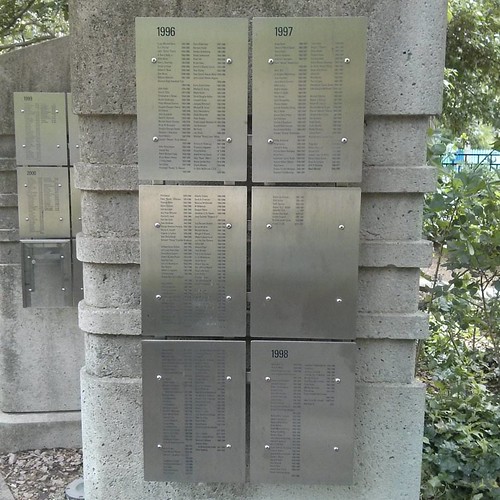
Impact of HIV antiretrovirals, 1996-1998 #toronto #churchandwellesley #barbarahallpark #aidsmemorial #hiv #aids #antiretroviraltherapy


There is actually quite a lot of information you could surmise about the epidemic from the information on the plates. In the first years of the 1980s the plates are almost empty, one being more than enough for a year's dead. Later, they spill over into multiple plates. Still later, around 1990, the plates shift to a smaller type.

In the mid-1990s, the impact of effective antiretroviral therapy, much more effective than the easily blunted AZT monotherapy, becomes evident. It is on the 1996-1998 pillar this is most visible. The year 1995 took up most of the previous pillar, but 1996 took up a mere half, 1997 two plates, and 1998 only one. Later plates and later years revert to the low density of names of the mid-1980s, this time with the smaller font. (The 1999 and 2000 plates on the next pillar are visible to the left. Later years' plates have fewer names still, reverting to the early 1980s, as HIV infection becomes manageable.)

Anti-retrovirals worked. They continue to work, and in ways that might not have been imagined by the originators of modern anti-retroviral therapy, treating and even preventing HIV infection. Toronto's AIDS Memorial, and like memorials in other cities around the world, serve as effective partial records both of a terrible medical/human tragedy and how, if too late, this tragedy began to be ended. It's still too far away from ending in some parts of the world, but there is hope. What better testimony is there to this than the pillars of the AIDS Memorial which remain unscarred by plaques?

Profile

rfmcdonald: (Default)rfmcdonald

February 2021

S M T W T F S
 123456
78910111213
14151617181920
212223242526 27
28      

Style Credit

Expand Cut Tags

No cut tags
Page generated Apr. 12th, 2026 06:07 pm
Powered by Dreamwidth Studios