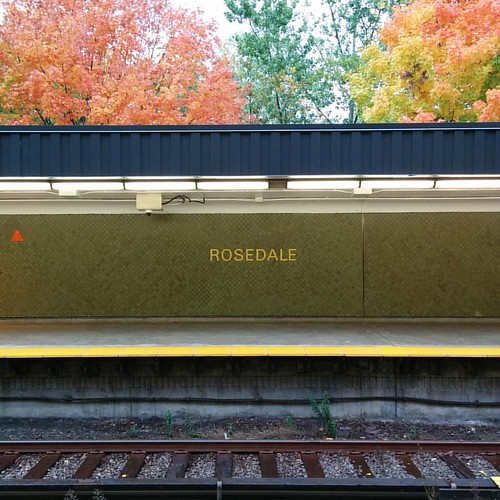
The Rosedale TTC station is open to the air above. In fall, in the wooded Rosedale neighbourhood, this can lend itself to some lovely scenes.


The easy winter that Toronto experienced last year will not be repeated according the weather forecasts for 2016/2017. While there's some discrepancy in long term reports regarding whether or not southern Ontario will experience average or below average temperatures this winter, no one is calling for a mild season.
The Toronto region is expected to deal with high levels of snowfall thanks in part to the record setting heat we had this summer. While a warm summer doesn't typically have bearing on the winter temperature forecast, the above average temperatures of the Great Lakes means that lake effect snow will accompany the arrival of arctic air.
You can expect a lot of this type of snow during early winter in December and January.
As far as the general patterns go, climatologists predict a return to cold/classic winter temperatures partially because the strong El Niño event that influenced last year's weather is absent heading into this season.
"The current pattern has the look of a weak La Niña event, but it is unlikely to meet the criteria needed to be classified as such," writes Meteorologist Doug Gillham for the Weather Network. In fact, the current climatic patterns look more similar the ones that recently delivered us brutal winters rather than last year's balminess.
It’s been 18 years since the City of Toronto created the Shifting Gears plan for cycling policy.
While its vision—creating a cycling culture and building infrastructure to allow cyclists and drivers to share the same roads—may finally be coming to life, the challenge of maintaining safety is even greater today than it was back then.
[. . .]
In the 1890s, there was a cycling boom across Canada and the United States. Cyclists began to share the roads with pedestrians, horse-drawn vehicles, and electric streetcars.
Cars were something new at the time.
There were many bike paths on Toronto streets, and there was a growing debate among cyclists about whether they should fight for exclusive paths for themselves or safer roads for drivers and cyclists.
When automobiles began to dominate beginning in the 1920s, cycling was increasingly relegated to a recreational activity. However, deliveries by bike continued to be popular.
The number of cyclists per 1,000 people increased from 220 in 1950 to 350 in 1960 [PDF], and climbed to 480 by 1970.
Two months before permanently closing, Honest Ed's will start selling the last of its iconic, hand-painted signs this weekend.
Beginning Saturday, thousands of pun-heavy signs will be up for grabs, at a starting price of $1.
The signs are a defining feature of the discount Toronto department store, which will close on Dec. 31 after 68 years in business.
"Many of the signs bring back all sorts of memories for me," said owner David Mirvish, son of Edwin "Honest Ed" Mirvish.
"I didn't think I'd be quite so overwhelmed by it as I am today."
The future is urban and nowhere is that more true than in Bangladesh. If current rates of urbanisation continue, the country’s urban population will double by 2035. Around the Bay of Bengal, a mega city would join Dhaka to Chittagong, creating one of the world’s largest conglomerations. Whether that process produces a congested toxic unlivable mess of concrete and steel, or whether it becomes a thriving, connected, wonderful city to live in, is almost entirely down to the political and policy choices we make.
This week a critical meeting in Quito, Ecuador, will look at those critical political and policy choices. The Habitat III conference to adopt a “New Urban Agenda” builds on the Habitat Agenda of Istanbul in 1996 (Habitat II).
The new agenda is intended to reinvigorate the global commitment to sustainable urbanisation. The conference is expected to result in a concise, focused, forward-looking and action-oriented outcome document on making cities and human settlements equitable, prosperous, sustainable, just, equal and safe until 2030. By the middle of the century, a majority of the world’s citizens —four out of five people — could be living in towns or cities. Indeed, in the time since the Habitat Agenda was adopted, the world has become majority urban, lending extra urgency to the New Urban Agenda.
Habitat III is one of the first major global conferences to be held after the adoption of two key agreements, last year. Agenda 2030, a new development plan for the world; and a new Climate Change agreement adopted in Paris. It offers a unique opportunity to discuss the important challenge of how cities, towns and villages are planned and managed in a sustainable manner, to meet the new global agenda and climate change goals.
The New Urban Agenda, agreed upon at Habitat III in Quito, will guide the efforts around urbanisation of a wide range of actors — nation states, city and regional leaders, international development funders, UN programmes and civil society — for the next 20 years. Inevitably, this agenda will also lay the groundwork for policies and approaches that will have long lasting impact.
At first, Yury Scherbakov thought the cracks appearing in a wall he had installed in his two-room flat were caused by shoddy workmanship. But then other walls started cracking, and then the floor started to incline. “We sat on the couch and could feel it tilt,” says his wife, Nadezhda, as they carry furniture out of the flat.
Yury wasn’t a poor craftsman, and Nadezhda wasn’t crazy: One corner of their five-story building at 59 Talnakhskaya Street in the northern Russian city of Norilsk was sinking as the permafrost underneath it thawed and the foundation slowly disintegrated. In March 2015, local authorities posted notices in the stairwells that the building was condemned.
Cracking and collapsing structures are a growing problem in cities like Norilsk—a nickel-producing centre of 177,000 people located 180 miles above the Arctic Circle—as climate change thaws the perennially frozen soil and increases precipitation. Valery Tereshkov, deputy head of the emergencies ministry in the Krasnoyarsk region, wrote in an article this year that almost 60 percent of all buildings in Norilsk have been deformed as a result of climate change shrinking the permafrost zone. Local engineers said more than 100 residential buildings, or one-tenth of the housing fund, have been vacated here due to damage from thawing permafrost.
In most cases, these are slow-motion wrecks that can be patched up or prevented by engineering solutions. But if a foundation shifts suddenly it can put lives at risk: cement slabs broke a doctor’s legs when the front steps and overhanging roof of a Norilsk blood bank collapsed in June 2015. Building and maintenance costs will have to be ramped up to keep cities in Russia’s resource-rich north running.
Engineers and geologists are careful to note that “technogenic factors” like sewer and building heat and chemical pollution are also warming the permafrost in places like Norilsk, the most polluted city in Russia. But climate change is deepening the thaw and speeding up the destruction, at the very same time that Russia is establishing new military bases and oil-drilling infrastructure across the Arctic. Greenpeace has warned that permafrost thawing has caused thousands of oil and gas pipeline breaks.
Most Americans, to the degree that they think about climate-change adaptation, probably think of bigger sea walls, or maybe changing the kinds of houses we live in. You're looking at something different.
There's been an ongoing war that dates back at least 200 years between people who favor building engineered structures versus critics who say you're overpromising. That's the "protect" strategy -- it can be a wall, which is what most people are familiar with. Almost always, that’s the top preference; it sounds good.
The second strategy is to accommodate -- raising houses on stilts. Both the protect strategy and the accommodation strategy keep people in place.
The third one is, move. You just cannot protect your way out of the whole thing. Humans have always moved and retreated from shorelines. Archaeologists now are able to do underwater excavations; what they're telling us about long-term adaptation to the climate really has some lessons for us.
In a new paper, you write about one New Jersey town, Toms River, which includes both barrier islands and part of the mainland. You argue that creating new tourism attractions on the mainland, such as artificial lakes, might pull people in from the barrier islands.
The word "retreat" seems to indicate defeat. What we wanted to do is to think about the tourism economy. There are, it turns out, lots of sand mines that are near shore areas in the U.S. It's already a pit. So let's make it into an artificial lake.
You could develop resorts around this. You can create things that are like boardwalk attractions. You can have amusement parks. You could have condominiums along the water. And it's close enough to the estuaries that you could actually have access to saltwater as well.
A new study of the Charlottetown waterfront looks at what wind, waves and sea level rise could mean in the present and into the future.
The report, commissioned by the Charlottetown Area Development Corporation or CADC, proposes ways to protect against flooding while also improving public access to the waterfront.
Ottawa's Coldwater Consulting based the report on what it calls the "latest and most reliable climate change scenarios," predicting flood risk along the Charlottetown waterfront by 2045 and 2090.
[. . .]
The report examines the current state of waterfront infrastructure from the Hillsborough Bridge to the end of the boardwalk in Victoria Park.
"If there's a weak link in the chain, then it can affect far beyond where that's actually at," said Ron Waite, CADC general manager.
One of the options is a large floating breakwater near the Charlottetown Yacht Club, but Waite says potential ice damage makes that a challenge because of the size of the structure that would be needed.
The report also proposes extending the waterfront boardwalk, elevating it where needed, to form a "ring dyke" that could protect the downtown area from flooding.
While an expensive idea, the report highlights how the expanded boardwalk could also "enhance access to and enjoyment of the waterfront".
The cost to flood-protect the Port Lands in eastern Toronto, transforming 715 acres into developable land, has risen from $975 million to $1.25 billion.
“Flood-protecting the Port Lands would unlock its great potential for development, for more parks, more public space and for providing room to support the city’s population and it’s job growth,” said Waterfront Toronto CEO Will Fleissig at a news conference Thursday. “This is a transformative opportunity for our city.”
The cost estimate was confirmed by a due diligence report from tri-government agency Waterfront Toronto released Thursday. The study found the probability of the actual cost being $1.25 billion or less is 90 per cent. It is very unlikely the project will costs less than $1 billion.
The increased cost is mostly due to the additional need for soil excavation, soil and groundwater treatment and issues related to flowing sand and compressible peat, which complicates soil excavation and how the land is filled for development.
The three levels of government have already been negotiating cost-sharing of the project, which was made a priority for the waterfront agency 14 years ago.
Neither the federal nor provincial government has committed to fund the flood protection of the largely government-owned land. All three governments did put up $83 million to redo the area around the old Essroc quay, which is a large part of the overall project.

![[personal profile]](https://www.dreamwidth.org/img/silk/identity/user.png) branchandrootdancing_serpent
branchandrootdancing_serpent
