Jan. 27th, 2018

rfmcdonald: (Default)

  • Anthropology.net notes that the discovery of an ancient Homo sapiens jawbone in Israel pushes back the history of our species by quite a bit.

  • Bad Astronomer Phil Plait shares stunning photos of spiral galaxy NGC 1398.

  • Centauri Dreams considers the ways in which the highly reflective surface of Europa might be misleading to probes seeking to land on its surface.

  • The Dragon's Tales rounds up more information about extrasolar visitor 'Oumuamua.

  • Far Outliers considers the staggering losses, human and territorial and strategic, of Finland in the Winter War.

  • Hornet Stories notes preliminary plans to set up an original sequel to Call Me Be Your Name later in the 1980s, in the era of AIDS.

  • Russell Arben Fox at In Media Res considers if Wichita will be able to elect a Wichitan as governor of Kansas, for the first time in a while.

  • io9 takes a look at the interesting ways in which Star Wars and Star Trek have been subverting traditional audience assumptions about these franchises.

  • JSTOR Daily links to a paper examining what decision-makers in North Vietnam were thinking on the eve of the Tet offensive, fifty years ago.

  • The LRB Blog takes a look at a new book examining the 1984 IRA assassination attempt against Margaret Thatcher.

  • The Map Room Blog links to an article examining how school districts, not just electoral districts, can be products of gerrymandering.

  • Marginal Revolution seeks suggestions for good books to explain Canada to non-Canadians, and comes up with a shortlist of its own.

  • Kenan Malik at the NYR Daily takes a look at contemporary efforts to justify the British Empire as good for its subjects. Who is doing this, and why?

rfmcdonald: (Default)

  • blogTO notes an exciting plan for the revitalization of Allan Gardens.

  • Torontonians have been complaining about the state of our streets for well over a century, as the Toronto Star notes.

  • CBC notes that investigating a serial killer case, as the Bruce McArthur case seems to be, without having any bodies, makes it difficult but still (especially with modern forensics) potentially workable.

  • Toronto police have confirmed that Barry and Honey Sherman, Toronto billionaires, were murdered. The Toronto Star reports.

  • The ombudsman review of the state of Toronto Community Housing speaks ill of that organization's ability to adequately house its tenants. The Toronto Star goes into detail.

rfmcdonald: (Default)

  • The idea of making the Toronto Islands an officially designated bird sanctuary makes sense on a lot of levels. The Toronto Star reports.

  • The community of Saanich, on Vancouver Island, is expected to host the biggest marijuana farm in Canada come legalization, making many there unhappy. Global News reports.

  • Trump tariffs may doom a pulp and paper mills in the western Newfoundland city of Corner Brook. CBC reports.

  • Wired features this heartbreaking choices facing the inhabitants of the Louisiana town of Isle de Jean Charles as their island submerges beneath rising waters. What will they do? Where will they go? Can the community survive?

  • CityMetric tells the story about how people on the Channel Island of Jersey wanted to build a bridge to France, why this didn't happen, and how this relates to Brexit.

rfmcdonald: (Default)

  • This CityLab post reviews a fantastic map book about the Great Lakes and their history.

  • An upcoming bout of Arctic chill in the United States (Canada, too) is connected to the ongoing process of climate change featuring global warming. Bloomberg explains.

  • National Geographic takes a look at upcoming testing for the United States' new Orion program, a spacecraft that may take people back to the Moon.

  • 52 baboons escaped a Paris zoo, in so demonstrating their smarts. National Geographic explains.

  • Sparrows in the oilpatch, National Observer notes, are changing their song in order to compete with noise from machinery.

rfmcdonald: (photo)
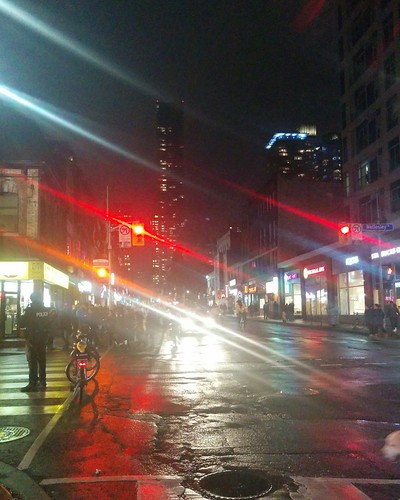
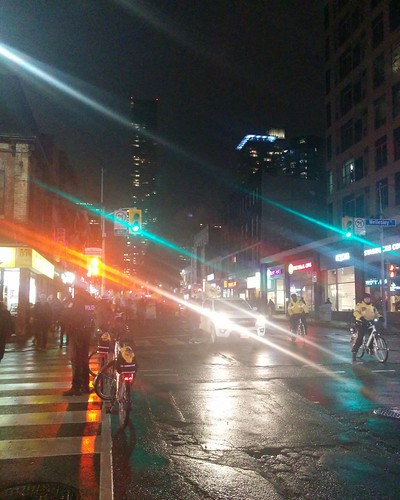
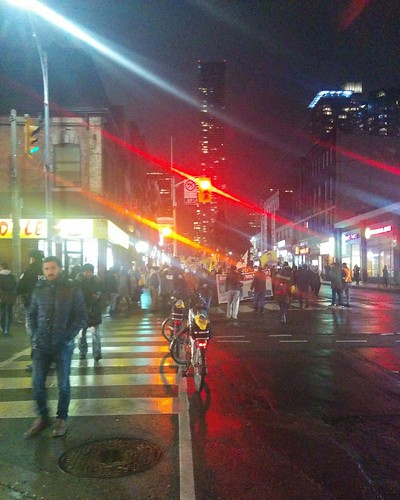
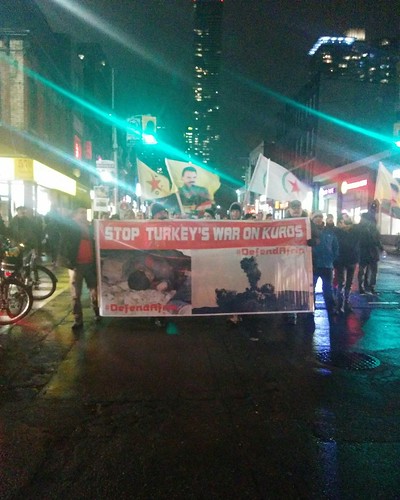
The ongoing Turkish invasion of Afrin, westernmost of the three cantons of the autonomous Kurdish area in Syria commonly known as Rojava, just produced visible results in Toronto. As I got out at Wellesley station a bit before 6 o'clock, I heard a crowd marching down Yonge. I crossed the street, and prepared to photograph.

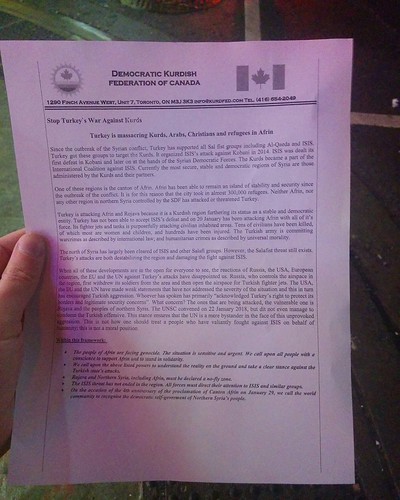
I was given a handout with the letterhead of the Democratic Kurdish Federation of Canada denouncing the inaction of outside powers--the West and Russia, specifically--in doing nothing to undermine the Turkish invasion of a self-governing Kurdish area. I accepted the handout, and kept it. I agree almost entirely with the sentiment, sharing the anger of people frustrated with yet another Turkish invasion of a self-governing Kurdish area outside its frontiers, feeling frustrated that a Turkish-Kurdish alliance once might think the most natural one possible in the MIddle East is being thwarted by Turkey run by people who betrayed their government's liberal promise at the century's beginning. I stood, and watched, because there was nothing else I could do but witness justified anger and share it.

(Certainly this group has links with radical Kurdish groups internationally. The last photo in this series shows a yellow flag flapped into a blur by the wind. When unfurled, the flag had on it a clear portrait of Abdullah Öcalan above a slogan demanding his release.)

Protest against Turkey in Syria (1) #toronto #protest #march #kurdish #kurd #turkey #syria #rojava #afrin #night


Protest against Turkey in Syria (2) #toronto #protest #march #kurdish #kurd #turkey #syria #rojava #afrin #night


Protest against Turkey in Syria (4) #toronto #protest #march #kurdish #flyer #pamphlet #kurd #turkey #syria #rojava #afrin #night #yongeandwellesley


Protest against Turkey in Syria (5) #toronto #protest #march #kurdish #flyer #pamphlet #kurd #turkey #syria #rojava #afrin #night #yongeandwellesley


Protest against Turkey in Syria (6) #toronto #protest #march #kurdish #pamphlet #kurd #turkey #syria #rojava #afrin #night #yongeandwellesley


Protest against Turkey in Syria (7) #toronto #protest #march #kurdish #flags #kurd #turkey #syria #rojava #afrin #night #yongeandwellesley


Protest against Turkey in Syria (8) #toronto #protest #march #kurdish #flags #kurd #turkey #syria #rojava #afrin #night #yongeandwellesley


Protest against Turkey in Syria (9) #toronto #protest #march #kurdish #flags #kurd #turkey #syria #rojava #afrin #night #yongeandwellesley
rfmcdonald: (Default)
On the 13th of January, 2018, when the world learned of an official warning of an impending ballistic missile attack on the state of Hawaii, I was in the American Museum of Natural History with friends. Scott mentioned the warning and flashed me a screen of the screenshotted image of the message from Twitter. I felt stunned. Certainly I'd not been aware of any catastrophic worsening of the United States' relations with North Korea or anyone else, so this couldn't be true. But then, this was a wholly unprecedented event in any case, something no one on this world had any experience with. Who was I to say that this might not be the first I'd learn of another world-changing event in my life? I hoped only that the people I knew and love in Hawaii would be safe.

Thank God that this was simply a false alarm, consequence of an appalling badly designed user interface that does not clearly distinguish between different options for issuing state-wide alerts and consequence of the state governor's unconscionable ignorance of his Twitter password to let the world know of the false alarm. (It does not take 20 minutes to reset a password, at least not on any system I'm familiar with.) It goes without saying that, beyond being a terrifying experience for people in Hawaii and decidedly unsettling for the rest of the population of the world, this sort of alert has potentially catastrophic consequences. What if this false alarm was seized upon as justification for some response? That so much of the world lacks even Hawaii's flawed preparedness, meanwhile, is worrisome. Mack Lamoureaux's suggestion at VICE that the first warning Canadians would learn of a missile attack would be fro the nuclear shockwave, unless they signed up for text message warnings which are (first) voluntary only and (second) distributed through an ad hoc combination of ministries and telecom providers is--Well.

One element of the affair that interests me hugely, from a sociological perspective, is the way people in Hawaii dealt with the alert of their potential imminent doom. I may have missed reports between my New York City vacation and the hindrances of later retrospective news searched, but I do not think any of the violence that apocalyptic media tends to predict will occur in these circumstances--looting, violence, riots--actually did. Perhaps it might have if there have been a longer period of more severe tension, but I frankly doubt it. What we did see was people doing their best to try to do as much as they could with the remainder of their lives, to find explanations for what was happening and to share them, to seek shelter, to tell the people they cared for that they cared for them. People tried to protect themselves and others, and, where they thought they might not be able to, they tried to let their likely survivors know just how much they mattered. I think this speaks well of humanity, honestly--if this was a test, we passed.

This brought to my mind Ultravox's 1984 single "Dancing with Tears in My Eyes", sung from the perspective of a man desperate to get home to his family before the predicted nuclear apocalypse came about.


This song is ostensibly about a nuclear plant meltdown, not a nuclear attack. This song was also sung in the 1980s, released in the same year as (for instance) the BBC's post-nuclear apocalypse Threads (now on Blu-Ray!). Especially two years before Chernobyl and at the arguable height of the post-détente Cold War, nuclear apocalypse most certainly did include fears of warheads going. Its inclusion on Wikipedia's long list of song's dealing with nuclear war, a noteworthy trend in the 1980s' popular culture--that decade's sheer density ofsongs dealing with the nuclear apocalypse is something I've noted for decades.

That moment when I made the connection between Hawaii now and Ultravox then is when it hit me: We're back in touch with that 1980s mindset. The adulthood I've enjoyed free from fears of nuclear war, free from the contamination it inflicted on earlier generations and even on my childhood, is over. We feel the same threats the 1980s' generations did; we respond in the same ways, largely irrelevant details like the communications technologies we have aside. (I doubt a false alert of a missile attack on Hawaiian television in the 1980s would have differed that much.) The idyll I, and most of the rest of the world's population, enjoyed for decades is done with.

Profile

rfmcdonald: (Default)rfmcdonald

February 2021

S M T W T F S
 123456
78910111213
14151617181920
212223242526 27
28      

Style Credit

Expand Cut Tags

No cut tags
Page generated Mar. 11th, 2026 06:48 pm
Powered by Dreamwidth Studios