![[personal profile]](https://www.dreamwidth.org/img/silk/identity/user.png) rfmcdonald
rfmcdonaldPatrick Beithour's Globe and Mail article makes an interesting argument that I don't entirely buy. The title? "Canada’s new electoral divide: It’s about the money".
Below, courtesy of Wikipedia, is the map showing the results of yesterday's election.
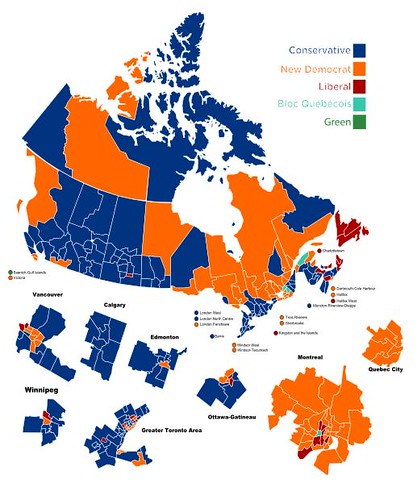
The Beauce region Breithour refers to--the deep blue area opposite Québec City--forms the core of the region of Chaudière-Appalaches, which has a population of a shade less than four hundred thousand people out of a Québec population of just a shade under eight million. The Census Metropolitan Areas of Montréal and Québec, the economic hubs of Québec and the former being easily the most internationally important city in the province, have a combined population of 4.6 million people. Looking at the electoral map, in fact, the downtown cores of most Canadian cities--save Alberta's Edmonton and Calgary, of course, and Manitoba's Winnipeg as well--voted solidly non-Conservative. These cities, in turn, are frequently much wealthier than their hinterlands. In some areas--especially in Toronto--the combined votes of the Liberals and NDP exceed those of the Conservatives, and under some sort of proportional representation system things would look different.
Economics matter, clearly. Equally clearly, they're not the only thing that matters: Culture, say, or regional identity, or ethnic background, or ... Always, always, always try to avoid reductionism.
The true divide, the new reality of Canadian politics, is between the economic heartlands that the Conservatives now dominate throughout the country and the economic hinterlands won by the NDP.
The energy powerhouses of Alberta and the B.C. Interior are Conservative, while B.C.’s struggling north coast is solidly NDP. The suburbs and thriving technology centres of Ontario are deep blue territory, but the north of the province is orange. Quebec’s rural areas are largely held by New Democrats, but the entrepreneurial hub of the Beauce remains a Tory bastion.
With Canada still shaking off the effects of the recession, the Conservatives were clearly looking to herd economically worried voters into their column at the start of the campaign. The party was aiming not just at the haves, looking to safeguard their affluence, but at the just-hads, aching to reclaim their recently lost prosperity.
That message resonated strongly in Southern Ontario, where the manufacturing industries are still reeling and voters are no mood to take risks. “In Southwestern Ontario, they are not screwing around with the economy,” said Greg Lyle, managing director at Innovative Research Group. (Although the NDP also benefited in a more limited way from those same worries, maintaining its traditional strength in Windsor and Hamilton.)
Then came the unexpected surge of the NDP, and Conservative Leader Stephen Harper’s eleventh-hour appeal to Liberal voters with economically conservative leanings, often called blue Liberals. “Let me speak very clearly to traditional Liberal voters: I know many of you do not want NDP policies. That you do not want NDP tax hikes,” Mr. Harper said on Sunday.
The message: Only we can protect your prosperity.
The result is that the Conservatives were able to achieve in 2011 what eluded them in 2008, a coalition of economically conservative-minded voters who cast their ballots based on pocketbook issues rather than concerns over cultural issues, including the Tories’ supposed leanings toward social conservatism.
Those blue Liberals were the missing element in the Conservative coalition. In the 1990s, they were the foundation of the successive Liberal sweeps of Ontario. So long as they remained with the Liberals, Mr. Harper would be shut out of the urban heart of most big Canadian cities.
[. . .]
Unfinished it may be, but the new Conservative coalition now dominates more than just the natural-resources powerhouses of the West – it also has strengthened its lead in the areas containing the brainy industries of Ontario, in the prosperous, immigrant-heavy suburban communities and even, most startlingly, in the wealthy ridings in the heart of Toronto.
Below, courtesy of Wikipedia, is the map showing the results of yesterday's election.
The Beauce region Breithour refers to--the deep blue area opposite Québec City--forms the core of the region of Chaudière-Appalaches, which has a population of a shade less than four hundred thousand people out of a Québec population of just a shade under eight million. The Census Metropolitan Areas of Montréal and Québec, the economic hubs of Québec and the former being easily the most internationally important city in the province, have a combined population of 4.6 million people. Looking at the electoral map, in fact, the downtown cores of most Canadian cities--save Alberta's Edmonton and Calgary, of course, and Manitoba's Winnipeg as well--voted solidly non-Conservative. These cities, in turn, are frequently much wealthier than their hinterlands. In some areas--especially in Toronto--the combined votes of the Liberals and NDP exceed those of the Conservatives, and under some sort of proportional representation system things would look different.
Economics matter, clearly. Equally clearly, they're not the only thing that matters: Culture, say, or regional identity, or ethnic background, or ... Always, always, always try to avoid reductionism.


