rfmcdonald: (photo)
While visiting New Glasgow and the grounds of the P.E.I. Preserve Company with my parents Monday, we came across the Company's Gardens of Hope and Butterfly House. The gardens are a peaceful setting for a hospice for the terminally ill and their caregivers, and the Butterfly Gardens--reopened in 2012 after a 2009 spider infestation--house butterflies of Costa Rican origin, the display of which helps finance the hospice. My mother (appearing in the fourth photo below, in iridescent green) and I paid the $C7 adult admission fee and entered.

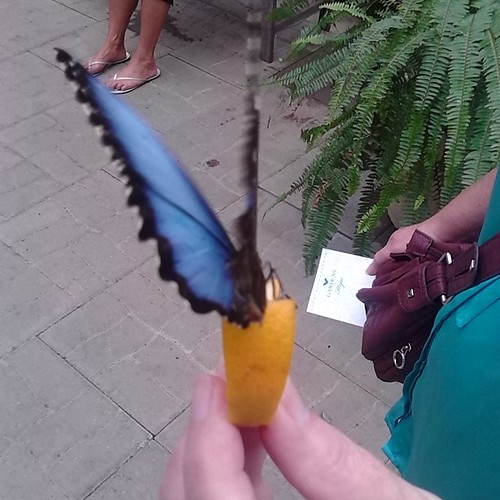
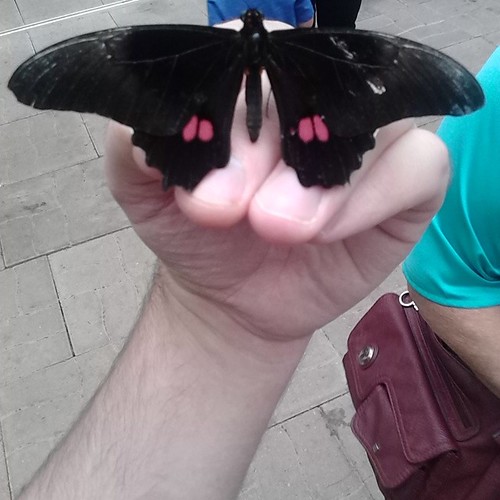
They were beautiful. These fast-moving creatures were difficult to photograph, but I was able to take a few when they alighted somewhere, on a flower or an orange slice or a finger.

Me and a butterfly in New Glasgow #princeedwardisland #pei #newglasgow #butterfly #butterflygarden #gardensofhope


Butterfly and orchid,  New Glasgow butterfly house #princeedwardisland #pei #newglasgow #gardensofhope #butterfly #orchid


Butterfly and orange slice #princeedwardisland #pei #newglasgow #butterfly #orange #gardensofhope


Butterfly feeding on an orange slice in my mother's hand #princeedwardisland #pei #newglasgow #butterfly #orange #gardensofhope


Butterfly amid flowers #princeedwardisland #pei #newglasgow #flowers #butterfly #gardensofhope


Butterfly on my hand #princeedwardisland #pei #newglasgow #butterfly #gardensofhope
rfmcdonald: (Default)

  • In a guest photo essay at Bag News Notes, Rita Leistner draws from her experiences in Afghanistan to investigate the ways in which different forms of photography can have different effects on their users.

  • Centauri Dreams notes the latest effort to discover planets orbiting Proxima Centauri, the dim red dwarf star that's not only the dim third component in Alpha Centauri but the closest star to our own. (No superterrestrials in the habitable zone, at least.)

  • Daniel Drezner starts to define the Sino-American relationship, noting that continuing cooperation disproves the idea that they are inherently confrontational.

  • Geocurrents' Martin Lewis notes Egyptian upset at Ethiopia's plan to dam one of the tributaries of the Nile, noting that Egyptian (and Sudanese) dependence on current flows of the Nile and the ongoing efforts of upstream black African countries to develop may be a serious cause for tension.

  • Marginal Revolution's Tyler Cowen draws too much importance from the ongoing horrors in Syria, which no more disprove the idea of progress than other isolated horrors.

  • The Numerati's Stephen Baker likens the brief tumultuous and fatal activity of a cicada to that of a teenage human contemporary.

  • Torontoist's Hamutal Dotan notes the belief of Gawker that the alleged Rob Ford crack video is "gone", whatever that means.

  • Window on Eurasia reproduces a Tatar nationalist's call for a national revolution in Tatarstan.

rfmcdonald: (Default)

  • Arctic Progress observes that northwestern European Russia and northern Norden are entering a resources-driven economic boom.

  • At blogTO, Derek Flack walks along the former course of Garrison Creek, a buried watercourse that incidentally has always been near my residences.

  • Burgh Diaspora observes that post-crackdown Arizona is hemorrhaging Hispanics of all citizenship statuses.

  • Crooked Timber's Henry Farrell cuts-and-pastes an essay together out of two economists who argue that the particular nature of Ireland's political economy--weak budget management driven the ideological preferences on taxation, networks between builders and government officials, ad peculiar union restructuring of the workforce--caused the meltdown.

  • Eastern Approaches comments on the politics of naming Balkan airports.

  • Landscape+Urbanism celebrates the rise of the urban turkey, which can apparently thrive in urban and suburban areas.

  • Language Log comments on some unusual free speech cases in the United Kingdom and Ireland, arguing that common sense rather than the sorts of overreaction that leads to judicial prosecution would be preferable.

  • Personal Reflection's Jim Belshaw suggests that one reason New Zealand living standards are comparable to the Australian despite significantly lower FDP per capita comes from a truncated income pyramid (fewer wealthy people, since a smaller and more distant market provided fewer high-paying jobs). He's skeptical that GDP per capita can converge given current paradigms.

  • At The Search, Douglas Todd blogs about self-righteous activists from the left and right--he mentions Greens, here--whose self-righteousness masks personal concerns.

  • Torontoist reposted photos of female strippers (and others) who used the roof of strip club Zanzibar for smoke breaks. Controversy ensued.

  • At The Zeds, Michael Steeleworthy shows some of the video tutorials that he and his fellow librarians have developed for new users of the Dalhousie University library system.

rfmcdonald: (Default)
The Allan Gardens park in downtown Toronto hosts a large squirrel population: plenty of trees, plenty of friendly people.

P4100147

Again, a squirrel demonstrates situational bipedalism.

P4100185

The squirrel can blend into its background quite effectively in its native habitat.
rfmcdonald: (photo)
The squirrel is well-adapted to life in Toronto, perhaps not least because they do such a good job at attracting and hiding peanuts. These three photos were shot at a distance, hence the blurriness, but the near-hominid cuteness comes through.

P4100068

P4100069

Yonge and Gloucester Squirrel (3)
rfmcdonald: (Default)
A tree stump in Warkworth, well in the process of decay, caught my attention while I had my camera with me. There's something about its peculiar texture, especially on close up, that gets me. It's almost fractal in its structured complexity.

P3260065

P3260066

P3260067
rfmcdonald: (Default)
Robert Frost's 1920 poem "Fire and Ice", is simple, short, and stunning.

Some say the world will end in fire,
Some say in ice.
From what I’ve tasted of desire
I hold with those who favor fire.
But if it had to perish twice,
I think I know enough of hate
To say that for destruction ice
Is also great,
And would suffice.


The poem can be taken to refer relatively directly to the likely fates of the Earth--will it be engulfed by a Sol turned red giants, or will it freeze?--and more abstracts connects to the human heart's ability to wreck the world. I was surprised to find out, via Not Rocket Science, that ice might in fact have fostered the emergence of life on Earth.

Some of the most popular theories suggest that life began in a hellish setting, in rocky undersea vents that churn out superheated water from deep within the earth. But a new paper suggests an alternative backdrop, and one that seems like the polar opposite (pun intended) of the hot vents –ice.

[. . .]

RNA can store information, speed up chemical reactions, and make copies of itself without any outside help. It evolves too – stick it in a test tube with the right raw materials and a source of energy and it eventually gets better and better at copying itself. This ability was first demonstrated in 1972 by Sol Spiegelman and the brutally efficient RNA strand that resulted was melodramatically known as Spiegelman’s monster.

[. . .]

But RNA’s unique physical properties aren’t enough. The molecule is also very fragile and it would rapidly degrade under all but the gentlest environmental conditions. It also needs to be concentrated in some way. A molecule that makes copies of itself needs to be kept in the same place as its constituent chemicals; if the parts are allowed to disperse, the whole will never come together. So RNA may have the right qualities, but it needs a stable and confined space to make the RNA world a reality. Attwater thinks that ice provides just such a space.

At first glance, this seems like a bizarre idea. For a start, cold temperatures can slow many chemical reactions to a crawl. Proteins that piece together RNA molecules stop working when they’re frozen. But remember, RNA in the form of ribozymes can speed up its own creation without any proteins. And Attwater found that one such ribozyme called R18 is still active at subzero temperatures. In fact, ice actually stabilised the ribozyme, preventing it from breaking down. On ice, the ribozyme was slower than at room temperature but it also carried on working for longer. As a result, it was actually more productive, creating longer lengths of RNA with no less accuracy.

That’s one problem down, but there’s also the fact that ice is solid. You might think that this would prevent molecules from meeting each other with ease, but ice isn’t completely solid. At a microscopic level, weaving their way between the crystals, there’s a complicated network of channels and spaces that haven’t frozen completely.

The water in these spaces is salty; as the surrounding molecules froze, any dissolved impurities were pushed away and became concentrated in the remaining liquid. Attwater found that this process boosts the concentration of ions, nucleotides and other chemicals in the liquid compartments by over 200 times. That accelerates the work of the ribozymes, and more than compensates for the slowing effects of the cold.


The blog concludes that this theory works only if the early Earth was icy. Some recent evidence suggests so, and certainly the dimness of early Sol relative to today--Sol was only 70% as bright as it is now--might facilitate this chill.

This model also has serious implications for life on other worlds. It's reasonably well-known that many moons--Jupiter's Europa, Saturn's Enceladus--almost certainly harbour oceans of liquid water under their icy surfaces, and that this water could theoretically support life. Might the fact that these worlds have so much ice say interesting things about the prospect of Europan and Enceladean biospheres?
rfmcdonald: (forums)
Some time ago, there was a post at Wired Science--Jonah Lehrer's "The Psychology of Nature"--that made me think at the time, and that I thought of after the Warkworth trip.

In the late 1990s, Frances Kuo, director of the Landscape and Human Health Laboratory at the University of Illinois, began interviewing female residents in the Robert Taylor Homes, a massive housing project on the South Side of Chicago. Kuo and her colleagues compared women randomly assigned to various apartments. Some had a view of nothing but concrete sprawl, the blacktop of parking lots and basketball courts. Others looked out on grassy courtyards filled with trees and flowerbeds. Kuo then measured the two groups on a variety of tasks, from basic tests of attention to surveys that looked at how the women were handling major life challenges. She found that living in an apartment with a view of greenery led to significant improvements in every category.

What happened? Kuo argues that simply looking at a tree “refreshes the ability to concentrate,” allowing the residents to better deal with their problems. Instead of getting flustered and angry, they could stare out the window and relax. In other words, there is something inherently “restorative” about natural setting – places without people are good for the mind.

[. . .]


Does this mean we should all flee the city? Of course not. It simply means that it’s a good idea to build a little greenery into our life. This isn’t a particularly new idea. Long before scientists fretted about the cognitive load of city streets, philosophers and landscape architects were warning about the effects of the undiluted city, and looking for ways to integrate nature into modern life. Ralph Waldo Emerson advised people to “adopt the pace of nature,” while the landscape architect Frederick Law Olmsted sought to create vibrant urban parks, such as Central Park in New York and the Emerald Necklace in Boston, that allowed the masses to escape the maelstrom of urban life. (As Berman told me, “It’s not an accident that Central Park is in the middle of Manhattan…They needed to put a park there.”)


I'm an urbanite, a confirmed one; the Warkworth trip was arguably my first extended venture into a pastoral area in five years. From time to time, I visit green spaces in Toronto like the Toronto Islands, or High Park, but these are relatively short ventures into very managed areas, nothing nearly as therapeutic as Japanese forest bathing, extended treks into the wilderness, inhaling coniferous aromas, that reportedly boosts immune systems and diminishes stress. Maybe I should try to enjoy more greenery, urban and rural both.

And you? How much do you engage with natural environments? Do you engage with natural environments?

Discuss.
rfmcdonald: (photo)
I recently went on a trip with [livejournal.com profile] gmul295 to Warkworth, a small village perhaps two hours east of Toronto known for its strong artistic community. It was a trip made with a sad goal in mind, but it was a good trip nonetheless. We took a break to take some photographs along a car path in the woods, letting me get reacquainted with the wild--at least the second-generation wild--after several years, at least. Here's a few below, in all their imperfections.

P3260055

P3260056

P3260057

P3260093

P3260079
rfmcdonald: (Default)
This photo, sadly the best of the bunch taken beneath a canal edging in Lindsay, is as good a demonstration of the prey/predator principle as any I've found. (Carroll did a good job.
rfmcdonald: (Default)
While on our Saturday excursion to Scarborough, [livejournal.com profile] larkvi called my attention to the nature of light, about the way in which the frequency of ambient light changes in the course of the day. The light that falls in uniformly shadowed areas is blue, it turns out, refracted by our world's nitrogen-rich atmosphere and perfect (so [livejournal.com profile] larkvi the photographer told me) for portrait photos.

[T]he universal Blue
Blue an open door to soul
An infinite possibility
Becoming tangible


Leaving Dooney's Cafe (511 Bloor Street West) this evening at 6:40, just before sunset, [livejournal.com profile] talktooloose called my attention to the late evening sky that was visibly if you looked west down Bloor Street. Framed by the low-slung buildings and accented by the neo-blue signs of the Korean peninsula that adorn the Korean Business Area's lampposts, the sun's light created a rainbow hugging the horizon--red lowest, then stratified levels of range and yellow--before this light faded into a perfect cloudless blue.
rfmcdonald: (Default)
I don't know what it is about the quality of the light these past two days, but the light is such as to bring my eyes' rods and cones up to full strength. Everything was visible, delicate twigs of winter-nude hedges and the patterns of dampness on the sidewalk as I trod. Even the mud of Dufferin Grove Park seemed more vivid, the unnatural kaolin-grey of Upper Canadian clay on the walking paths and the more natural-looking organic mulch under the trees both.
Page generated May. 7th, 2026 08:02 am
Powered by Dreamwidth Studios