Jan. 6th, 2015

rfmcdonald: (photo)
Back on the night of the 4th of October, I joined thousands of Torontonians in wandering the streets late at night, looking at some of the works of art put out for public display in the all-night art festival of Nuit Blanche. One of the works I found most evocative was an installation mounted by Montréal-based artist Maria Ezcurra, draped on an alleyway on Spadina Alley in Toronto's oldest oldest Chinatown. The installation's title? Made in China.

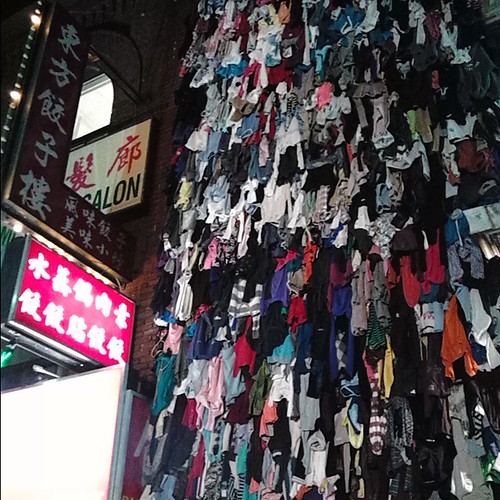
Made in China, Maria Ezcurra, at Nuit Blanche #madeinchina #toronto @sbnuitblancheTO #mariaezcurra


The installation is composed of clothes labeled “Made in China,” donated by the community and set in a Chinatown alleyway. This collaborative piece functions as a façade filling an empty space between two buildings, creating in this way both a physical and a symbolic connection among cultures.

The work is about connections between Eastern and Western societies, between old customs and current trends, between globalization and tradition. It is about how we see and understand ourselves from other views, and vice versa. But mostly, it is about trying to build a bridge in which we are all represented, as a society as much as individuals.

Made in China is an anthropology of our shared present. Clothing in this project is perceived as an effective artistic medium for knowing and learning in new ways about ourselves in relation to others, thus symbolically connecting individual knowledge with culturally produced ideas.


Made in China, Maria Ezcurra, at @sbnuitblancheTO #toronto #nuitblanche #madeinchina #mariaezcurra
rfmcdonald: (Default)
At Spacing Toronto, Shoshanne Saxe argues that the greenhouse gas emissions of various modalities of transit, in Toronto and elsewhere, should be

The type of infrastructure that gets built will strongly influence the types of travel choices people make and the emissions associated with each trip. For instance, where walking or cycling are options, trips can be made without any greenhouse gas emissions, but getting more people onto bikes will require more bike routes and a change in tone on cycling policy. For powered trips, public transit is generally much “greener” than private transit, like cars or motorcycles. A bus is greener than car travel as long as the bus route averages an occupancy of six; in other words, as long as there are at least six passengers on every bus, those passengers are contributing less carbon to the atmosphere than drivers in private vehicles. Streetcars, light rail, and the subway need to average only a few people per carriage to emit fewer greenhouse gases per passenger kilometer travelled than cars.

However, people can’t choose public transit unless we build it, especially in parts of the city that are underserved or over capacity. The trade off is that building anything results in greenhouse gas emissions through material use and the energy required in construction. To make real progress towards reducing greenhouse gas emissions the transit infrastructure built should facilitate transit usage in a way that rapidly pays back the initial greenhouse gas emissions invested.

In 2007, Toronto City Council unanimously adopted greenhouse gas reduction targets for the city. Council committed to reducing the city’s emissions by 80% from 1990 (PDF) levels by 2050. Interim targets of 6% by 2012, and 20% by 2020 were also set at the time.

For Toronto to meet these goals, we will have to cut our growing transportation emissions while also keeping in mind the greenhouse gas impact of building new infrastructure. From 1990 to 2011, the city’s total greenhouse gas emissions from power, transport and waste decreased by 15%, despite transportation emissions increasing by 15%. The impact of the construction industry is not reported in the Toronto inventory, but to give an idea of scale, global cement production alone accounts for 5% of all anthropogenic greenhouse gas emissions.

Transport emissions are increasing for a number of reasons: The city is growing, more people means more trips; these trips are also getting longer, annual average travel distance is Canada (PDF) is increasing, often in larger cars (there are more SUVs on the road). Transportation is making up a growing slice of the emissions pie, now accounting for 36% of total emissions, up from 27% in 1990. It could appear that this doesn’t matter given the overall improvement in greenhouse gas output, but a large part of the progress made so far comes from the closing of Ontario’s coal plants, which resulted in much cleaner electricity for Toronto. The electricity supply mix in Ontario is now relatively green (PDF) and will be hard to make much greener over the coming decades. Further emission reductions will need to come from other sectors.
rfmcdonald: (Default)

  • Centauri Dreams and The Dragon's Gaze both consider the extent to which super-Earths might do a very good job of retaining water oceans over eons.

  • The Dragon's Tales looks at recent Russian military reforms.

  • The Frailest Thing shares a fascinating dialogue between philosophers Hans Jonas and Hannah Arendt on technology and values.

  • Joe. My. God. notes discussion of "highsexuality", of people becoming sexually experimental across boundaries of orientation.

  • Lawyers, Guns and Money and Joe. My. God. each report on an inadvertantly hilarious campaign in Ireland against same-sex marriage warning about the "sounds of sodomy". (Social media is now full of parodies.)

  • pollotenchegg looks at post-Soviet demographic change in three different Ukrainian districts.

  • The Power and the Money's Noel Maurer wonders why Russia might impose capital controls.

  • Understanding Society's Daniel Little considers the concept of a European identity.

  • The Volokh Conspiracy argues that American federal law should recognize civil unions as actual marriages.

  • Window on Eurasia notes Russian incomprehension of Ukraine and observes Russian propaganda against Latvia.

  • Writing Through the Fog features photos of Macau.

rfmcdonald: (Default)
The Inter Press Service's Irfan Ahmed reports on a badly underreported famine in Pakistan. Blame for the deaths of so many children is placed in the article on a badly prepared Pakistani state.

The main entrance to the Civil Hospital in Mithi, headquarters of the Tharparkar district in Pakistan’s southern Sindh Province, is blocked by a couple of men clad in traditional dress and turbans. They are trying to console a woman who is sobbing so heavily she has to gasp for breath.

She lost her two-year-old son just moments ago and these men, both relations of hers, were the ones to carry the child into the hospital where doctors tried – and failed – to save him.

Just a couple of yards away, a team of paramedics waits for the shell-shocked family to move on. They understand that the mother is in pain, but scenes like this have become a matter of routine for them: for the last two months they have witnessed dozens of people, mostly infants, die from starvation, unable to withstand the fierce drought that continues to grip this region.

The death toll hit 650 at the close of 2014, but continues to rise in the New Year as scant food stocks wither away and cattle belonging to herding communities perish under the blistering sun.

[. . .]

The tragedy did not unfold overnight. According to Amar Guriro, a Sindh-based journalist who has reported extensively on the region, inhabitants of this district that borders the Indian states of Rajastan and Gujarat are facing a drought for the third consecutive year.

Despite ample evidence that additional food stocks are needed between the months of July and September, typically the monsoon season, in the event of inadequate rainfall, the Pakistan People’s Party (PPP)-led Sindh government failed to develop and execute contingency plans for the vulnerable residents.
rfmcdonald: (Default)
Writer Charlie Stross makes the case at his blog that just because something is technologically possible doesn't mean it will come about. In this case, he's talking about sub-orbital passenger flight. Even if it could be afforded, dear God, the security issues!

Let's start with a simple normative assumption; that sub-orbital spaceplanes are going to obey the laws of physics. One consequence of this is that the amount of energy it takes to get from A to B via hypersonic airliner is going to exceed the energy input it takes to cover the same distance using a subsonic jet, by quite a margin. Yes, we can save some fuel by travelling above the atmosphere and cutting air resistance, but it's not a free lunch: you expend energy getting up to altitude and speed, and the fuel burn for going faster rises nonlinearly with speed. Concorde, flying trans-Atlantic at Mach 2.0, burned about the same amount of fuel as a Boeing 747 of similar vintage flying trans-Atlantic at Mach 0.85 ... while carrying less than a quarter as many passengers.

Rockets aren't a magic technology. Neither are hybrid hypersonic air-breathing gadgets like Reaction Engines' Sabre engine. It's going to be a wee bit expensive. But let's suppose we can get the price down far enough that a seat in a Mach 5 to Mach 10 hypersonic or sub-orbital passenger aircraft is cost-competitive with a high-end first class seat on a subsonic jet. Surely the super-rich will all switch to hypersonic services in a shot, just as they used Concorde to commute between New York and London back before Airbus killed it off by cancelling support after the 30-year operational milestone?

Well, no.

Firstly, this is the post-9/11 age. Obviously security is a consideration for all civil aviation, right? Well, no: business jets are largely exempt, thanks to lobbying by their operators, backed up by their billionaire owners. But those of us who travel by civil airliners open to the general ticket-buying public are all suspects. If something goes wrong with a scheduled service, fighters are scrambled to intercept it, lest some fruitcake tries to fly it into a skyscraper.

It's going to be a lot harder to intercept a hypersonic service, to say the least. If nothing else, the reaction time will shrink by an order of magnitude. Today, it takes perhaps 2-5 minutes to get an RAF QRA Typhoon-II into the air. It can then go supersonic and overhaul a subsonic target at relatively high speed. From Coningsby or Leuchars a Typhoon-II can reach just about any spot over the UK in 15-20 minutes, in which time a subsonic airliner can travel perhaps 100-200 miles. The picture is very different for a hypersonic passenger craft. In 20 minutes such an aircraft would travel somewhere between 1000 and 3000 miles. None of today's military aircraft are up to the job of intercepting it, and indeed, active radar can't even track it effectively—for that, you'd need something on the order of a cold war ballistic missile warning radar system, designed to provide advance notice of an ICBM strike.

A hypothetical hijacker interfering with the flight profile of a hypersonic transport wouldn't need to deviate from their flight plan 20 minutes before it crashes into a target; it could be a last-minute gambit. So the security surrounding such flights is going to be intense, they're only going to be allowed to fly on well-established schedules (no short-notice bizjet-equivalents need apply!), and they're going to fly in and out of spaceports some distance from the destination city. For example, there's a proposal to use the former RAF Lossiemouth in Scotland as a spaceport for the UK. It's a good site for polar orbit satellite launches (north of Moscow but with far more clement weather), but it's nearly 600 miles from London. Similarly, the New Mexico spaceport isn't exactly next door to Los Angeles.
rfmcdonald: (Default)
In a sort of followup to the Brett Anderson Medium article on Louisiana's catastrophically eroding coastline that I linked to in September, Al Jazeera's Stell Simonton reports on the plight of the Houma Indians of the Louisiana coast. Their homeland is literally slipping away from them, even without oil pollution.

[Houma Chief Thomas Dardar Jr]’s administrative assistant, Bette Billiot, drove her black minivan down a narrow road alongside Pointe-aux-Chenes Bayou in early December, the white feathers of a dreamcatcher swaying from her rearview mirror.

The bayou is in Terrebonne Parish, one of six coastal parishes where the Houma and other Native peoples are concentrated.

She pointed to the right. “That’s Lora Ann Chaisson’s property,” she said. Chaisson, the vice principal chief of the Houma, used to own 15 acres, but only 12 acres of her land still exist. “She has three acres of water now,” Billiot said.

Billiot turned the van onto a narrow road leading to Isle de Jean Charles, a stretch of land that was inspiration for the 2012 film “Beasts of the Southern Wild.”

For years, it was home to a community of Native Americans. Once, 125 or so families lived there, she said. Now it’s only about 25 families. The island was 5 miles wide and 11 miles long in the 1950s, according to the U.S. Geological Survey. Now it’s barely a quarter of a mile wide and 2 miles long.
rfmcdonald: (Default)
CBC reports that two CBC executives linked to the Jian Ghomeshi scandal have been placed on involuntary leaves of absence.

The CBC announced Monday that two senior managers — radio executive Chris Boyce and human resources executive Todd Spencer — have been placed on leave until further notice.

CBC spokesman Chuck Thompson said the decision was related to the Jian Ghomeshi scandal but declined to offer specifics. The former host of CBC Radio's Q was fired in late October from his job as host of the popular arts and culture show.

Ghomeshi was fired after CBC executives saw what they described as graphic evidence that he had physically injured a woman.

[. . .]

A note from Heather Conway, executive vice-president of English services, and Roula Zaarour, vice-president of people and culture, sent to staff on Monday said the past couple of months "have been difficult for many people," but provided scant details about the leave.

"As I’m sure you can also appreciate, we will not be making any further public comment about Todd or Chris or their leaves of absence at this time," the memo says.
rfmcdonald: (Default)
The National Post's Michael Den Tandt is not hopeful for Thomas Mulcair's prospects. The declining importance of Question Period is parliament is cited as one key reason for this.

Prime Minister Stephen Harper’s House of Commons’ style is stolid, conventional and cautious — in a word, dull. He stands, buttons the jacket, faces and addresses the Speaker, rarely modulating his tone, rarely raising his voice. He makes his point and sits. The jacket is unbuttoned once again. Mission accomplished.

Liberal Leader Justin Trudeau is more naturally theatrical — and clearly trying to curb that habit. His approach during question period is simply to say as little as he can get away with, while avoiding making any mistakes. He’ll refer to his notes, make the points he must make, then happily hand off to his caucus mates at the earliest decent opportunity. He’s not that unlike Harper in this regard.

But Mulcair, in marked contrast, is never more in his element than when he stands to pose his first barbed question of the day. In this role, his evolution has been remarkable. Early on, he ditched speaking notes — except for the longest addresses. In 2013, he began glaring directly across the aisle at the prime minister, impaling him with his gaze. Always, the opposition leader’s body language says: “I do not believe a word you say. I own you.” It is an ability that should be devastating.

The problem: Only other MPs, staffers and journalists who cover the Commons watch question period, and thus are aware of Mulcair’s prowess. For most Canadians, it may as well not exist. The evening TV news will feature short clips of the key players. More often than not, these clips will showcase a Liberal rather than a New Democrat, because seconds are precious and news editors watch polls, too. If the Liberals are the government-in-waiting, as every poll and Conservative attack ads suggest, then their opposition view is the one that counts. It becomes a self-fulfilling phenomenon.

None of that would matter as much as it does, if Mulcair had aggressively taken his show on the road in Ontario and British Columbia, in an effort to raise his profile among the people he needs most — beyond Quebec — in order to form a national government. But for reasons that defy easy explanation, he hasn’t done this. Instead, from the very beginning of his tenure as leader in March 2012, Mulcair has taken positions antithetical to the views of the millions of English-Canadian swing voters who handed the country to Harper in 2006, 2008 and 2011.
rfmcdonald: (Default)
I've a post up at Demography Matters noting the ridiculousness of Michel Houellebecq's new novel describing a Muslim takeover of France in 2022. May we be saved from the self-proclaimed prophets of the grimdark,
Page generated Mar. 28th, 2026 05:06 pm
Powered by Dreamwidth Studios