![[personal profile]](https://www.dreamwidth.org/img/silk/identity/user.png)
Mar. 30th, 2015


[BLOG] Some Monday links
Mar. 30th, 2015 02:18 pm- The Broadside Blog's Caitlin Kelly considers old friends.
- Centauri Dreams considers the search for extraterrestrial civilizations using infrared astronomy, concentrating on Dyson spheres and the like.
- The Dragon's Gaze has two links to papers looking at unusual brown dwarfs.
- The Dragon's Tales reports on the flora of late Permian Antarctica.
- Language Log notes a potentially problematic effort at Bangladesh to put hundreds of thousands of Bengali words online with Google, ready for translators. What of quality control, Victor Mair asks?
- Lawyers, Guns and Money comments on the Burmese slaves in the Thai fisheries and looks at the desperate last efforts of Confederates to persist.
- Marginal Revolution suggests that air conditioning really didn't drive much interstate migration in the United States.
- The Planetary Society Blog observes discoveries and anticipation for more at Ceres and Pluto.
- Savage Minds looks to the example of Lesotho to point out that giving people land title by no means necessarily helps them out of poverty.
- Torontoist looks at the Prism music video prize.
Tags:
- antarctica,
- astronomy,
- bangladesh,
- blogs,
- burma,
- ceres,
- earth,
- environment,
- extraterrestrial intelligence,
- extraterrestrial life,
- fisheries,
- friends,
- globalization,
- links,
- migration,
- music video,
- pluto,
- popular culture,
- popular music,
- slavery,
- southeast asia,
- space science,
- space travel,
- thailand,
- toronto,
- united states,
- war
National Geographic's Nadia Drake reports on an unusual feature of Ganymede's surface that is, among other things, a hint about the existence of an ocean.
There’s a big, weird bulge on Ganymede, the largest moon in the solar system. Protruding from a spot on the moon’s equator, the bulge is about 375 miles (600 kilometers) across, about the area of Ecuador, and two miles (three kilometers) tall, about half the height of Mount Kilimanjaro.
It’s not at all what scientists expected to find on this moon of Jupiter.
“I found it a bit by accident while I was looking to complete the global mapping of Ganymede,” says planetary scientist Paul Schenk of the Lunar and Planetary Institute, in Houston. He reported the weird feature on March 20 at the Lunar and Planetary Science Conference.
The size and location of Ganymede’s bulge, which appears to be made of thick ice, suggest that once upon a time, the moon’s icy shell rotated atop the rest of the moon, like an interplanetary Magic 8 Ball.
First, Schenk thinks, the bulge began growing at one of the poles. Then, once the bulge grew big enough, its mass began to drag the shell into a different position. The shell slid atop the ocean, while the moon’s interior stayed in the same orientation. Eventually, the part of the shell that once capped the poles ended up at the equator.
Bloomberg's Robert Hutton reports. British politics can get very interesting, I think.
Scottish Nationalist leader Nicola Sturgeon said her party can win all of Scotland’s 59 seats in the May 7 U.K. general election.
The SNP is meeting in Glasgow, Scotland’s biggest city, for its pre-election conference on the back of a huge surge in support after failing to win last year’s referendum on independence. Polls suggest the SNP may win as many as 50 districts and become the third-biggest party in the House of Commons in London.
“No constituency is off limits for the SNP in this election,” Sturgeon, who’s also the first minister in the Scotland’s semi-autonomous government, told activists Saturday. “We will fight for every vote and every seat. Let’s get out there and turn these poll predictions into reality.”
The Dragon's Tales linked last week to this Discovery News report suggesting that the resurrection of the mammoth may not be too far off.
Researchers from Harvard University have successfully inserted genes from a woolly mammoth into living cells from an Asian elephant, the extinct giant's closest remaining relative.
Harvard geneticist George Church used DNA from Arctic permafrost woolly mammoth samples to copy 14 mammoth genes -- emphasizing those related to its chilly lifestyle.
"We prioritized genes associated with cold resistance including hairiness, ear size, subcutaneous fat and, especially, hemoglobin," Church told The Sunday Times.
Then, using a kind of DNA cut/paste system called CRISPR (clustered regularly interspaced short palindromic repeat), Church dropped the genes into Asian elephant skin cells.
The result? A petri dish of elephant cells functioning normally with mammoth DNA in them, marking the first time mammoth genes have been on the job since the creature went extinct some 4,000 years ago, as Sarah Fecht, from Popular Science, noted.
Denise Balkissoon's article in The Globe and Mail, "The renting gap: Is Toronto in the midst of a rental renaissance – or is it just more of the same?" is not very hopeful.
The rental sector is desperate for square footage – the Canadian Mortgage and Housing Corporation puts Toronto’s vacancy rate at 1.6 per cent – so every unit is welcome. Yet even as 32,726 new condos have gone on the rental market in the past half-decade, tenants continue to struggle with affordability, unit size and family-friendliness, plus trickier issues such as security of tenure and landlord-tenant relationships. Once the first rush of gladness about new space wears off, many landlords, tenants and market watchers are left frustrated at a piecemeal approach that isn’t necessarily filling the gaps that exist.
Rental properties, when they are built to meet all of a prospective tenant’s needs, attract a range of incomes and living circumstances that elevate the diversity of a neighbourhood. “I think the enlightened development community that get it, they see integration as an important public benefit,” says Sean Gadon. As director of the City of Toronto’s Affordable Housing Office, his job often requires much liaising between other public agencies and developers to find innovative means of adding affordable housing to new construction. With the current state of the rental market, Mr. Gadon has seen that “key workers in the economy are squeezed out of access to housing.”
Private developers have 12 tower projects designed specifically for rental currently under way, but most of them are clustered along the city’s wealthy north-south axis. A few carefully negotiated city-led partnerships between developers and non-profit organizations are bearing fruit, but not nearly as much as is needed.
Gillespie, whose company has almost 4,000 new rental units under way across Canada, knows that his brand-new complex in an upper-middle-class neighbourhood won’t be accessible to all. He believes the Honest Ed’s project will add to “the housing continuum,” saying that as new buildings go up, “older housing becomes more affordable.”
Geordie Dent, executive director of the Federation of Metro Tenant Associations doesn’t agree the trickle-down effect will materialize. He points out that despite all of the new individual condo rentals that have come online, the FMTA still gets thousands of calls a year from people who can’t find affordable places to live.
The Halifax Chronicle-Herald's Stephen Cooke looks at the literally hidden history of the Nova Scotian capital.
The city of Halifax has been building upwards since it was founded in 1749, as newer and shinier buildings replace older wood and stone structures, but there is another history beneath the streets and sidewalks that has remained unchanged since long-forgotten labourers constructed it.
Halifax Underground is a new documentary by filmmaker Scott Simpson and Tell Tale Productions, airing on CBC-TV’s Land & Sea on Sunday at noon, that looks at the mythology and reality of a secret world underneath the city’s pavement and landmarks and examines stories of secret tunnels extending from Fort George on Citadel Hill to the waterfront, or even out under the harbour to Georges Island.
The stories have been passed down through generations, and like many urban myths there is an element of truth to them, but Simpson says many of us have never taken the extra step to find out what really lies beneath our feet.
“We’re not tourists in our own town,” he says.
“When we travel abroad, we’ll often take a tour or explore a museum or whatever, but we rarely do that at home. I’m learning things through my kids because we take them to museums and places like that, so I’m learning new things through their eyes because I’m doing things with them I wouldn’t have done on my own.
blogTO's Chris Bateman engages in a bit of alternate history, pointing out that the city of Toronto could have extended down to Lake Ontario if not for Union Station.
Everyone knows about the Queen Street line, Toronto's great (mostly) unbuilt subway. But not many know about the abandoned plan to extend the Yonge and University lines south to Queens Quay.
It started with Metro Centre, a joint proposal by Canadian Pacific and Canadian National railways to redevelop the sprawling tangle of surplus downtown sidings, marshalling yards, and roundhouses owned by both companies into a massive "city-within-a-city." At the time, it was the largest single improvement scheme ever conceived in North America, possibly the world.
Unveiled in 1967 in a lavish ceremony at the Royal York Hotel, the unprecedented $1 billion proposal called for almost 200 acres of new downtown offices, hotels, residential buildings, and commercial centres between Bathurst, Front, Yonge, and the lake shore.
There would be a skyscraping broadcast tower and maybe even a sports stadium. Central to Metro Centre was a new transit centre that would integrate GO, TTC, inter-city rail, bus, and airport shuttles to be built at York and Lake Shore Blvd.
The catch? 45-year-old Union Station would have to make way for a cluster of office buildings.
CP and CN hoped the TTC would extend the downtown subway loop south to the waterfront, adding three new stops at Front and York, Queens Quay and Bay, and Yonge and Esplanade. The southernmost station, to be built roughly where the Queens Quay ferry docks streetcar stop is today, would serve the new transit centre and surrounding offices and residences.
Tags:
I mentioned back in February of last year my interest in the question-and-answer site Quora. I have remained active in the community, and productive to the point that one of my entries earned inclusion in the three-volume Quora Anthology 2014, a selection of the site's best writing.
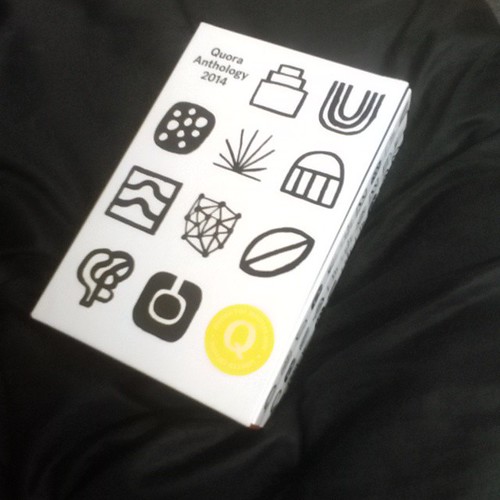
Below is the start of winning entry, a comparison of Australia with Canada intended to bring out the reasons why neither became a superpower.

It is nice to have my words in print again.
Below is the start of winning entry, a comparison of Australia with Canada intended to bring out the reasons why neither became a superpower.
It is nice to have my words in print again.