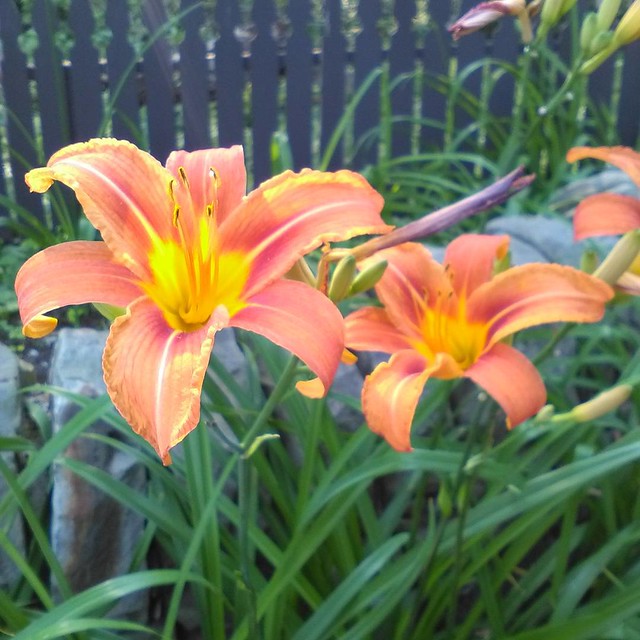
I walked part of the way home, exhausted, through Wychwood Park. At the southern gate of this planned Neighbourhood adjoining Davenport Road were clumps of bright orange Daylilies, the flowers still fresh. They enliven me even now.
Nicholas Suchecki Guillén is blind. His dream was to visit the Panama Canal expansion works, touch the cement structures, and feel part of this new period of history in his country.
The 11-year-old stood on the third set of locks in Cocolí, near the Pacific Ocean. He had the privilege of forming part of the last group allowed to visit the complex before the flooding started – a long process that on this side began on Jun. 22.
Like Nicholas, many Panamanians visited the new locks free of charge on tours promoted by the Panama Canal Authority (ACP), the agency that has run the canal since it was handed back to this country by the United States in 1999.
“I feel proud to see what we have done,” engineer Luis Ferreira, spokesman for the ACP, told IPS. “When the first locks were built, 222 Panamanians participated. On this occasion, 36,276 Panamanians took part.”
The expansion also represents a promise of economic growth. “The canal’s contributions to the state coffers amounted to more than nine billion dollars between 2000 and 2014. With the new locks, they could climb to three billion dollars a year,” Ferreira said.
Thailand’s capital is both glitzy and gritty, a city of glass towers and cement hovels teeming with nearly 10 million people.
All that steel and concrete and humanity sits on what was once marshland. The ground beneath is spongy and moist. Imagine a brick resting on top of a birthday cake. That’s Bangkok — and it’s sinking into the Earth at an alarming rate.
Thailand’s disaster specialists have been warning of this coming calamity for years. One expert has said he’s “worried about Bangkok resembling Atlantis.” Another previously told GlobalPost that the city will be under five feet of water by 2030.
Previous estimates showed that Bangkok is sinking more than three inches per year. But newer data suggests the rate is closer to four inches per year.
The predictions for 2100 are even more dire. By then, Bangkok will be fully submerged and unlivable.
The March 30 attack has prompted soul-searching not just in Rowland Heights but also in China — the victim and her alleged attackers were "parachute kids," part of a new wave of Chinese youngsters who live in Southern California and attend local schools while their parents remain back home.
Parachute kids typically stay in private homes in the San Gabriel Valley, paying for room, board, transportation and substitute parenting from their hosts. Most are in high school, though some are younger, studying here to get a jump start on admission to an American college.
In the attack on [Yiran "Camellia" Liu], who is 18, three teenagers have been charged as adults and pleaded not guilty to torture, kidnapping and assault. Attorneys for Yunyao "Helen" Zhai, 19, and Yuhan "Coco" Yang, 18, acknowledge that their clients participated in the attack and said they hope to reach plea agreements that dismiss the most serious charges. Torture carries a life prison sentence with the possibility of parole. A lawyer for the third defendant, Xinlei "John" Zhang, 18, argued in court that his client was only a bystander.
[. . .]
For parachute kids, living in the U.S. is a chance to learn a new language and culture and to escape China's ultra-competitive college entrance exams. Some thrive in their new environment and go on to colleges such as UC Berkeley and UC San Diego. For others, struggles with dating, friendships or school can spiral out of control without the steadying influence of parents and other family members.
The court testimony of Liu and the second victim offers a glimpse into a world devoid of adults, centered on the Chinese teahouses and karaoke parlors of the east San Gabriel Valley, where some of these teenagers drive Mercedes cars and stay out past 2 a.m. on school nights.
Travel across the US and the cuisine doesn’t change much from state to state. It has a reputation for being sodium-filled, sweetened and glutenous (though, arguably, delicious) food. But chef Sean Sherman, known as the Sioux Chef, is hoping to redefine what we think of as “American” food.
At his newly launched Minneapolis food truck Tatanka, named after the American bison, dishes are made with ingredients that could be found living or growing locally before the arrival of European settlers. So you can forget processed sugars, wheat flour, beef, chicken and pork, Sherman serves wild rice and taco-style cornflour cakes with bison, turkey or rabbit, topped with wild greens and washed down with maple water. As well as being truly American, the food is super-healthy, organic – and local.
“We’ve worked with a couple of native-run farms to grow back some heirloom varieties of beans, squash, melon and corn,” says Sherman.
The anger and fatigue were visible in the face of Slovak Finance Minister Peter Kazimir 27 June when he spoke to reporters in Brussels about another urgent eurozone meeting on Greece.
“For four months we’ve been solving the electoral promises of Syriza,” Kazimir said to Czech and Slovak TV reporters. “If somebody has promised heaven on earth and isn’t able to deliver that, he shouldn’t blame others. Truth is truth, a lie is a lie.”
And that was the polite version. Behind closed doors, reporters were told, the post-communist eurozone member ministers used even stronger language.
These small countries de facto didn’t have much say in the solution to the Greek crisis, since decision-making was down to big member states, and the biggest contributors to the rescue funds. But having fresh memories of painful economic and political transformation, those governments – even the leftist ones, as in Slovakia – don’t have much patience with or understanding of Greek problems.
“We’re prepared to save Greece but not at any price,” Slovak Prime Minister Robert Fico said a week earlier at a conference in Bratislava.
Organic, meaningful and natural. That’s the familiar language of the writer looking for an excuse not to introduce diversity to his (or her; usually his) work. It’s the magical view of storytelling as a gift from the muses, except these muses are a vegetable delivery service, and if they didn’t bring any gay characters in the delivery box, you can’t use any gay characters in your recipe. If the gods of literature did not inspire you with gay characters, you cannot offend the gods and add some anyway.
In this way the writer can present his cowardice, laziness, and lack of imagination, as artistic integrity. “I couldn’t write gay characters; I didn’t have any.” Hand-to-forehead; the tortured auteur.
Yet writing is a sequence of decisions, and you can be sure that’s at least as true in Hollywood, or at a publisher like Marvel Comics, as it is anywhere else in storytelling. Writers build worlds, sometimes in advance and sometimes as they go, and if the writer decides that their world should have robots or dragons, you can be sure they’ll contrive ways to put the robots or dragons into key scenes in the story.
Gay characters aren’t like robots or dragons, because the world the writer is building already has same-sex relationships. I’m sorry if that seems prescriptive, but it’s true; people in same-sex relationships exist in all fictional worlds, because they are a natural, meaningful, and organic part of the real world. They are already there. Maybe they’re hiding behind the dragons, but they’re there.
Unless, that is, you choose to exclude them.


![[personal profile]](https://www.dreamwidth.org/img/silk/identity/user.png) branchandrootdancing_serpent
branchandrootdancing_serpent