rfmcdonald: (Default)
Jill Mahoney AND Leyland Cecco's photo-heavy article in The Globe and Mail looks at the complexities of urban forestry in Toronto.

[There] are among at least 20 victims of falling tree limbs in Toronto in the past seven years, according to a Globe and Mail investigation that found the city has paid out more than $2-million in liability claims.

In addition, countless others have had close calls, saved by a few lucky moments that kept them out of harm’s way or by their ability to hear the cracking of a branch and sprint to safety.

The toll raises difficult questions about whether the city is doing enough to prevent such mishaps by adequately maintaining its 4.1 million trees – one-fifth of which are in fair, poor or even worse condition – and protecting people from the rare but sometimes catastrophic damage they can cause.

[. . .]

Toronto, which bills itself as “a city within a park,” is facing sweeping challenges in caring for its trees, with pressure from all sides. With a chronic budget crunch, the city admits it is not pruning public trees as often as its own experts recommend and acknowledges that it relies heavily on residents to report possibly dangerous trees.

At the same time, Toronto’s park, street and ravine trees have been hit hard by the destructive emerald ash borer, the 2013 ice storm and summer droughts, which can all weaken trees.

Despite this, officials are under pressure to increase the canopy and the significant benefits that trees provide to cities, including cleaning the air, cooling neighbourhoods, conserving energy and increasing property values. In addition, many residents have strong attachments to trees and vehemently oppose cutting them down.
rfmcdonald: (Default)
The National Post's Joe O'Connor and Graham Runciman report, with video, on a fan of High Park's cherry blossoms who wants to find out what happened this year.

Steve (Sakura Steve) Joniak moves with weary-purpose, camera at the ready.

Treading slowly, pausing, peering up through a large zoom lens, while hoping that he might zero in on a telling bit of evidence that could unlock a baffling springtime mystery that has taken root in High Park. The park is a Toronto icon, an idyllic, 161-acre hub for community sports teams, skating and pool parties, picnicking families, joggers, dog walkers, fishermen and those who simply want to spread a blanket beneath a shady tree and while away the afternoon.

It is the trees that Sakura Steve is most interested in. Chiefly: the sakura (cherry) blossom trees. For many Torontonians — and for many others from parts nearby and from places as far away as Japan — the sakura blossoms are the Beatles of the park’s ecosystem. Each spring they bloom, transforming a slope at the southern end of the park into a sea of pink and white. This fleeting, flowery paradise lasts but for a handful of days, attracting blossom lovers and the curious by the tens of thousands to wander in their midst.

The sakuras were a gift from a Japan, an arboreal thank you note to the citizens of Toronto for welcoming thousands of Japanese refugees after the Second World War. They are a treasure and, alas, in 2016, they are not blooming — (neither are the crowds) — and Sakura Steve is determined to find out why.

“It is disheartening,” he says, of the blossoms mysterious absence. “The blossoms, they sort of become a part of you.”
rfmcdonald: (Default)
blogTO was kind enough to list places other than High Park in the city of Toronto where cherry blossoms may be found. I may have to make these pilgrimages, for, as Steve" Kupferman writes in Toronto Life, the inconstant spring may mean that there will be no sakura in High Park this year.

Anyone planning on Instagramming the hell out of their cherry blossom picnic may want to sit down for this. Steve Joniak, who in past years has been reliable at forecasting peak bloom in High Park’s famous Somei-Yoshino cherry groves, writes on his Sakura Watch blog that this year’s fluctuating temperatures will prevent the vast majority of the little pink flowers from poking out of their buds.

“2016 proved to be such an up and down year that we simply didn’t have enough consecutive warm days to help the trees along,” Joniak writes. “[I]f they are stuck in this cycle long enough, they just forget [blossoming] and let the leaves take over instead.”

The High Park Nature Centre agrees with this assessment. “If they do bloom in mid-to-late May there will certainly be fewer flowers,” the centre’s website says.

Links are at the site.
rfmcdonald: (Default)
I learned from the Toronto Star's Allan Woods that Québec's dominance of the maple syrup industry is being challenged by the province's near neighbours, in Canada and the United States.

A sprouting maple-syrup industry in the United States is challenging Quebec’s superiority, the province’s tree-tappers are nervous about the future and rebel suppliers are rising up against the union that sets prices, handles sales and disciplines those who try to go it alone.

With such uncertainty around the popular cans of sticky, golden sweetness, the bitter side of Quebec’s maple syrup industry can be difficult to confront. But ignoring the problem risks ruin in a fast-changing market where Quebec producers remain the dominant player—for now.

That was the message contained in a sharply contested report to the provincial government last month, which confirmed for a wider public a trend that some producers say they have been seeing for years.

“The maple industry . . . has become a flagship of Quebec agriculture,” wrote Florent Gagné, a former Quebec deputy minister. “However, the greatest danger it could face is . . . refusing to see that real threats are looming on the horizon and have begun taking shape.”

The main threats to Quebec’s dominance are from the United States as well as New Brunswick and Ontario, which have swaths of largely untapped maple forests that are increasingly being put to use.
rfmcdonald: (photo)
Tree in December #toronto #trees #churchstreet #alexanderstreet #winter


Last Thursday, Toronto was spring-like and warm. This lone tree stood out, not so much because it was alone in still having its leaves but because it was alone in behaving in normal tree-like fashion in spring.

Something is broken.
rfmcdonald: (Default)
National Geographic's Tina Casagrand notes the collapse of ash tree populations in the United States--and Canada, too?--under the impact of the emerald ash borer beetle. Introduced in 2002, it has since spread catastrophically.

There are seven billion ash trees in North America, and within the next few decades, the beetle could kill most of them—a die-off ten times bigger than the one caused by Dutch elm disease.

In big cities, where ash species account for up to a quarter of trees in public spaces, planners must consider the environmental consequences of the massive die-off—liability hazards, an increase in stormwater runoff, and the simple problem of disposing of millions of dead trees. And officials don't have time to waste.

Eight years after the initial discovery of the beetles in an area, about 50 percent of the ash population will die—all at once. The rest die within another two to three years. In the Kansas City metropolitan area, where Lapointe works, 6.4 million ashes are on track to die as early as 2015—unless they receive insecticide treatment.

Chad Tinkel, who inherited an EAB problem when he became the city arborist of Fort Wayne, Indiana, didn't have the luxury of early identification or a big city budget for prevention. Of the 18,000 ash trees that once shaded Fort Wayne's sidewalks and parking lots, only about 1,300 remain alive. Tinkel now speaks about EAB to municipalities across the country.

"If you know that it's coming, be proactive," he says. "Get your plan in place. Get your budget set. Too few decision-makers realize that trees are infrastructure—just like a city bench, just like a streetlight—and they pay back more than they cost to put in."
rfmcdonald: (Default)

  • blogTO identifies the ten most important buildings in Toronto.

  • Centauri Dreams looks at evidence for plate tectonics in Europa's ice crust.

  • The Dragon's Gaze notes the discovery of methane, carbon monoxide and ammonia in the atmospheres of some brown dwarfs and looks at implications of variability in brown dwarf atmospheres.

  • The Dragon's Tales notes China's plans to launch a second space station into orbit.

  • A Fistful of Euros' notes how Germany's Left Party is continuing its strong support from Russia.

  • Joe. My. God. observes how Ted Cruz' support for Israel was unpopular at an event for Middle Eastern Christians, including many Palestinian Christians.

  • Language Hat notes some signs of cultural cosmopolitanism in the Stalinist Soviet literacy scene.

  • Lawyers, Guns and Money notes that global warming will devastate forests in the western United States.

  • Otto Pohl notes the arbitrariness of race and geography in bounding Africa.

  • Discover's Out There and the Planetary Society Blog's Emily Lakdawalla both note Rosetta's views of its target comet.

  • The Speed River Journal's Van Waffle chronicles with photos the story of the vole he found eating his potatoes.

  • Towleroad notes a mother in Alabama who is trying to cut her dead son's husband out of his estate.

  • Why I Love Toronto celebrates Queen Street West.

  • Window on Eurasia suggests that diasporas of Russian minorities should also be recognized as Russian, argues that Putin is cornered, and notes the significant differences between Estonians and Russophones in Estonia in beliefs about religious and the supernatural.

  • The Financial Times' The World notes controversy over whether Ukraine should try to cut a deal with Russia.

rfmcdonald: (photo)
I took these pictures in late May, walking north along Gladstone north of Bloor. It's time for me to post them!

I'm confident in identifying the blossoms in six of these photos as magnolia blossoms. I suspect that the other pictures are of cherry blossoms, given the season, but don't hesitate to correct me as, in fact, ashnistrike on Livejournal did.

Magnolias of Gladstone (1)


Magnolias of Gladstone (2)


Blossoms of Gladstone (1)


Blossoms of Gladstone (2)


Read more... )
rfmcdonald: (photo)
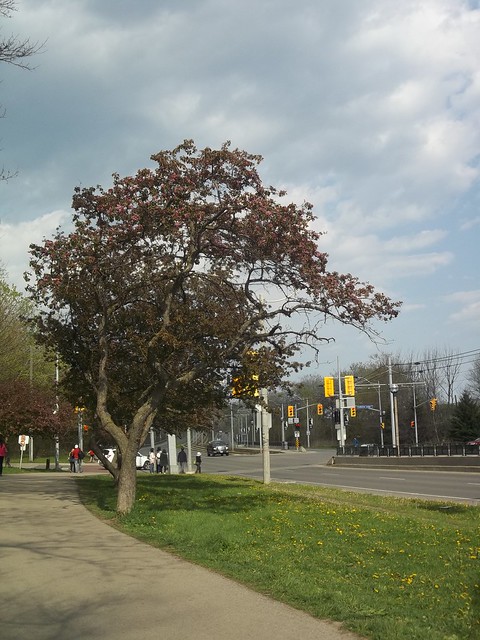
This is a set of ten photos from my High Park trip earlier this month that don't fit into any of my sets: shots of modernist park shelters and cafes, pictures of the crowded hills in the southwest of the park, the image of a tower across the water, a lonely look north across Grenadier Pond from the southern end of that body of water. There's even a couple of pictures of rare cherry blossoms in the mix.

Seen around High Park, May 2014 (1)


Seen around High Park, May 2014 (2)


Seen around High Park, May 2014 (3)


Seen around High Park, May 2014 (4)


Seen around High Park, May 2014 (5)


Seen around High Park, May 2014 (6)


Seen around High Park, May 2014 (7)


Seen around High Park, May 2014 (8)


Seen around High Park, May 2014 (9)


Seen around High Park, May 2014 (10)
rfmcdonald: (photo)
I went to High Park yesterday to see the last of the cherry blossoms and to take photographs of the park in spring bloom, not necessarily in that order. (I managed to winnow down my photographs to sixty or so. I'm getting better at that.)

The park was packed. All sorts of people had come to take advantage of a beautiful day, the last and titular day of the Victoria Day long weekend, to enjoy an increasingly green High Park anow that a long and brutal winter was finally over. One of these sorts were photographers. We were everywhere, taking group shots by the tulips at the northern entrance opposite the subway station, solitary shots among the trees or by Grenadier Pond or on the Queensway, or just posing under trees like a graceful weeping willow or even the last tree in the park to keep its cherry blossoms.

Photographing photographers at High Park on Victoria Day (1)


Photographing photographers at High Park on Victoria Day (2)


Photographing photographers at High Park on Victoria Day (3)


Photographing photographers at High Park on Victoria Day (4)


Photographing photographers at High Park on Victoria Day (5)


Photographing photographers at High Park on Victoria Day (6)


Photographing photographers at High Park on Victoria Day (7)


Photographing photographers at High Park on Victoria Day (8)

Profile

rfmcdonald: (Default)rfmcdonald

February 2021

S M T W T F S
 123456
78910111213
14151617181920
212223242526 27
28      

Syndicate

RSS Atom

Style Credit

Expand Cut Tags

No cut tags
Page generated Jan. 9th, 2026 05:24 am
Powered by Dreamwidth Studios