May. 3rd, 2011

rfmcdonald: (Default)
Laywers, Guns and Money's Scott Lemieux is too kind.

Globe and Mail and the CBC calling a Conservative majority government, NDP not only official opposition (as widely predicted) but towards the top end of their range, Bloq wiped out. It even looks like the NDP will win my old riding, which used to have among the widest Liberal margins in the country.

If I wrote a satirical novel in which a particularly douchey “liberal hawk” took over Canada’s Natural Governing Party (TM), forced a completely unnecessary early election, and handed the conservative opposition a majority government while putting up the worst showing in the party’s history, I think it would seem a little heavy-handed.

… Iggy seems to be implying in his concession speech that he won’t resign. Clearly, he needs to hear some historical analogies from Tom Hagen.


Michael Ignatieff was parachuted parachuted into the Toronto riding of Etobicoke-Lakeshore. I say "parachuted" since, up until that point, Ignatieff had no substantive connections with the riding apart from it being available as a base from which he could launch a political career (which, to be fair, at the time I thought to be the Liberals' best chance). He lost the riding yesterday, of course.

(Thanks for the correction on the riding location: 1:12 AM wasn't the most coherent time for me.)
rfmcdonald: (Default)
The suggestion of Jeremy Keehn, writing in Slate, that Michael Ignatieff's lack of popularity can be traced mainly to a Canadian "tall poppy" syndrome, of a distrust of someone whose career took him outside of the country, strikes me as wrong. I disliked Ignatieff because he was a parachuted candidate, previously lacking any involvement in Canadian domestic politics and lacking any personal appeal until it was far, far too late. He lost because he deserved to lose.

I think Keehn is right about this being a secondary factor, to be sure, alongside the urban/rural polarization of the electorate, and I do like his choice of illustrative anecdote.

No one has captured the culture of suspicion toward Ignatieff types in the Canadian hinterlands quite so well as Alice Munro. In her second book, Lives of Girls and Women, her alter ego, Del, watches two aunts mock their neighbor's new husband at an introductory dinner:

"Oh, the law-yer!" cried Aunt Elspeth elegantly, and leaning across the table inquired, "Have you always—been interested—in country life?" After their marvelous courtesy to him I found this faintly chilling; it was a warning. Didn't he think he was somebody! That was their final condemnation, lightly said. He thinks he's somebody. Don't they think they're somebody. Pretensions were everywhere.

Not that they were against ability. They acknowledged it in their own family, our family. But it seemed the thing to do was keep it more or less a secret. Ambition was what they were alarmed by, for to be ambitious was to court failure and to risk making a fool of oneself.


The aunts then brag about their talented brother, who they claim could have sat in the province's Cabinet. "Didn't he get elected?" Del asks. "Don't be silly, he never ran," Aunt Elspeth replies.

Under the Conservative barrage, Ignatieff no doubt often wished he hadn't either. But there's wisdom, too, in the fears of small towns. A mistrust of ambition holds a country to one war instead of two or three; it keeps national banks from gorging on mortgage-backed securities. And it helps sort out the leaders from the carpetbaggers.

The Conservatives were smart to smear Ignatieff as the latter, but whether they were right remains to be seen. Examples of his vanity abound, to be sure—this is a man who once posed, in a raffish pink suit, for the cover of GQ's U.K. edition. And he did make a fool of himself as one of the leading thinkers to support the Iraq War. Yet his otherwise illustrious international career was grounded in the values of the country he left behind in 1969. One of the downsides to shying away from ambition is that you can also be quick to abandon your ideals—and back then, Canada prided itself on being internationally oriented, morally engaged, and spiritually generous. The international community has found Harper's Canada to have these qualities in shorter supply.


Oh well. Four more years.
rfmcdonald: (Default)
As you may have gathered, the signal fact of yesterday's election in Toronto is the collapse of the Liberal Party. blogTO's maps illustrate this, the first one showing the results of the 2008 federal election, the second yesterday's. Red represents the Liberals, orange the NDP, blue the Conservatives.

20081014_GTA_results[1]

201152-2011-GTA-ridings[1]


The Globe and Mail captures the significance of this in text. Brief version? The Liberals are screwed. The article even cites my Davenport riding as an example of this.

Before election night, it was thought that the Liberal Party could save face as long as it clung to the 21 Toronto ridings that have served as the party’s intellectual and electoral nucleus stretching as far back as the governments of Lester Pearson.

But Liberal Leader Michael Ignatieff lost his seat and the party lost other key ridings belonging to stalwarts Joe Volpe, Ken Dryden and Gerard Kennedy.

“This is the capital of the English Liberal Party in the country,” said Stephen Clarkson, University of Toronto professor and author of Big Red Machine: How the Liberal Party Dominates Canadian Politics. “A rout in Toronto, it’s devastating for the prospects of the Liberal Party recovering its national standing.”

The phenomena that worked against the Liberals on election night: a late surge in popularity for Jack Layton that landed NDP candidates in Parkdale-High Park and Davenport and several other ridings, a Conservative election machine that conscripted the services of Mayor Rob Ford in targeting seats where Grit support was believed to be soft, and then a combination of the two where vote splitting between Liberals and NDP allowed a Conservative candidate to come up the middle.

In Toronto, the bellwether for the NDP’s history-making fortunes was Davenport. The riding has been considered a Grit entitlement for decades, passing faithfully from Pearson-era finance minister Walter Gordon to Charles Caccia, who held it for nearly 40 years before incumbent Mario Silva took it over.

The man that upset that era of Liberal dominance is NDPer Andrew Cash, a musician running in his first election. At Mr. Cash’s campaign celebration, cheers erupted as the candidate swept the polls. Eric Double said Mr. Cash got his vote for his energy and personal politics. “I'm interested in him fighting for the rights of people like me.”
rfmcdonald: (Default)
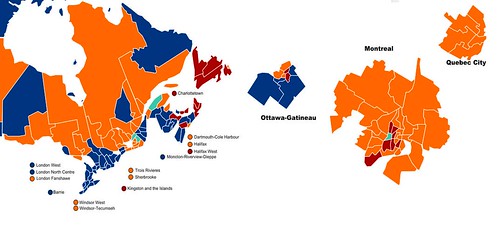
The annihilation of the Bloc Québécois, the party losing 43 of the 47 seats in the federal parliament (including the seat of then-party leader Gilles Duceppe) has played almost entirely to the benefit of the New Democratic Party, which now draws almost half of its caucus from Québec. Including ridings in northern Ontario, Ottawa-Gatineau and New Brunswick with large Francophone populations (but not eastern Ontario), the case can be made that the New Democratic Party--a federalist party--is now the leading political party of French Canada.

(Oh, even one week ago I never would have believed that.)

polmapeastcan


The NDP is orange, if you're curious. The Conservatives have some ridings on the far side of the St. Lawrence river from Québec City, the Bloc Québécois some scattered ridings in eastern Québec and one in downtown Montréal, and the Liberals a half-dozen in Montréal, but that's it. The NDP is hegemonic in Québec.

The major problem with this remarkable new dominance is that the NDP has historically been quite weak in Québec. The only NDP parliamentarian in Québec before the election was downtown Montréal MP Thomas Mulcair, who himself was only the second NDP member in federal parliament ever elected from Québec. 58 of the 68 seats gained by the NDP--59 of the 102 total--were gained in Québec. Might the spectacularly rapid growth lead to growing pains, especially since the overwhelming majority of these parliamentarians are new to politics?

NDP Leader Jack Layton defended his youngest, least-experienced caucus members Tuesday morning after Quebec voters elected three McGill University students and a pub manager who doesn't speak French or live in the Francophone riding she'll represent.

“I don’t share this notion that a young person is somehow not qualified, and evidently the people who voted for these new MPs in Quebec feel the same way,” Layton, now the leader of the Official Opposition in the House of Commons, said in Toronto just 12 hours after his party saw its best-ever election results.

The NDP crushed the Bloc Québécois in the province, taking 58 of 75 seats. But the orange wave of popularity that decimated the other parties in the province swept several newbies to the House of commons, including three students, a karate instructor and the pub manager.

Layton promised all the new MPs will work as hard as those with more experience.

"First of all, we also have a lot of experienced MPs who are judged by most of the people who watched the Parliament as some of the most effective," he said.

"And we will have a lot of new blood, new energy, new talent … when people vote for change, that's what they're hoping happens."


While the NDP fits the generally left-leaning political culture of Québec, and given general fatigue with the Bloc Québécois, distrust of the Conservatives, and disinterest in the Liberals was the only alternative, it's possible that if the NDP flirtation doesn't work out--if the sovereignty movement complicates the NDP's life, or if the new MPs don't grow quickly into their positions--there could be a breakdown. Then again, if the NDP manages this all and cements its position as the only political party including both Canadian solitudes, its chances of becoming a viable party of government would become that much stronger.
rfmcdonald: (Default)
Since the early 20th century, the Liberal Party of Canada has drawn much of its strength on the basis of ethnicity, with French Canadians and people of non-British/French stock being particularly numerous. Québec (not the rest of French Canada) has become increasingly skeptical of the Liberal Party since the repatriation of the Canadian constitution in 1981 was made without the consent of the Québec provincial government, however. After passing through the Bloc Québécois and flirting with the Conservatives, Québec has now settled--as I mentioned in my previous post--on the New Democratic Party. In the past decade, as Liberal strength has ebbed, the party has become increasingly an urban party, concentrated in urban areas and in central Canada and depending increasingly on "New Canadians", on the immigrant communities from around the world that have arrived in the past decades.

Not so much, now.

It took 13 seats to tip the Tories into a comfortable majority in Monday’s election, and two-thirds of those came from the 905 region of Greater Toronto — a direct result, experts say, of the party’s drive to target ethnic voters.

When the dust had settled, Conservatives picked up 23 of the region’s 24 ridings, including nine previously held by Liberals. Incumbent John McCallum in Markham-Unionville, who has swept the past few elections, remained the lone Grit clinging to a seat after besting his Conservative opponent by fewer than 2,000 votes, the tightest race of his career.

While vote-splitting between the Liberals and the NDP gave Conservative candidates an edge in some of the more closely contested 905 ridings, experts say the main factor behind the blue wave was the Tories’ deliberate appeal to the immigrant vote.

“It’s been a concerted, vigorous, really thought-out, slightly right-of-centre strategy, and it’s been delivered apparently with very sophisticated targeting of areas and groups,” said Stephen Clarkson, a professor of Canadian politics at the University of Toronto.

Prime Minister Stephen Harper made a flurry of campaign stops in cities such as Brampton and Mississauga with a goal to reverse the historic trend of new immigrants voting Liberal, Mr. Clarkson noted — and with the Ignatieff campaign in freefall, it appeared to work.

“Many of the immigrant voters may not have the same connection to the Liberal Party as they might have had even in the previous election,” Ryerson University political scientist Duncan MacLellan said Tuesday. “There were some shifts happening that [Conservatives] were able to take advantage of.”


The diversification in the 1960s on immigration to Canada beyond Europe (and family reunification from Asia) to (in 1967) a new non-discriminatory system that allowed people to immigrate to Canada based on their qualifications was achieved by the Liberal Party. Canadian multiculturalism, too, is a policy that was enacted by Pierre Trudeau's Liberals in the 1970s. Not unnaturally, the rapidly growing demographic has inclined strongly towards the political party that let them exist. And it is a big demographic.

Members of Canada’s three major forces entered this country in trickles and droves over the years, beginning with the arrival of the ancestors of the Aboriginal peoples from Asia, followed thousands of years later by the French and the British colonizers, who appointed themselves the official founders of Canada. At the turn of this century, the gates opened to allow immigrants from other Europeans countries into Canada, although not without hostility from a substantial portion of the public. In percentage terms, the influx peaked in 1912 and 1913, when annual arrivals exceeded 5% of the total population.

In recent years, the number of immigrants coming into Canada has risen to all-time highs. Between 1991 and 2000, 2.2 million immigrants were admitted to Canada. In percentage terms, the annual intake ranged between 0.6% and 0.9% of the total population during this period. Patterns of immigration have also shifted toward non-traditional sources such as Asia, the Caribbean, and South and Central America. Equally significant has been the unprecedented influx of landed refugees – many of them from Third World countries – who have requested entry into Canada.

Canada’s cultural diversity is manifest at the level of ethnic and immigrant composition. At the time of Confederation, Canada’s population was chiefly British (60%) and French (30%). By 1981, the combination of declining birthrate and infusion of non-European immigrants saw the British and French total decline to 40% and 27%, respectively. By the beginning of the 21st century, the proportion of people with British, French, and/or Canadian ethnic origins had dropped to below one-half of the total population (46%). (The term “Canadian” ethnic origin was first introduced in the 1996 census.) An ethnic diversity survey published by Statistics Canada in 2003 showed that 21% of the population aged 15 years and older was of British-only ancestry, while 10% reported only French origins, 8% were Canadian only, and 7% were a mix of these three origins.

This increased diversity was evident in the 2001 census, in which more than 200 different ethnic origins were reported. After Canadian, British, and French ethnic origins, the most common ancestries were German, Italian, Chinese, Ukrainian, and North American Indian. The 2001 census also found that 18.4% of the population was born outside Canada – the highest proportion in 70 years – and that immigrants were increasingly from Asia. The visible minority population accounted for 13.4% of the population, up from 4.7% in 1981.

Language diversity is also at the core of Canadian pluralism. In 2001, according to census data, English dominated as the first language (mother tongue) in 59.1% of the population. French came next at 22.9%, while the allophone category (having a mother tongue other than English or French) was 18.0%. The number of allophones has risen quickly – between 1996 and 2001 it increased by 12.5%.


This demographic, however, is two, even three generations old. As these communities have become more deeply rooted, more assimilated into the framework of Canadian political life, the members of these communities have started to move beyond primordial allegiances. Between social conservatism and sympathy for Conservatives' economic policies, voting patterns have been shifting.

The Canadian Election Study reveals that, in 2008, immigrants were almost as likely to vote Conservative (33 per cent of them did) as Liberal (38 per cent). That’s a drop of 17 percentage points in Liberal support between the 2000 and 2008 elections.

Although overall support for the Conservatives among immigrants remained steady over the last decade at around one voter in three, among more recent immigrants – those who are likely to be visible minorities – a switch is clearly under way.

Between 2000 and 2008 support for the Liberals among “viz mins” plummeted from 83 per cent to 49 per cent, while Conservative support climbed from 16 to 26 per cent.

The immigrant vote will only grow more important with each election, as Canada imports the equivalent of the city of Toronto every 10 years. New legislation proposed by the Conservatives would add 30 seats to the House of Commons and all the new ridings will be in urban areas and most will have large immigrant populations.

For Liberals, the erosion of their support is desperate news. The immigrant vote has been a pillar of the party’s success since the Second World War. Everyone, especially immigrants, knew that Liberals wanted to let people in; Tories wanted to keep them out.


This shift is ultimately a good thing. No, I don't think it's good that the Conservative Party won so; yes, I think these voting patterns are a good sign that New Canadians (awkward term, this, but you know what I mean) have continued their assimilation into Canadian life, thanks to the normalization of the ideals of non-racist immigration policies and multiculturalism across the Canadian political spectrum. It's a very good thing whenever people no longer feel bound by their personal characteristics (or a characteristic) to support a particular political faction. It's always good when someone gets at last to become just another person free to choose.
rfmcdonald: (Default)
Patrick Beithour's Globe and Mail article makes an interesting argument that I don't entirely buy. The title? "Canada’s new electoral divide: It’s about the money".

The true divide, the new reality of Canadian politics, is between the economic heartlands that the Conservatives now dominate throughout the country and the economic hinterlands won by the NDP.

The energy powerhouses of Alberta and the B.C. Interior are Conservative, while B.C.’s struggling north coast is solidly NDP. The suburbs and thriving technology centres of Ontario are deep blue territory, but the north of the province is orange. Quebec’s rural areas are largely held by New Democrats, but the entrepreneurial hub of the Beauce remains a Tory bastion.

With Canada still shaking off the effects of the recession, the Conservatives were clearly looking to herd economically worried voters into their column at the start of the campaign. The party was aiming not just at the haves, looking to safeguard their affluence, but at the just-hads, aching to reclaim their recently lost prosperity.

That message resonated strongly in Southern Ontario, where the manufacturing industries are still reeling and voters are no mood to take risks. “In Southwestern Ontario, they are not screwing around with the economy,” said Greg Lyle, managing director at Innovative Research Group. (Although the NDP also benefited in a more limited way from those same worries, maintaining its traditional strength in Windsor and Hamilton.)

Then came the unexpected surge of the NDP, and Conservative Leader Stephen Harper’s eleventh-hour appeal to Liberal voters with economically conservative leanings, often called blue Liberals. “Let me speak very clearly to traditional Liberal voters: I know many of you do not want NDP policies. That you do not want NDP tax hikes,” Mr. Harper said on Sunday.

The message: Only we can protect your prosperity.

The result is that the Conservatives were able to achieve in 2011 what eluded them in 2008, a coalition of economically conservative-minded voters who cast their ballots based on pocketbook issues rather than concerns over cultural issues, including the Tories’ supposed leanings toward social conservatism.

Those blue Liberals were the missing element in the Conservative coalition. In the 1990s, they were the foundation of the successive Liberal sweeps of Ontario. So long as they remained with the Liberals, Mr. Harper would be shut out of the urban heart of most big Canadian cities.

[. . .]

Unfinished it may be, but the new Conservative coalition now dominates more than just the natural-resources powerhouses of the West – it also has strengthened its lead in the areas containing the brainy industries of Ontario, in the prosperous, immigrant-heavy suburban communities and even, most startlingly, in the wealthy ridings in the heart of Toronto.


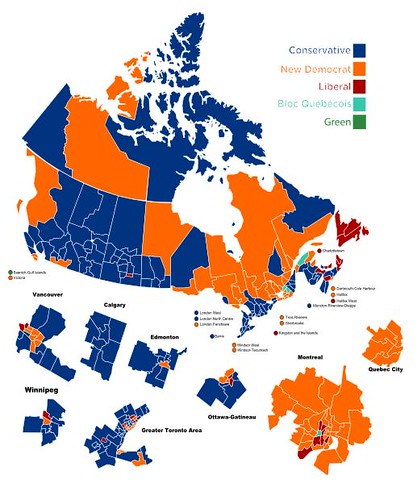
Below, courtesy of Wikipedia, is the map showing the results of yesterday's election.

Results of 2011 federal election, Canada


The Beauce region Breithour refers to--the deep blue area opposite Québec City--forms the core of the region of Chaudière-Appalaches, which has a population of a shade less than four hundred thousand people out of a Québec population of just a shade under eight million. The Census Metropolitan Areas of Montréal and Québec, the economic hubs of Québec and the former being easily the most internationally important city in the province, have a combined population of 4.6 million people. Looking at the electoral map, in fact, the downtown cores of most Canadian cities--save Alberta's Edmonton and Calgary, of course, and Manitoba's Winnipeg as well--voted solidly non-Conservative. These cities, in turn, are frequently much wealthier than their hinterlands. In some areas--especially in Toronto--the combined votes of the Liberals and NDP exceed those of the Conservatives, and under some sort of proportional representation system things would look different.

Economics matter, clearly. Equally clearly, they're not the only thing that matters: Culture, say, or regional identity, or ethnic background, or ... Always, always, always try to avoid reductionism.
Page generated May. 10th, 2026 05:11 am
Powered by Dreamwidth Studios