![[personal profile]](https://www.dreamwidth.org/img/silk/identity/user.png)
Sep. 17th, 2014


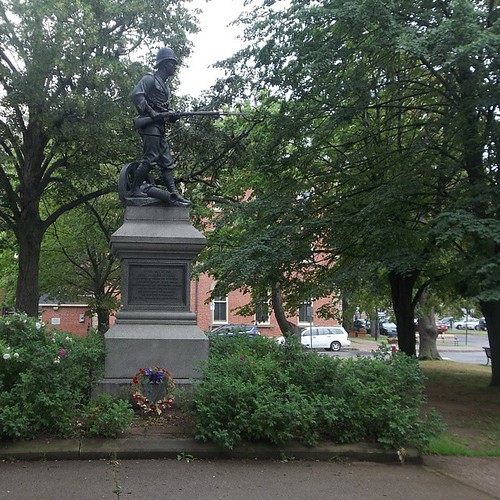
This statue standing just a bit to the east of Province House and Great George Street commemorates Prince Edward Island's participation in the Boer War, with particular emphasis on the reverse side of the casualties among Island volunteers in the Battle of Paardeberg.
I blogged about this monument and the battle it commemorates back in 2008, and in 2009 I linked to a blog post by Jussi Jalonen describing Nordic volunteer participation in this battle on the side of the Boers.
From Canada.com:
Liposarcoma is apparently a treatable cancer with a high survival rate, but the medical experts consulted on CBC were surprised that Cohen didn't engage in surgery first. This, to them, suggested that the cancer had spread substantially.
Doctors have determined the tumour in Toronto mayor Rob Ford’s abdomen is cancerous and the mayor will now undergo chemotherapy.
The official diagnosis is liposarcoma, a maligant tumour that arises in soft tissue, said Mount Sinai’s Dr. Zane Cohen. The “very difficult tumour” is large in size at 12 centimetres long and wide. Another smaller tumour — about two centimetres— was found in the mayor’s buttocks, behind his left hip.
Dr. Cohen said it’s also a rare case, comprising only one per cent of all cancers.
“We think it’s a fairly aggressive tumor. These types of tumors are often slow growing. To get to the size that it is now is often several years,” said Dr. Cohen. He could not specify what stage the cancer is in.
Dr. Cohen said after speaking with 45-year-old Ford and his family, the decision has been made to go ahead with chemotherapy, starting with three days of in-patient treatment followed by 18 days of “washout” before repeating. He could not rule out the future possibility of radiation treatment or surgery. The initial round of chemotherapy will begin within the next 48 hours and doctors plan to reassess in 40 days time.
Liposarcoma is apparently a treatable cancer with a high survival rate, but the medical experts consulted on CBC were surprised that Cohen didn't engage in surgery first. This, to them, suggested that the cancer had spread substantially.
[BLOG] Some Wednesday links
Sep. 17th, 2014 07:50 pm- Claus Vistesen at Alpha Sources notes that the Italian economy has slipped back into recession.
- blogTO identifies ten secret things in Toronto.
- Centauri Dreams looks at gas giants with very unusual, even misaligned, orbits around their local suns.
- The Dragon's Gaze links to one study on the internal geology of silicon-carbon worlds and to another on the moderating impact of oceans on planetary climates.
- The Dragon's Tales notes the Indian military buildup in the Andaman and Nicobar Islands, and links to a study suggesting that even the very early Earth might have been hospitable towards life.
- Geocurrents features a guest post from Will Rayner pointing out ways in which statistics can lie (Luxembourg looks very wealthy, but this is an artifact of a huge day-commuter workforce coming from outside of its frontiers).
- Joe. My. God. reports that the Egyptian police seem to be using Grindr to hunt down gay men for arrests.
- The Russian Demographics Blog notes the ethnographic justification for the Soviet invasion and partition of Poland.
- Spacing Toronto points to an upcoming photo exhibit showcasing Toronto's tower neighbourhoods.
- Torontoist reports on the success of urban agriculture as an experiment in New York City.
- Window on Eurasia notes the deteriorating situation of Crimean Tatars and suggests Russia is preparing to move into the Baltic States.
Tags:
- agriculture,
- astronomy,
- baltic states,
- belarus,
- biology,
- blogs,
- borders,
- earth,
- economics,
- egypt,
- ethnic conflict,
- european union,
- eurozone,
- former soviet union,
- glbt issues,
- history,
- india,
- italy,
- links,
- luxembourg,
- maps,
- middle east,
- migration,
- neighbourhoods,
- new york city,
- oceans,
- oddities,
- photography,
- poland,
- police,
- russia,
- social networking,
- southeast asia,
- space science,
- toronto,
- ukraine
Universe Today's Elizabeth Howell notes that NASA space probe Dawn will be delayed in arriving at dwarf planet Ceres by a month. All seems well otherwise, thankfully.
NASA’s Dawn spacecraft experienced technical problems in the past week that will force it to arrive at dwarf planet Ceres one month later than planned, the agency said in a statement yesterday (Sept. 16).
Controllers discovered Dawn was in safe mode Sept. 11 after radiation disabled its ion engine, which uses electrical fields to “push” the spacecraft along. The radiation stopped all engine thrusting activities. The thrusting resumed Monday (Sept. 15) after controllers identified and fixed the problem, but then they found another anomaly troubling the spacecraft.
Dawn’s main antenna was also disabled, forcing the spacecraft to send signals to Earth (a 53-minute roundtrip by light speed) through a weaker secondary antenna and slowing communications. The cause of this problem hasn’t been figured out yet, but controllers suspect radiation affected the computer’s software. A computer reset has solved the issue, NASA added. The spacecraft is now functioning normally.
Bloomberg's Mark Gilbert notes a study of Twitter posts suggesting that momentum may be with separatists.
Opinion polls remain inconclusive as to whether Scotland will decide to secede tomorrow, as the final hours tick by before a referendum. Still, an analysis of Twitter messages by academics at Oxford University has shed a little more light, suggesting that the momentum is with those who favor independence.
Karo Moilanen, a visiting academic at the university, has dissected more than 1 million tweets in the past month. The "yes" campaign has generated more than 782,000 missives, compared with 341,000 for those backing the "no" movement. Both camps saw a dive in activity yesterday, though those backing the Scottish nationalists were still twice as active as the unionists[.]
Moreover, Moilanen's software, called TheySay, parses the sentiments in messages using language algorithms. The results suggest those who would go it alone are more upbeat in their tweeting than their unionist opponents[.]
[. . .] The most recent opinion polls show the "no" campaign leading with about 52 percent, compared with 48 percent for the "yes" group when undecided voters are excluded. That makes the vote too close to call given the margins of error involved and the inherent imprecision of opinion polling. So the excitement of those young Twitter users, voting for the first time, may just determine the fates of both Scotland and the U.K.
Patrick Donahue and Arne Delfs's Bloomberg article suggests general disarray across Europe at the prospect of a Scottish vote in favour of independence, with the Germany that is becoming the central power of Europe and a Spain facing even graver separatist issues being highlighted.
German Chancellor Angela Merkel’s government is counting on Scots to reject independence and hasn’t made contingency plans for a U.K. split, underscoring a lack of preparedness across Europe before tomorrow’s referendum.
While Merkel has avoided weighing in on Scotland’s future, German policy makers view independence as an ill-advised choice for Scots and are concerned it would spur separatism in other European Union countries such as Spain, according to three government officials in Berlin who asked not to be named because the discussions are private.
The possible breakup of the EU’s third-biggest economy has been low on Europe’s agenda as leaders focused on the Ukraine conflict and the advance of Islamic State militants in Iraq. While the “yes” campaign for Scottish independence gathered steam, Merkel spent days campaigning in three German state elections.
“Everybody seems to have underestimated what Scottish independence may mean,” said Joerg Forbrig, an analyst at the German Marshall Fund in Berlin, citing questions about the future of U.K. nuclear weapons and Scottish membership in the North Atlantic Treaty Organization. “Nobody wants the disintegration of any European countries, be it Scotland or Catalonia.”
All surveys suggest the contest over Scotland’s future tightened in the final days of campaigning. Four of the five latest polls showed the anti-independence Better Together group backed by Prime Minister David Cameron and the main U.K. parties leading the “yes” campaign by 52 percent to 48 percent, excluding undecided voters.
[. . .]
The British pound has lost 3.1 percent against the U.S. dollar since the start of August as polls showing a growing “yes” vote led to market uncertainty. The yield on Spanish 10-year bonds climbed the most in 15 months on speculation the vote could stoke the Catalan region’s bid for autonomy.
Tags:
Canadian politics blogger Éric Grenier, the man behind ThreeHundredEight.com, has a piece of analysis at CBC suggesting the outcome of Thursday's referendum could be quite close indeed.
The consensus view in general is that undecideds tend to break disproportionately toward the status quo, opting at the last moment not to take a step into the unknown. This is what seems to have occurred in the 1995 Quebec referendum, when polls suggested the Yes side was on track for a slim victory.
Yet, this has so far not been the case in the Scottish referendum campaign. From March to July, support for independence stood at an average of 36 per cent, with 46 per cent supporting continued union and 17 per cent remaining undecided.
In August, the number of undecideds fell to about 13 per cent, with neither the Yes nor the No campaigns benefiting more than the other. Support for independence increased by two points to 38 per cent. Support for union was up three points to 49 per cent — a proportional increase.
But lately support has swung strongly to the Yes side. Undecideds have fallen again, by four points to an average of nine per cent, but support for independence has surged by six points to 44 per cent, with support for the "Better Together" campaign dropping to 47 per cent. In other words, not only has "Yes Scotland" drawn some undecideds toward its option, it has also converted some former unionists.
Writer Anthony Barnett has a long essay at Open Democracy about English identity in the wake of the Scottish referendum, and its relationship to British identity.
[A] great cry of pain arises from the Brits, including from the hearts and souls of many of my friends and compatriots south of the border. For them, the idea of Scotland ‘leaving’, never before taken seriously, is enraging. The mere thought of it—let alone the thought of becoming English—fills them not with the thrill of self-determination but with despair.
[. . .]
There is no doubting the sincerity of this lucidly expressed feeling. But it is very strange. Why would [Martin] Wolf lose part of himself? Why should he and Tom Holland and many, many others in England suffer such a dramatic amputation, all the more painful for being internal, as a consequence of less than ten per cent of the UK peacefully choosing to govern themselves in so far as they can? They would not feel the same way if Northern Ireland voted to leave, as the Good Friday Agreement explicitly permits. So it is not about part of the UK deciding its own fate.
A clue shouts out from Wolf’s description of Englishness as “ethnic” (meaning a racial identity that excludes him) whilst contemporary Britishness is “civic”. For him and many others to become English is experienced as a threat, even though it is their actual nationality, for Britishness is multi-national and you cannot be ‘just’ British. The strain in Wolf’s observation can be seen more clearly if you start from the fact that Scottishness is civic: the Scottish parliament represents a multi-faith, multi-ethnic, open society, whether the vote is Yes or No. The Yes campaign invites everyone to join it. If the Scottishness is civic and also part of being British how come Englishness is ethnic? Why is it racial while Scottishness and Welshness are not?
I am British and have embraced the fact of my Englishness, and found that England too is a civic, tolerant, anti-fascist country that I am proud to call my own. I came to this realisation thanks to the Scottish experience, which I have been following closely over two decades. For me it is an emancipation: not a loss but a gain. However, there is no doubting that Holland and Wolf express the majority experience. It is not just an opinion or even a profound sentimental attachment to Britishness that they fear to lose, it is an internal part of themselves that feels threatened.
The pain of this is not going to be healed by a ‘No’ vote, however relieved they may be. They can see perfectly well that Scotland would vote ‘Yes’ if the English offered to help diminish the risks, not threaten to increase them. This week’s pre-referendum editorial in the Economist bewailing the prospect of a Yes vote included this extraordinary sentence: “The rump of Britain would be diminished in every international forum: why should anyone heed a country whose own people shun it?”