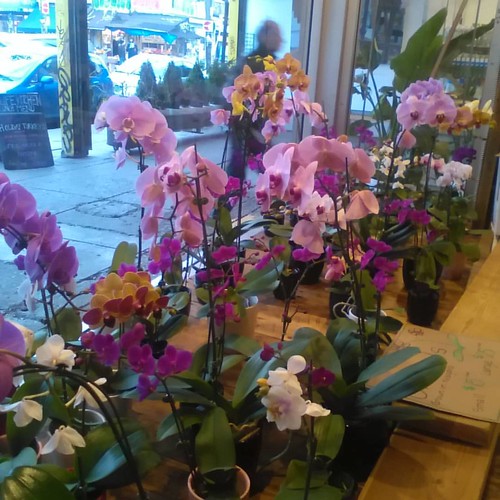
Orchids fill the front window of Kensington Market's 4Life Natural Foods, an organic supermarket in Toronto's Kensington Market that fills the space formerly occupied by Zimmerman's Discount.


To track how glaciers grew and shrank over time, the scientists extracted sediment cores from a glacier-fed lake that provided the first continuous observation of glacier change in southeastern Greenland. They then compared the results to similar rare cores from Iceland and Canada's Baffin Island for a regional view.
"Two things are happening," said study co-author William D'Andrea, a paleoclimatologist at Columbia University's Lamont-Doherty Earth Observatory. "One is you have a very gradual decrease in the amount of sunlight hitting high latitudes in the summer. If that were the only thing happening, we would expect these glaciers to very slowly be creeping forward, forward, forward. But then we come along and start burning fossil fuels and adding carbon dioxide to the atmosphere, and glaciers that would still be growing start to melt back because summer temperatures are warmer."
Glaciers are dynamic and heavy. As a glacier moves, it grinds the bedrock beneath, creating silt that the glacier's meltwater washes into the lake below. The larger the glacier, the more bedrock it grinds away. Scientists can take sediment cores from the bottom of glacier-fed lakes to see how much silt and organic material settled over time, along with other indicators of a changing climate. They can then use radiocarbon dating to determine when more or less silt was deposited.
Sediment cores from the glacier-fed Kulusuk Lake allowed the scientists to track changes in two nearby glaciers going back 9,500 years. Before the 20th century, the fastest rate of glacier retreat reflected in the core was about 8,500 years ago, at a time when the Earth's position relative to the sun resulted in more summer sunlight in the Arctic.
"If we compare the rate that these glaciers have retreated in the last hundred years to the rate that they retreated when they disappeared between 8,000 and 7,000 years ago, we see the rate of retreat in the last 100 years was about twice what it was under this naturally forced disappearance," D'Andrea said.
A young female elephant spends almost every minute of every day by her mother’s side. The deep mother-daughter bond is a reflection of the important role older matriarchs serve in elephants’ complex social networks. Elder females are the glue that keeps groups together.
But the passage of time yields longer tusks, which puts matriarchs square in poachers’ crosshairs, and the resurgent ivory trade has claimed the lives of countless elephant family leaders. But in the face of dramatic familial disruption, the daughters who spent their lives in their mother’s shadow step up and fill the void left behind by mom, a new study reveals. For elephants, it appears their social bonds are stronger than the ravages of poaching.
For nearly two decades, George Wittemyer has followed the same elephant families in northern Kenya’s Samburu and Buffalo Springs national reserves. He’s witnessed pachyderm groups soldier through adversity — from droughts to periods of heavy poaching. And from his extended research, he’s developed a deep appreciation for just how important elephant social networks are to their survival.
“Elephants are highly socially complex, and are probably among the most complex species next to ourselves,” Wittemyer says. “Their social structure is really critical…In some ways, their relationships are stronger than our own.”
The researchers measured selenium isotopes in rock samples laid down under the ocean to track oxygen levels from 770 to 525 million years ago (across the full period believed to be covered by what is known as the Neoproterozoic Oxygenation Event). The marine shales are drawn from seven different geological sections, with samples from Canada (the Mackenzie Mountains), China (the so-called Yangtze Platform), Australia and the western US.
This is a fascinating period because three major glaciation events occurred during it: The Sturtian (‘snowball Earth’) of roughly 716 million years ago, the Marinoan (635 million years ago, or 635Ma), and the Gaskiers glaciation (about 580 Ma).
This would be a planet that looked nothing like what we’re familiar with, as the image above suggests. The land would have been covered in ice and the oceans frozen all the way to the equatorial regions. Temperature changes as these eras progressed would in each case melt the glaciers and produce a flow of nutrients into the oceans, one that would build the levels of organic carbon in seafloor sediments as oceanic plankton that flourished from that flow died. The growth in such carbon would lead to gradual increases in the level of oxygen.
A key finding of the paper is that rather than occurring after the Gaskiers glaciation, the oxygenation began much earlier, during or at the end of the Marinoan glaciation. From the paper:
“…the significance of the Se isotope record is not only that it adds to growing evidence that the late Proterozoic and Cambrian ocean and atmosphere reached a progressively more oxic state, coinciding with the diversification of animal life, but also that the process of oxidation was protracted, and not ultimately triggered by the Gaskiers deglaciation, as other data suggest.”
Moreover, it took approximately 100 million years for atmospheric oxygen to climb from less than 1 percent to over ten percent of today’s level. The occurrence of oxygenation in fits and starts over such a lengthy period of time is evidence, the team believes, that early animal evolution received its needed boost from these increased levels of oxygen. Says Pogge von Strandmann: “We were surprised to see how long it took Earth to produce oxygen and our findings dispel theories that it was a quick process caused by a change in animal behaviour.”
Hans Island is a 1.2-square-km rock in the Kennedy Channel of the Nares Strait between Canada’s Ellesmere Island and Denmark’s Greenland.
In practical terms, it’s worthless (even if it would likely incite bidding wars in the real-estate markets of Vancouver or Toronto).
Just before Christmas in 1973, Canada and Denmark agreed to a treaty that established the boundary between Canada and Greenland.
The boundary-makers drew a series of geodesic lines up the middle of the waterway, and all went swimmingly until they bumped into Hans Island. Since their mandate was to draw maritime, not land divisions, they hopped over it.
Perhaps not surprisingly, Canada claimed Hans as Canadian. Denmark assumed it to be Danish. And the two sides have not seen eye to eye on Hans since.
The year in Southwestern Ontario comes to a close, the air surprisingly – perhaps even a bit alarmingly – warm, with the sun burning off an early morning fog along the Grand River.
The air is so still the mist hovers rather than swirls. The canoe and a couple of accompanying kayaks waltz through the random swifts and riffles, all quiet until a half dozen mallard ducks explode into the air from behind a large rock in the river.
The silence is notable in that this river and its many tributaries are surrounded by roughly a million people. There are industrial cities, college towns, tourist villages, First Nations, farms, freeways, back roads, wind turbines, discount tobacco shops and, by last count, 678 bridges along the sprawling watershed of the Grand River.
At times, with no structures along long stretches of its shoreline and no roads within hearing distance, the Grand can seem – in the words of Guelph’s James Gordon – almost “pastoral” as it gently twists through the rolling hills and farmland on its journey south to Lake Erie.
Mr. Gordon is a city councillor, a founding member of the Wellington Water Watchers and also a professional musician. As a solo artist as well as a member of the folk group Tamarack, he has recorded multiple songs about the Grand, tracing its First Nations history, its European settlement and its fascinating gorges.
No community in Canada is growing faster than Milton. And there’s probably no place in the country where the stresses of daily life, for residents like Zeeshan Hamid, are so closely tied with the inevitable growth.
Two of Hamid’s three children learn inside portables at their elementary school, which opened just four years ago. That’s not rare. Most schools in Milton are far beyond capacity. Hamid even feels lucky that his youngest actually gets to stay inside the building.
Hours before his children leave for school, Hamid’s own workday commute begins with one purpose in mind: finding a parking spot at Milton’s only GO Train station.
It was opened in 1981, after a decade of startling growth that saw the municipality’s population soar, from 7,018 residents in 1971 to 28,067 a decade later, a 300 per cent increase. Flash forward to today, and that figure is a mind-boggling 1,600 per cent, with Milton’s estimated population at the end of this year projected to be around 120,000.
With the GTA’s population set to rise by almost 3 million people over the next 25 years, the vast majority in the 905 area code, the provincial agency responsible for implementing the growth strategy is facing sharp criticism about desperately needed infrastructure that’s nowhere in sight.
“Our forecasts are suggesting that there’ll be approximately 13.5 million people in the Greater Golden Horseshoe by 2041,” says Larry Clay, assistant deputy minister of the Ontario Growth Secretariat, which operates under the Ministry of Municipal Affairs and Housing. “The growth is coming, this is likely where it’s going to grow, and we need to plan better for it, going forward . . . it’s a very fast growing region.”
Broken Hill is known for its 130 years of history as a mining community. Now the Australian Outback city is home to one of the first large solar projects that’s feeding electricity to the country's national grid.
The AGL Energy Ltd. and First Solar Inc. plant reached full capacity in October, sending 53 megawatts of clean energy to the national electricity market. It will produce enough power to meet the needs of 17,000 homes a year.
The Broken Hill plant has about 678,000 solar modules installed at a 25-degree angle, facing north. Those panels are wired together and connected to inverters that transform the direct electrical current that’s produced into an alternating current. That power can then be fed to the grid. The solar farm is linked to an existing substation almost 3 kilometers away through a 22-kilovolt transmission line.
In the national market, high voltage electricity is converted to low voltage, with distribution lines carrying the power to homes, offices and factories that use electricity for lighting, heating and powering appliances.
It works as a “pool”, or spot market, where power supply and demand is matched instantly. The national electricity market serves about 19 million residents and has 40,000 kilometers (25,000 miles) of transmission lines and cables, according to the Australian Energy Market Operator.
In Najran, the thump of artillery reverberates all day across a valley ringed by desert mountains along Saudi Arabia’s southern frontier with Yemen.
Security guards at an archaeological site outside the city barely register the blasts as Saudi land forces fire shells across the border. Like many in Najran, they’ve gotten used to the daily reality of a war that most Saudis only see on their TV screens, if at all.
For most of the nine-month conflict, the frontlines have been far south of the kingdom’s borders, around cities like Taiz and Aden, where the Saudis and their coalition partners pushed out Houthi rebels seen as allies of Iran. On the Saudi side, it’s only in Najran -- even if on a far smaller scale -- that war is having a direct impact.
The city’s airport is closed, forcing residents to travel almost 300 kilometers (186 miles) to the nearest alternative. Schools open then shut again, depending on the fighting. Once-busy markets are empty. Across the border, swaths of Yemen have been heavily bombed, leaving thousands of civilian casualties and refugees.
“None of the people in Najran like this war,” said Hassan al-Wadee, a 57-year-old man whose shop sells the curved Yemeni daggers knowns as jambiyas. “We want this war to end.”
Russia's newest surprise from its bag of tricks in Syria has come from deep in the water: It's the Rostov-on-Don submarine that, according to Russian Defense Minister Sergei Shoigu, has begun to cruise the eastern Mediterranean Sea along the coasts of Syria, Lebanon and Israel. The submarine is almost undetectable, armed with a large number of cruise missiles and regarded as a sophisticated, almost invisible intelligence-gathering vehicle. The Rostov-on-Don has already fired cruise missiles toward Islamic State targets in Syria, but it is the submarine's other capabilities that are causing far greater concern to other players in the region, such as Israel.
It is still unclear what the ratcheting up of the combined efforts of Russia and Iran will achieve on the Syrian battlefield. A Dec. 10 Bloomberg News article stated that the Iranians have begun withdrawing their forces from Syria after heavy losses there, including the wounding of Gen. Qasem Soleimani. The source of the news tidbit was, evidently, American intelligence that discovered convoys of Iranian fighters returning to the land of the ayatollahs, their tails between their legs.
This week, Israeli intelligence sources denied this information. “We are not convinced that this points to desertion of the battleground,” one source told Al-Monitor on condition of anonymity. “There is movement of Revolutionary Guard soldiers within Syria, and it is actually unclear whether they are leaving or not. Perhaps it is redeployment. It is too early to say that Iran is giving up on Syria, though. In light of their meager results so far, anything is possible.”
In October, a record number of 7,000 elite Iranian Islamic Revolutionary Guard Corps soldiers fought together with Hezbollah and Syrian President Bashar al-Assad against the rebels in Syria. They were recently joined by the Russians. This coalition set far-reaching goals for itself: stabilization of Assad’s regime, ensuring his continued rule and enlarging the regions he controls by retaking a number of key cities, including Idlib.
![[personal profile]](https://www.dreamwidth.org/img/silk/identity/user.png) branchandrootdancing_serpent
branchandrootdancing_serpent