rfmcdonald: (Default)

  • Bad Astronomer Phil Plait notes that mysterious Boyajian's Star has nearly two dozen identified analogues, like HD 139139.

  • James Bow reports from his con trip to Portland.

  • Caitlin Kelly at the Broadside Blog notes the particular pleasure of having old friends, people with long baselines on us.

  • Centauri Dreams describes a proposed mission to interstellar comet C/2019 Q4 (Borisov).

  • The Crux notes how feeding cows seaweed could sharply reduce their methane production.

  • D-Brief notes that comet C/2019 Q4 is decidedly red.

  • Bruce Dorminey notes a claim that water-rich exoplanet K2-18b might well have more water than Earth.

  • Gizmodo reports on a claim that Loki, biggest volcano on Io, is set to explode in a massive eruption.

  • io9 notes that Warner Brothers is planning a Funko Pop movie.

  • Joe. My. God. notes the claim of Donald Trump that he is ready for war with Iran.

  • JSTOR Daily looks at how people in early modern Europe thought they could treat wounds with magic.

  • Language Hat considers how "I tip my hat" might, translated, sound funny to a speaker of Canadian French.

  • Language Log considers how speakers of Korean, and other languages, can find word spacing a challenge.

  • Lawyers, Guns and Money looks at the partisan politics of the US Supreme Court.

  • At the NYR Daily, Naomi Klein makes a case for the political and environmental necessity of a Green New Deal.

  • Peter Watts takes apart a recent argument proclaiming the existence of free will.

  • Peter Rukavina tells how travelling by rail or air from Prince Edward Island to points of the mainland can not only be terribly inconvenient, but environmentally worse than car travel. PEI does need better rail connections.

  • The Russian Demographics Blog examines how different countries in Europe will conduct their census in 2020.

  • Window on Eurasia shares the arguments of a geographer who makes the point that China has a larger effective territory than Russia (or Canada).

  • Yorkshire Ranter Alex Harrowell looks at a 1971 prediction by J.G. Ballard about demagoguery and guilt, something that now looks reasonably accurate.

  • Arnold Zwicky considers models of segregation of cartoon characters from normal ones in comics.

rfmcdonald: (Default)

  • Bad Astronomer Phil Plait notes the import of the discovery of asteroid 2019 AQ3, a rare near-Venus asteroid.

  • Centauri Dreams notes the how the choice of language used by SETI researchers, like the eye-catching "technosignatures", may reflect the vulnerability of the field to criticism on Earth.

  • John Holbo at Crooked Timber considers what is to be done about Virginia, given the compromising of so many of its top leaders by secrets from the past.

  • The Crux notes how the imminent recovery of ancient human DNA from Africa is likely to lead to a revolution in our understanding of human histories there.

  • D-Brief notes how astronomers were able to use the light echoes in the accretion disk surrounding stellar-mass black hole MAXI J1820+070 to map its environment.

  • JSTOR Daily considers the snow day as a sort of modern festival.

  • Robert Farley at Lawyers, Guns and Money links to his consideration of the plans of the German Empire to build superdreadnoughts, aborted only by defeat. Had Germany won the First World War, there surely would have been a major naval arms race.

  • The NYR Daily looks at two exhibitions of different photographers, Brassaï and Louis Stettner.

  • Emily Lakdawalla at the Planetary Society Blog shares an evocative crescent profile of Ultima Thule taken by New Horizons, and crescent profiles of other worlds, too.

  • Starts With A Bang's Ethan Siegel looks at the mystery of why there is so little antimatter in the observable universe.

  • Frank Jacobs at Strange Maps shares a map exploring the dates and locations of first contact with aliens in the United States as shown in film.

  • Window on Eurasia notes a new push by Circassian activists for the Circassian identity to be represented in the 2020 census.

rfmcdonald: (Default)

  • D-Brief notes that, with the Dawn probe unresponsive, its mission to Vesta and Ceres is now over.

  • The Dragon's Tales reports that NASA is seeking commercial partners to deliver cargo to the proposed Gateway station.

  • JSTOR Daily looks back to a time where chestnuts were a staple food in Appalachia.

  • Language Log takes a look at prehistoric words in Eurasia for honey, in Indo-European and Old Sinitic.

  • Joy Katz at the LRB Blog writes about her lived experience of the conventional Pittsburgh neighbourhood of Squirrel Hill, a perhaps unlikely scene of tragedy.

  • The Map Room Blog links to an interactive map showing the Québec election results.

  • Marginal Revolution links to that New York Magazine article about young people who do not vote to start a discussion.

  • Roads and Kingdoms looks at the real dangers faced by Venezuelan refugees in the northern Brazilian state of Roraima, at the start of the era of Bolsonaro.

  • Window on Eurasia argues that changes to the Russian census allowing people to identify with multiple ethnicities could lead to a sharp shrinking in the numbers of minority nationalities.

rfmcdonald: (Default)

  • Bloomberg reports on how Canada-Mexico relations will be tested by NAFTA and Trump.

  • Canada, the 2016 Census reported, is marked by noteworthy linguistic diversity (Tagalog does particularly well.)

  • Vice notes how Galen Weston's opposition to the minimum wage increase for workers at Loblaws is not in his self-interest.

  • Vice's Motherboard looks at how greenhouse agriculture in Nunavut could help drastically reduce food insecurity in that territory.

rfmcdonald: (Default)
At Demography Matters, I linked to Canadian newsmagazine MacLean's, which hosts Jordan Press' Canadian Press article "Census still vulnerable to political meddling, says former chief". Wayne Smith warns that the Canadian census is still vulnerable to political interference, even with new legislation.

The federal government’s bid to protect Statistics Canada from political interference has a significant oversight that exposes the census to the possibility of government meddling, says Canada’s former chief statistician.

Wayne Smith, who resigned abruptly from the agency in September, said newly introduced legislation doesn’t change the parts of the Statistics Act that give cabinet control over the content of the questionnaire.

That leaves the census – used by governments to plan infrastructure and services – vulnerable to the sorts of changes the Conservatives imposed in 2011 by turning the long-form census into a voluntary survey, Smith said.

“That’s a major flaw in this bill,” he said. “The government brought this bill in because of the census, but it’s failing to deal with the census.”

Smith described the bill as a first step towards broadening the agency’s authority over how information on all types of subjects is collected, analyzed and disseminated, shifting that authority away from the minister.


Freedom, including access to public data both accurate and meaningful, is a constant struggle now, as it always has been.
rfmcdonald: (Default)
The Globe and Mail's Bill Curry reports on the 2016 census' few issues.

The Globe and Mail has learned that 347 letters were sent last month to individuals who had not yet completed the 2016 census (202 for the short form and 145 for the long form). That is about in line with 331 letters that were sent after the 2011 census, when only the short form was mandatory.

Restoring the mandatory long-form census was one of the first official acts of the new Liberal government last year. The quick decision allowed Statistics Canada to shift gears in time for the 2016 survey, which is now complete. The agency has said it received a response rate of 98.4 per cent, including 97.8 per cent for the long-form census, which does not go out to all households.

Statistics Canada’s chief statistician, Wayne Smith, announced his resignation on Sept. 19 as a protest against information technology issues that he said were compromising the agency’s independence. Mr. Smith sent the 347 compliance letters on Aug. 19, and the letters give a deadline of Sept. 9.

“Anyone convicted of an offence under the Statistics Act is liable to punishment as set out in the Statistics Act,” the compliance letters stated.

The act says a person found guilty could face a fine of up to $500, up to three months in jail, or both.

How to manage these files is now an issue for Mr. Smith’s replacement, Anil Arora.
rfmcdonald: (Default)
I've a post up looking at the recent resignation of Statistics Canada's chief statistician Wayne Smith, prompted by the insecure data services offered by the federal government's ill-conceived platform.
rfmcdonald: (Default)
There were a lot of interesting posts made around the web from Sunday evening on.


  • blogTO takes issue with the poor design of the buildings on Bloor Street West east of Dundas West.

  • Crooked Timber notes the tragedy inherent in the life of Phyllis Schlafly.

  • The Dragon's Gaze notes that two of the worlds in the TRAPPIST-1 system may have Venus-like environments.

  • The Dragon's Tales looks at the fate of Planet Nine at the end of the sun's life.

  • Lawyers, Guns and Money looks at good music from the past.

  • The Power and the Money's Noel Maurer has two questions about the SpaceX explosion.

  • Savage Minds has its own blog roundup.

  • Strange Maps considers the Icelandic letter that reached its destination with a map of its destination.

  • The Volokh Conspiracy wonders if people of recent immigrant stock are less nativist.

  • Window on Eurasia looks at school crowding in Dagestan, notes the popularity of Arabic in the highlands, worries about changes to Russian census-taking methodology, and suggests the number of Jews in Russia has been underestimated.

  • Yorkshire Ranter Alex Harrowell looks at the demographics of the Brexit referendum.

rfmcdonald: (Default)
At Demography Matters, I u>report briefly on the apparently wide-spread concerns over privacy and security associated with this year's Australian census.
rfmcdonald: (Default)
At Demography Matters, I react to an io9 article that draws from a Brisbane Times article about how people claiming to follow the Jedi religion in the Australian census can actually worsen the collection of data.

This is funny, but this is also an important example of how modern statistics can be flawed.
rfmcdonald: (Default)
(I blogged this on Demography Matters, too.)

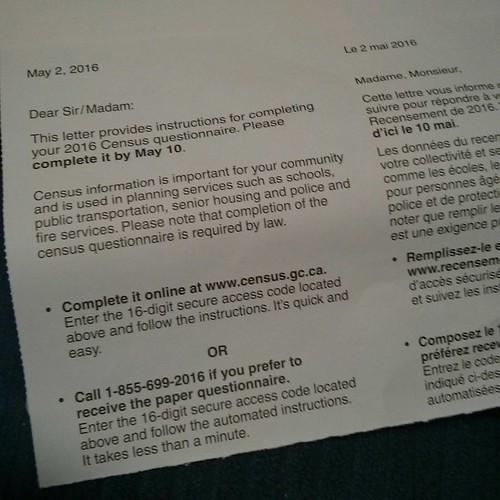
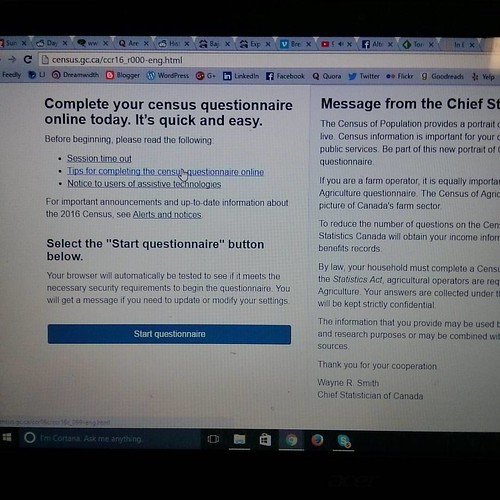
The return of the long-form census has become a trending hashtag on Twitter, #Census2016. It was more than that: As both the CBC and the Huffington Post noted, when the census collection period began on the 2nd of May, it became a major pop-culture trend in Canada. So many people responded that the official census website was briefly knocked down.

Me, I decided to be fashionably late.

Census selfie #toronto #me #selfie #canada #census #census2016


One in four Canadian households, selected at random, received 36-page long-form questionnaire known as the National Household Survey. I, unfortunately, did not, instead clicking through ten short questions. Still, it got done. I could have received it, after all.

Instructions #canada #census #census2016


Starting #cabada #census #census2016


The whole episode has been reassuring for fans of good data. Shannon Proudfoot's MacLean's article "The census is back with a swagger" took an extended look at how the census matters, and how it became so important.

This week, the furious preparations of the agency over the last several months come to fruition: May 10 is census day, when Canadians raise their hands to be counted. The voluntary National Household Survey that replaced the long-form census in 2011 ended up being neither the pointless disaster its staunchest critics had envisioned, nor the perfectly useful replacement its proponents predicted. It had serious limitations that caused 1,100 small communities to vanish off the statistical map; it produced a few weird findings that simply didn’t look right; and it made looking for change over time all but impossible. It did, however, offer a serviceable snapshot of the country. Now that StatsCan is returning to a mandatory long-form census—and in a hurry—the question is what will become of the evolving national portrait that underpins everything from people’s bus routes and commuter highways to their children’s schools and where they can grab groceries on their way home from work.

What was once the driest and most esoteric of citizen duties—the statistical backbone of the country that, frankly, most people were oblivious to—became an unlikely flashpoint in 2010. That July, then-prime minister Stephen Harper axed the mandatory long-form census, arguing it was inappropriate to compel citizens to answer questions about their education, work, ethnicity and housing, among other topics. Critics of the move—they were nearly unanimous among those who use census data, including researchers, municipal planners and community organizations—insisted that a mandatory census was the only way to get an accurate picture of who Canadians are and what they need.

Ultimately, 68 per cent of households responded to the 2011 National Household Survey (NHS)—far short of the 94 per cent that completed the long-form census in 2006, but better than the 50 per cent response rate StatsCan projected in some of its testing. The agency’s analysts did everything they could to verify and shore up the information they had. In the end, they released the data they believed was solid, but anything below a certain quality threshold—a highly technical measure that amounts to overall non-response combined with “item non-response,” or individual questions people skipped—was simply not released. “We were very transparent in saying that at the small community level, we cannot do the same level of validation,” says Hamel. That meant that 1,100 small towns and specks on the map, representing three per cent of the Canadian population, became statistical ghost towns, except for the basic information collected on the short-form census. If you wanted to know what the 1,400 residents of Shellbrook, Sask., do for work, how much education they have or their ethnic backgrounds, you’d hit a dead end.

But even with all the quality control StatsCan conducted, there were a few odd glitches that spoke to the problems with using a voluntary survey to obtain a full portrait of your country. The NHS, for example, found that between 2006 and 2011, the largest proportion of Canada’s new immigrants came from the Philippines, followed by China. But a tiny numbered footnote attached to that observation warns that it doesn’t square with immigration records, which showed that in fact the largest slice of newcomers came from China. Presumably, a significant number of new Chinese arrivals either didn’t fill out the NHS or didn’t identify their recent country of origin.

However, the biggest problem with the 2011 survey is simply that it’s different. StatsCan told users flatly that the NHS results were useful for comparing different regions of the country at a single moment in time, but they shouldn’t be measured against 2006 or earlier census results, because the methodology had changed so fundamentally. And comparing data over time is “the most important single thing” for researchers, says Michael Veall, a professor of economics at McMaster University. Veall is quick to note that the NHS turned out better than he expected it would when he testified at a parliamentary committee hearing on the issue in 2010, but it still has serious limitations. “Statistical information is interesting when there’s a surprise, right?” he says. “So you find more people are doing this or more people are doing that. The trouble when we went from 2006 to 2011 [is] every time we see a surprise, we have to say, ‘Oh, is that because something really happened, or is that because there’s a problem with the data?’ ”


I'm glad it's back. I'm very glad that I'm not the only one. Hopefully next time I'll have a chance to fill in the long-form census.
rfmcdonald: (Default)
At Demography Matters, I have a brief note, crossposted below, about the return of the long-form census to Canada this year.

* * *

It's time for Canadians to deal with the 2016 Census, and this year, as the Liberal government has promised, the long-form census is back. CBC News' Hannah Jackson outlined this in "The long-form census is back, it's online — and this time, it's mandatory".

Statistics Canada today officially begins mailing out access codes so Canadians can prepare to complete the 2016 census online — either the regular or the newly restored long-form version — next week.

Census Day is May 10, but Statistics Canada is encouraging Canadians to complete their census forms as soon as they receive them.

The letters will provide a 16-digit access code to allow households to complete the census online, but also gives Canadians the option of having a paper version mailed to their homes.

[. . .]

One in four randomly selected households in Canada will receive the 36-page long-form questionnaire known as the National Household Survey, while the remainder of Canadians will receive the 10-question short version. Both are mandatory.

Under Section 31 of the Statistics Act, the consequence for failing to provide information to a mandatory census or falsely answering is liable to a summary conviction carrying a fine of up to $500, imprisonment of up to three months, or both.


The import of the census is outlined in Jordan Press' Canadian Press article "Long-form census forms return to mailboxes this week after absence", published at MacLean's and the Toronto Star.

For provincial coffers, the population estimates in the census determine how much per capita funding they will receive in transfers from the federal government.

For local governments and community groups, the demographic details in neighbourhoods help with decisions on where to place new schools, transit routes, seniors’ housing and emergency services.

For companies, the census data act as a much-needed complement to what’s become known as big data.

“Some people wonder, well, why do you even need a census when we have big data?” said Jan Kestle, president of Environics Analytics.

“When you combine the kind of data we now can collect with census data, you can really get a more integrated view of what consumers want both in terms of products and services and that’s also true in terms of what citizens want from government.”


The politics behind the 2011 cancellation are also explored briefly by Press.

The previous Conservative government replaced the long-form census with the voluntary survey five years ago in a move that caught many by surprise and lit a political fuse over the depth of data Statistics Canada collected through regular population counts. The results from the 2011 count prevented comparisons to previous years, left out some small communities over quality concerns, and raised reliability questions around response rates of immigrants and aboriginals.

As one of its first acts in government, the Liberals brought back the mandatory, long-form questionnaire.

Kestle said there will remain gaps in the data collected five years ago, but the return of the long-form census this year should bridge many of them created by the one-time absence.

“To be realistic, of course there will be breaks (in data), but I think missing one (census) is not nearly as bad as if we hadn’t had it come back,” she said.


Craig Silverman's humourous article at Buzzfeed is worth reading for the chuckles.
rfmcdonald: (Default)

  • The Broadside Blog's Caitlin Kelly describes her schedule as a freelance writer.

  • City of Brass' Aziz Poonawalla tries to start a discussion on the hijab.

  • Crooked Timber considers Piketty's analysis in inequality in the context of Australia.

  • Language Hat looks at how a Chinese font is created.

  • Language Log notes the old name of Serbia, "Servia".

  • Lawyers, Guns and Money notes the Mexican census' inclusion of Afro-Mexicans.

  • The Russian Demographics Blog notes the cancellation of the Ukrainian census.

  • Une heure de peine's Denis Colombi considers poverty in the holiday season.

  • Window on Eurasia notes Putin's search for legitimacy and observes Russian criticisms of the administration of Crimea.

rfmcdonald: (Default)
I've a post at Demography Matters sharing the good news. I did not want to base a post on the speculation earlier this week, but today it has been confirmed. From the Toronto Star:


The mandatory long-form census is back.


Just a day after taking office, the new Liberal government announced Thursday that the 61-question census form — axed by the Conservatives in 2010 — will be reinstated for the 2016 census.


Navdeep Bains, the newly named Minister of Innovation, Science and Development, confirmed the news to reporters on Parliament Hill, declaring that the country needed access to high quality data.


“Today, Canadians are reclaiming their right to accurate and more reliable information,” said Bains, the MP for Mississauga-Malton.


With the 2016 census, communities will “once again have access to high-quality data they require,” he said.


I, for one, am very pleased.
rfmcdonald: (Default)

  • blogTO considers if the Union-Pearson Express might work as a rapid transit line.

  • The Dragon's Gaze notes that Earth-like worlds which rapidly lose most of their water can extend their habitable lifetimes.

  • The Everyday Sociology Blog talks about the sociological lessons of party crashers.

  • Geocurrents notes the complexities of Valencian identity and its relationship to Catalonia.

  • Joe. My. God. notes the introduction of a civil unions bill into the Italian parliament.

  • Language Hat links to a contemporary survey of spoken Irish in the Aran Islands.

  • Language Log looks at the Hakka and their distinctive Chinese language.

  • Lawyers, Guns and Money notes the impacts of structural racism on the lives of people living in unincorporated communities in California.

  • Marginal Revolution notes some young Argentines are throwing wedding parties without an actual married couple.

  • Steve Munro looks at waterfront transit plans.

  • The Planetary Society Blog's Emily Lakdawalla notes a 3-d model of Charon.
  • The Russian Demographics Blog shows the 1897 Russian Imperial census' data on speakers of the Ukrainian language.

  • Window on Eurasia notes the extension of the Chinese transport net to the Russian Far East, argues Ukrainians are losing interest in Russia, and notes potential Russian border issues with the Baltic States.

rfmcdonald: (Default)
At Demography Matters, I blog about Donovan Vincent's Toronto Star article "Reviving the census debate" and about Anne Kingston's front-cover article in MacLean's, "Vanishing Canada: Why we’re all losers in Ottawa’s war on data". Good data sources matter.
rfmcdonald: (Default)
I blog at Demography Matters about the need of the American government to keep the American Community Survey in effect. Your country needs the information, guys.

Go, read.

Profile

rfmcdonald: (Default)rfmcdonald

February 2021

S M T W T F S
 123456
78910111213
14151617181920
212223242526 27
28      

Syndicate

RSS Atom

Style Credit

Expand Cut Tags

No cut tags
Page generated Feb. 11th, 2026 10:52 am
Powered by Dreamwidth Studios