![[personal profile]](https://www.dreamwidth.org/img/silk/identity/user.png)
- Can Charlottetown support a gay bar? A LGBTQ-oriented place might indeed do better than a nightclub, but even with students and tourists could the city support one? CBC reports.
- The City of Charlottetown needs to do better on creating affordable housing. The perfect is, after all, the enemy of the good. CBC reports.
- The West Prince community of Tignish seems to be doing as good a job as it can of remaining a dynamic community, at least according to this CBC article.
- The Guardian reports on the opening of a Filipino store in Bloomfield, oriented towards the growing Filipino community in that part of the Island.
- The Cavendish Musical Festival is apparently going well, with a minimum of unexpected issues. (Has anyone reading this ever been there? What is it like?) CBC reports.



The bend in Route 6 as it turns south towards Rustico, away from the Gulf of St. Lawrence to the north, lends itself to epically beautiful views.


Cavendish Grove, a winding network of paths through trees not far from the north shore, was built on the grounds of the well-loved but now closed amusement park of Rainbow Valley. It was a lovely space to eat lunch, but a bit disorienting to pass by places I knew quite well--there were the paddle boat ponds, there was the castle barring entry to the park, there was the UFO, over there was the talking owl--only to see nothing there.


There is not that much to the site of Lucy Maud Montgomery's Cavendish childhood home, just paths around the sandstone foundation and plenty of trees and a garden, and farmer's fields beyond. It's still a peaceful place, and a beautiful place, hinting at the reasons for Montgomery's love of this corner of the island.


The Site of L.M. Montgomery's Cavendish home marks the place where infant Lucy Maud was raised by her grandparents following the death of her mother. The home itself is gone, but the museum/gift shop holds some artifacts of note.
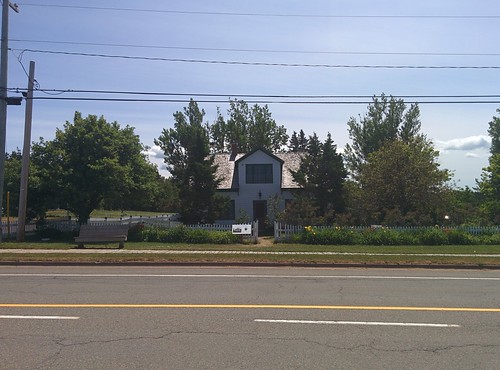

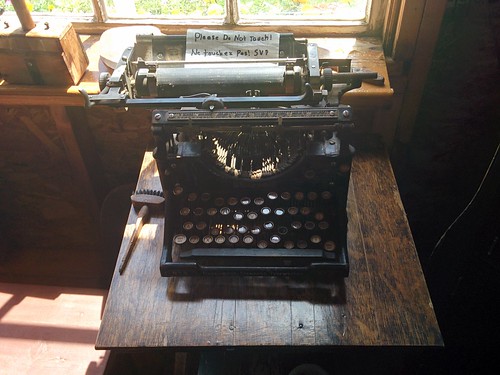


The site of Lucy Maud Montgomery's Cavendish home stands just west--right, in this photo--of the Cavendish church of the United Church of Canada that I shared yesterday.
[PHOTO] Fields of Cavendish, PEI
Sep. 26th, 2017 09:55 amCavendish's Friendly Lane, a street meandering off of Route 13 just east of the intersection with Route 6, is most famous as the street home to Canadian senator Mike Duffy, he who had been acquitted of charges of misusing public funds and of misrepresenting his residency on the island. There are other things to Friendly Lane, like nice views: if one looks to the east, across the green fields with cylindrical bales of hale stretching down to the Gulf of St. Lawrence, one would scarcely be displeased. It would be a nice place to live, at least in summer when the Gulf is not ice and the cold winds would not be blowing onto shore.


Prince Edward Island's Route 6 is seen here in Cavendish, looking west just west of 6's intersection with Route 13 at Cavendish Cemetery. Green Gables House lies just a few minutes' walk in this direction, among the craggy pines.

This grave is the end to innumerable secular pilgrimages.
The Cavendish Cemetery, on the southwest corner of the intersection of routes 6 and 13, is famous around the world as the place where Lucy Maud Montgomery rests in eternal peace. Alongside her are buried many of her relatives, including her mother and her maternal grandparents, MacNeills all. A sign at the entrance asks visits not to leave artificial flowers.


The Haunted Woods Trail is one of the major trails extending from the Green Gables house. This one extends east, into a patch of second-growth forest that has grown up on farmland abandoned since the National Park's creation in the early 20th century, on lands that--we are told, by signposts--are marked by the historic presence of Montgomery.


Notwithstanding this summer's drought, the lines to see Green Gables House are eternal.
The centrepiece of Cavendish's Green Gables Heritage Place is, of course, Green Gables House itself. Owned by the MacNeills, cousins of the young Lucy Maud Montgomery, this house inspired the setting of Anne of Green Gables. The interior is that of a well-appointed prosperous farmhouse from the late 19th century, narrow stairwells and beds for the hired help and all.


Yesterday, I linked to a National Observer report about an exciting new exhibit at the Ryerson Image Centre, of a cache of old New York Times photos acquired by that museum of photography and put on exhibit. The Faraway Nearby is indeed a good exhibit--I stopped by last night. My attention was caught particularly by a photograph taken of Green Gables House in 1966, long before the house had acquired its accretion of ersatz farm buildings and vast parking lots. The contrast with some of the photos I have been sharing--in particular, with yesterday's photo post--is enlightening.


The line to enter Green Gables House is long, but happily there are things to see while you wait.
Surrounding Green Gables House to the north is a passable reproduction of an Edwardian farm complex, barn and sheds and all arranged around a dusty yard. All this has been built up in the nearly two decades since I was last at Green Gables.


The Green Gables Heritage Place gift shop is full of Anne memorabilia, as one would expect, all different sizes and forms and in any number of languages.
The interior of the Long River Presbyterian Church, relocated to Avonlea Village and now a place not of worship but of music and theatre, is sparse and evocative. I just wonder what the church's builders,
a congregation divided over the controversial issue of allowing music in service, would think of its use now.


a congregation divided over the controversial issue of allowing music in service, would think of its use now.

