May. 10th, 2016

rfmcdonald: (photo)
Sunday afternoon's "A Time Travel Adventure at Galleria Mall!" was the last of my three Jane's Walks, but it was a very worthwhile one. Tour leader Shari Kasman took her Janeswalkers through the Galleria Mall, as well as the Wallace Emerson Community Centre and its associated park, pointing out past proposals to transform the area into a higher density area. As noted at blogTO, the northernmost end of Wallace Emerson is set for radical changes in the next few years.

The brick of the outer walls of the Galleria looks warm.

Brick wall of the Galleria #toronto #janeswalk #lovetowalk #galleriamall


The mall's restaurant isn't especially busy.

Galleria restaurant #toronto #janeswalk #lovetowalk #galleriamall #restaurant


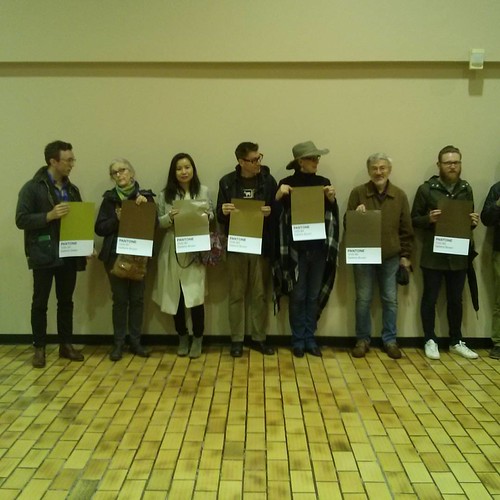
Here, Janeswalkers were holding up Pantone colour sheets with the very 1970s colour scheme used in the mall.

Colours of the Galleria #toronto #janeswalk #lovetowalk #galleriamall #colour #pantone


These panels listing the major retailers lies on the western wall, facing towards Lansdowne.

West side of the Galleria #toronto #janeswalk #lovetowalk #galleriamall #shopping #dupontstreet


I've taken many pictures of the Wallace Emerson Community Centre over the years, going as far as back as this 2009 photo post concentrating on the architecture and this one concentrating on the Tile Project mounted at the far end. I was saddened to learn that this stunning Brutalist structure will likely be torn down to make way for the new plans.

Pine tree #toronto #janeswalk #lovetowalk #galleriamall #wallaceemerson #pine #tree


Looking up #toronto #janeswalk #lovetowalk #galleriamall #wallaceemerson #architecture #sky


The dogwoods were in bloom, as were other trees with their loves and flowering plants with their vibrant colours.

Dogwood, steel and concrete #toronto #janeswalk #lovetowalk #galleriamall #dogwood #steel #concrete


Playground #toronto #janeswalk #lovetowalk #galleriamall #playground  #dogwood #architecture #wallaceemerson


Dogwoods by the wall #toronto #janeswalk #lovetowalk #galleriamall #wallaceemerson #dogwood #architecture


Here we end with another wall, this one from the Wallace Emerson Community Centre.

Tile #toronto #janeswalk #lovetowalk #galleriamall #wallaceemerson #tiles
rfmcdonald: (Default)

  • blogTO notes a new union for Toronto freelancers.

  • Dangerous Minds notes a Chinese ban on live streams of women eating bananas seductively.

  • The Dragon's Gaze notes a paper purporting to provide ways for telescopes to distinguish between exo-Venuses and exo-Earths.

  • The Dragon's Tales links to a study modelling the collision between Theia and the proto-Earth that created the moon.

  • Language Log notes Chinese colloquialisms.

  • The LRB Blog reflects on the environmental and political implications of the Fort McMurray fire.

  • Marginal Revolution recommends postponing tourism to some exotic destinations until they build up the needed infrastructure.

  • The NYRB Daily introduces readers to the Weimar-era novel Grand Hotel.

  • I disagree with Peter Watts' argument that things need to get worse before they get better.

  • North!'s Justin Petrone reflects on his experience of the esoteric in Estonia.

  • Window on Eurasia notes the importance of the Soviet victory in the Second World War as a way of justifying Russian hegemony.

rfmcdonald: (Default)

  • Bloomberg notes Petrobras' dismissal of rumours it is threatened by the impeachment, observes that many Europeans expect a chain reaction of departures if the United Kingdom leaves, notes that a return to high economic growth in Israel will require including the Palestinian minority, and
    looks at Panamanian efforts to convince the world that the country is not a tax haven.

  • The Globe and Mail remembers Mi'kMaq teacher Elsie Basque, and looks at how Mongolia is trying to adapt to the new economy.

  • Bloomberg View states the obvious, noting that an expected event is not a wild swan.

  • CBC notes Rachel Notley's tour of Fort McMurray.

  • The Inter Press Service notes the denial of everything about the Rohingya.

  • MacLean's looks at further confusion in Brazil.

  • Open Democracy notes a push for land reform in Paraguay and looks at the devastation of Scotland's Labour Party.

  • Wired notes the dependence of intelligence agencies on Twitter, proved by Twitter shutting an intermediary down.

rfmcdonald: (Default)
The National Post carries Ben Guarino's Washington Post article. It looks bad.

As the ocean rose, they had to flee.

“The sea has started to come inland, it forced us to move up to the hilltop and rebuild our village there away from the sea,” said Sirilo Sutaroti, 94, a leader of the Paurata tribe, to a group of Australian environmental scientists. The scene of this rising sea is an archipelago of upthrust volcanoes and coral atolls, which dots the Pacific to the northeast of Australia: the Solomon Islands. There, a swollen sea is claiming the shoreline — and even, researchers say, entire masses of land.

In a recent paper in the journal Environmental Research Letters, the scientists link the destructive sea level rise to anthropogenic — that is, human-caused — climate change. The study is the first time anyone has concretely analyzed the loss of Solomon Island shoreline in the context of global warming, they say.

Such work comes at a time when coastal villages — where a few hundred people like Sutaroti might live, whose familial roots could stretch back a century — have scattered, re-forming in smaller clusters where there is suitable higher ground. On the island of Nuatambu, the sea has claimed 11 houses. “Another 12 remain,” wrote Simon Albert, one of the study authors and a civil engineer at the University of Queensland, Australia, in an email to The Washington Post.

“The families that have left have moved to the nearby large island of Choiseul.” What was once a single community has fractured into five smaller hamlets.

Taro Island, a populated atoll in northwest Solomon Islands, may become the first capital city on the planet that people desert due to climate change, according to the Sydney Morning Herald. When Ban Ki-moon, the United Nations secretary-general, visited the Solomon Islands and nearby Kiribati, he witnessed an entire population of a Taro Island town preparing to move. (His hotel room, he said in the same 2014 speech, came equipped with life preservers.)
rfmcdonald: (Default)
The National Post carries Aly Thomson's Canadian Press article noting the impending closure of Charlottetown's Founder's Hall, a museum about Confederation, for lack of visitors. Apparently there had been talk of closing it down earlier, in 2013 for instance.

I never knew of the historical museum, for whatever it's worth, even when I lived there. I just thought of it as a venue for small tourist-related business. I hope they keep the building--it's a beautiful restored brick rail house.

A museum devoted to telling the story of Canada’s birth — built blocks away from the site of the Charlottetown Conference — has shut down permanently due to lack of interest.

Founders Hall in downtown Charlottetown opened in 2001 and explained Canada’s inception, beginning with the Charlottetown Conference in 1864.

But Ron Waite, general manager of the Charlottetown Area Development Corporation, said attendance has been dwindling in recent years as the attraction struggled to keep people interested.

“It’s a beautiful facility and you hate to see it go, but the pragmatic elements of it are that it’s losing money and at some stage you have to make a decision,” said Waite, whose corporation owns the building where the exhibit is located.

Waite said when Founders Hall first opened, up to 40,000 people would visit the exhibit in a year. But only about 13,000 people walked through its doors last year, he said.
rfmcdonald: (Default)
Spacing Toronto features Kieran Delamont's article noting the importance of Yorkville in Canadian music history. Now a home of high-end condos, Yorkville was a center of industry.

With Canadian Music Week taking place just in clubs throughout Toronto, the historic Masonic Temple concert hall on Yonge Street — which has hosted the likes of Zeppelin and the Stones — was home to a celebration of the folk music heritage of Yorkville last Friday night. Being unveiled were three new plaques from Heritage Toronto: two celebrating historic venues — the Purple Onion and the Penny Farthing — and one commemorating Yorkville’s contribution to Canadian music history.

“Yorkville was the birthplace of Canadian song,” said music historian Nicholas Jennings. “It’s very important that we don’t forget that history.”

A large crowd gathered in the Temple, filling the lower dance floor (and a large chunk of the upper balcony) to celebrate what was, for many guests, a cause to celebrate their youth. Though many are now older, members of the crowd seemed to embrace age as just a number. Many came dressed in tie-dye, leather jackets, and classic rock band t-shirts; guests shared with each other stories of concerts and dances they attended as teenagers; at one point, the crowded lobby smelled faintly of pot smoke.

The venues being celebrated — the Penny Farthing and the Purple Onion, both of which once stood just blocks away from the Masonic Temple — were important players in Yorkville’s 1960s music scene. The Penny Farthing, founded by John McHugh in 1963, was best known for its backyard swimming pool and bikini-clad waitresses, and was a popular coffee shop for both musicians and their fans. Many classic blues and jazz acts graced its upstairs stage, while folk acts played in the basement (McHugh was not, in fact, a fan of folk music, and at one point banned it from his hi-fi stereo system).
rfmcdonald: (Default)
NOW Toronto's Brian Eberdt reports on how Toronto police are being held to some account for their actions six years ago at the G20.

On the weekend of June 26, 2010, Toronto was held hostage by the G20 summit, literally. Six years have passed. Since then, there have been a series of precedent-setting decisions which hold the police accountable for their actions that weekend. Perhaps the most significant of them was released last month.

On April 6, the Court of Appeal upheld the decision of our Divisional Court in the case of Good v. Toronto Police Services Board. It is the first class action lawsuit dealing with use of the “kettling” technique, where police surrounded and detained hundreds of people and, in many cases, took them to jail.

The primary issue in the Court of Appeal’s decision was whether Good’s case could proceed as a class action, as opposed to an ordinary civil action involving only her. The benefit of the former is that it enables anyone who was detained in the various “kettling” incidents described in the claim to join the action without hiring their own lawyer and commencing separate lawsuits. The court’s decision will significantly increase any damages award made against the police. Good’s lawyers estimate this is in excess of 1,000 people. Many of these people were merely walking the streets of the city when they were detained – they weren’t even part of a protest.

Like any class action lawsuit, the case involves a “representative plaintiff,” Sherry Good, who represents the interests of the group (i.e. the “class”). Her statement to the court is compelling:

"At Queen and Spadina that afternoon, during a peaceful protest, with no warning, we were surrounded by hundreds of police in riot gear, fully armed. We could not leave. They kept us standing in one of the worst rain storms of the year for over four hours with no information disseminated to us, no food, no water, no toilets. Sometimes the police charged into the crown, picking out people indiscriminately for arrest, and dragging them away."
rfmcdonald: (Default)
Writing at Torontoist, Rignam Wangkhang celebrates the successful unionization of some Tibetan-Canadian workers at the Ontario Food Terminals, on its own terms and as a sign of hope for workers more generally.

Working at produce wholesaler Fresh Taste, situated away from the public eye on the Gardiner Expressway, Thupten Nyendak faced racism, discrimination, and unequal pay. Routinely told by management to “go back to his country” and that he “was stupid,” Nyendak, the eventual union steward, had had enough. He could no longer accept that his co-workers, some of whom had worked 19 years at the Ontario Food Terminal, were stuck making $14.50 an hour, while other unionized workers at the Terminal were being paid $20.

In November 2015, the first Toronto Tibetan union was born.

Months of seeking fair treatment and wages at the bargaining table eventually amounted to nothing. The only option was to strike. The initial number of strikers quickly ballooned into an entire community standing in solidarity. Almost every labour union in the area, concerned community members, politicians, and a large swath of Tibetans all supported the movement.

After 11 days of relentless, resolute picketing, an agreeable contract was reached. It was a huge victory: the first ever collective action by Tibetan immigrant workers in Toronto was successful.

Fourteen produce pickers of Fresh Taste ratified their first union contract earlier this month. Through this movement, other newcomer and marginalized workers have come to believe that they too have the power to seek fair wages and dignity.
rfmcdonald: (Default)
(I blogged this on Demography Matters, too.)

The return of the long-form census has become a trending hashtag on Twitter, #Census2016. It was more than that: As both the CBC and the Huffington Post noted, when the census collection period began on the 2nd of May, it became a major pop-culture trend in Canada. So many people responded that the official census website was briefly knocked down.

Me, I decided to be fashionably late.

Census selfie #toronto #me #selfie #canada #census #census2016


One in four Canadian households, selected at random, received 36-page long-form questionnaire known as the National Household Survey. I, unfortunately, did not, instead clicking through ten short questions. Still, it got done. I could have received it, after all.
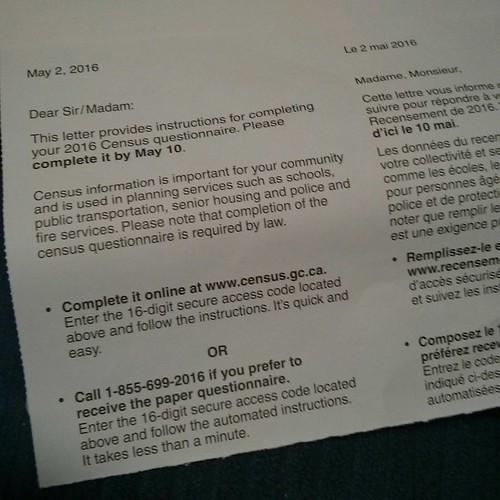
Instructions #canada #census #census2016


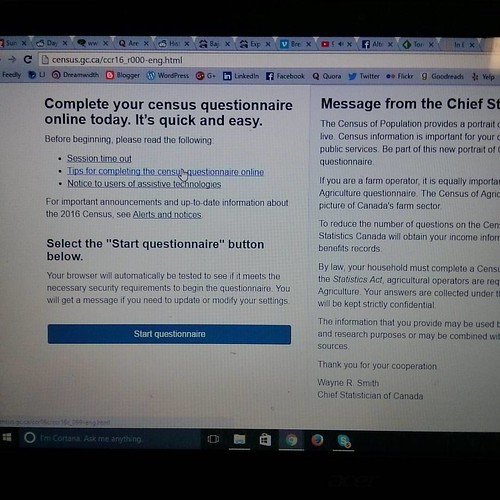
Starting #cabada #census #census2016


The whole episode has been reassuring for fans of good data. Shannon Proudfoot's MacLean's article "The census is back with a swagger" took an extended look at how the census matters, and how it became so important.

This week, the furious preparations of the agency over the last several months come to fruition: May 10 is census day, when Canadians raise their hands to be counted. The voluntary National Household Survey that replaced the long-form census in 2011 ended up being neither the pointless disaster its staunchest critics had envisioned, nor the perfectly useful replacement its proponents predicted. It had serious limitations that caused 1,100 small communities to vanish off the statistical map; it produced a few weird findings that simply didn’t look right; and it made looking for change over time all but impossible. It did, however, offer a serviceable snapshot of the country. Now that StatsCan is returning to a mandatory long-form census—and in a hurry—the question is what will become of the evolving national portrait that underpins everything from people’s bus routes and commuter highways to their children’s schools and where they can grab groceries on their way home from work.

What was once the driest and most esoteric of citizen duties—the statistical backbone of the country that, frankly, most people were oblivious to—became an unlikely flashpoint in 2010. That July, then-prime minister Stephen Harper axed the mandatory long-form census, arguing it was inappropriate to compel citizens to answer questions about their education, work, ethnicity and housing, among other topics. Critics of the move—they were nearly unanimous among those who use census data, including researchers, municipal planners and community organizations—insisted that a mandatory census was the only way to get an accurate picture of who Canadians are and what they need.

Ultimately, 68 per cent of households responded to the 2011 National Household Survey (NHS)—far short of the 94 per cent that completed the long-form census in 2006, but better than the 50 per cent response rate StatsCan projected in some of its testing. The agency’s analysts did everything they could to verify and shore up the information they had. In the end, they released the data they believed was solid, but anything below a certain quality threshold—a highly technical measure that amounts to overall non-response combined with “item non-response,” or individual questions people skipped—was simply not released. “We were very transparent in saying that at the small community level, we cannot do the same level of validation,” says Hamel. That meant that 1,100 small towns and specks on the map, representing three per cent of the Canadian population, became statistical ghost towns, except for the basic information collected on the short-form census. If you wanted to know what the 1,400 residents of Shellbrook, Sask., do for work, how much education they have or their ethnic backgrounds, you’d hit a dead end.

But even with all the quality control StatsCan conducted, there were a few odd glitches that spoke to the problems with using a voluntary survey to obtain a full portrait of your country. The NHS, for example, found that between 2006 and 2011, the largest proportion of Canada’s new immigrants came from the Philippines, followed by China. But a tiny numbered footnote attached to that observation warns that it doesn’t square with immigration records, which showed that in fact the largest slice of newcomers came from China. Presumably, a significant number of new Chinese arrivals either didn’t fill out the NHS or didn’t identify their recent country of origin.

However, the biggest problem with the 2011 survey is simply that it’s different. StatsCan told users flatly that the NHS results were useful for comparing different regions of the country at a single moment in time, but they shouldn’t be measured against 2006 or earlier census results, because the methodology had changed so fundamentally. And comparing data over time is “the most important single thing” for researchers, says Michael Veall, a professor of economics at McMaster University. Veall is quick to note that the NHS turned out better than he expected it would when he testified at a parliamentary committee hearing on the issue in 2010, but it still has serious limitations. “Statistical information is interesting when there’s a surprise, right?” he says. “So you find more people are doing this or more people are doing that. The trouble when we went from 2006 to 2011 [is] every time we see a surprise, we have to say, ‘Oh, is that because something really happened, or is that because there’s a problem with the data?’ ”


I'm glad it's back. I'm very glad that I'm not the only one. Hopefully next time I'll have a chance to fill in the long-form census.
Page generated May. 7th, 2026 02:49 am
Powered by Dreamwidth Studios